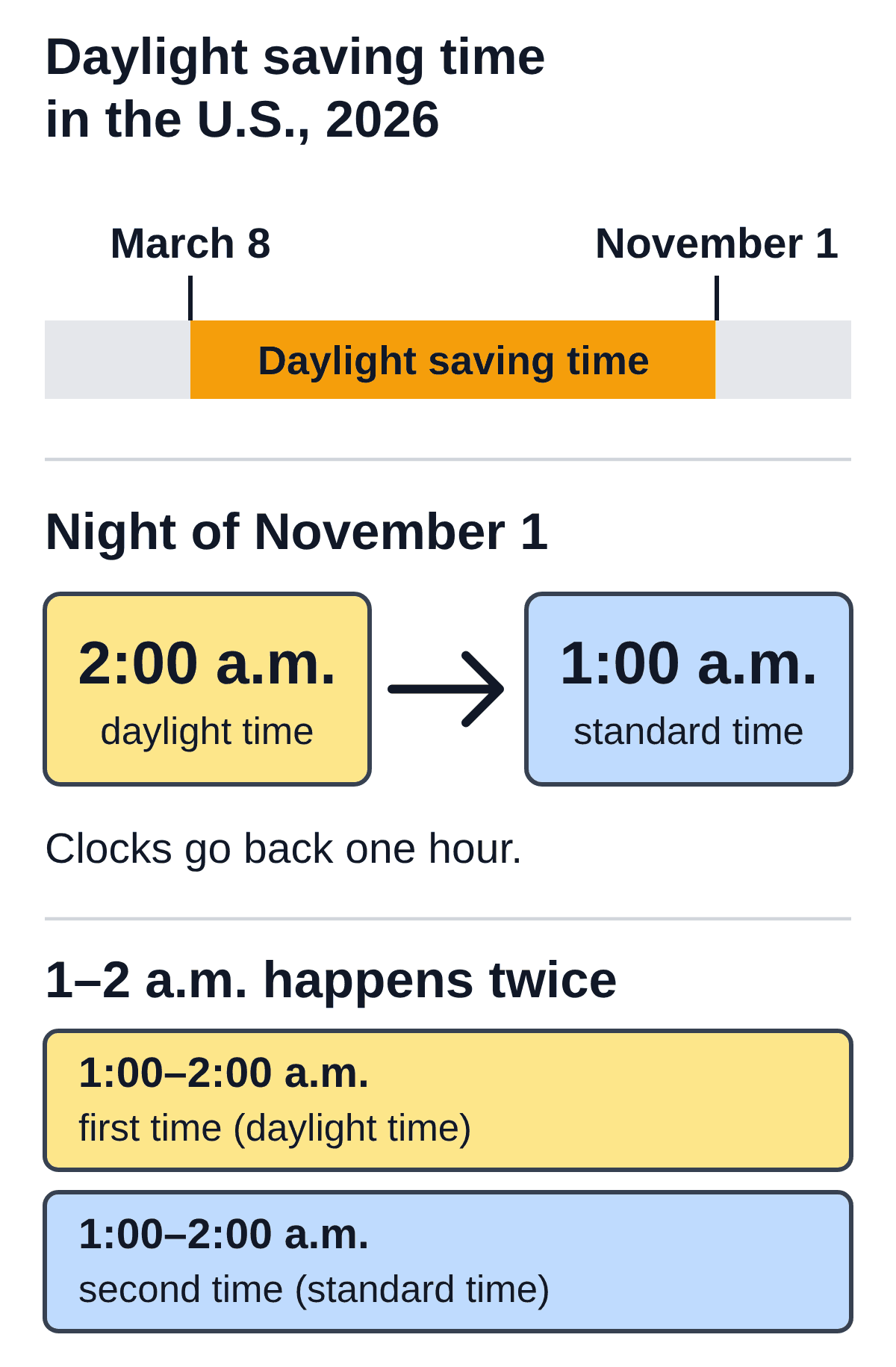
In the United States, daylight saving time ends on Sunday, November 1, 2026, at 2:00 a.m. local time. At that moment, clocks go back to 1:00 a.m.
This article covers the U.S. rule only. The facts below are as of October 6, 2026, and come from federal sources listed at the end.
What happens at 2:00 a.m. on November 1
When local clocks reach 2:00 a.m., they move back one hour to 1:00 a.m. That means the hour from 1:00 to 2:00 a.m. happens twice that night.
Daylight saving time began this year on March 8, 2026, when clocks moved ahead from 2:00 a.m. to 3:00 a.m.
The rule behind the date
Federal law sets daylight saving time to run from 2:00 a.m. on the second Sunday of March to 2:00 a.m. on the first Sunday of November (15 U.S.C. § 260a). In 2026, those Sundays are March 8 and November 1. The National Institute of Standards and Technology (NIST) cites the Energy Policy Act of 2005 for the current rule.
Where clocks do not change
The U.S. Department of Transportation (DOT) says these places do not observe daylight saving time:
| Place | Observes daylight saving time? |
|---|---|
| Hawaii | No |
| American Samoa | No |
| Guam | No |
| Northern Mariana Islands | No |
| Puerto Rico | No |
| The Virgin Islands | No |
| Arizona | No, for most of the state |
NIST’s list is almost the same. It does not mention the Northern Mariana Islands. For Arizona, NIST says the Navajo Indian Reservation is the exception and does observe daylight saving time.
Who decides
DOT oversees the nation’s time zones and the uniform observance of daylight saving time. DOT says it does not have the power to repeal or change daylight saving time. This article describes the rule as federal sources state it today and does not track proposals to change it.
Can a state stay on standard time?
Federal law allows a state to exempt itself from observing daylight saving time by state law. DOT says that states do not have the authority to choose permanent daylight saving time.
Sources
All pages were checked on October 6, 2026.
- National Institute of Standards and Technology, “Daylight Saving Time (DST),” updated February 9, 2026. https://www.nist.gov/pml/time-and-frequency-division/popular-links/daylight-saving-time-dst
- U.S. Department of Transportation, “Daylight Saving Time,” last updated September 3, 2025. https://www.transportation.gov/regulations/daylight-saving-time
- U.S. Department of Transportation, “Uniform Time,” last updated July 15, 2026. https://www.transportation.gov/regulations/time-act
- 15 U.S.C. § 260a, “Daylight saving time,” U.S. Government Publishing Office. https://www.govinfo.gov/link/uscode/15/260a