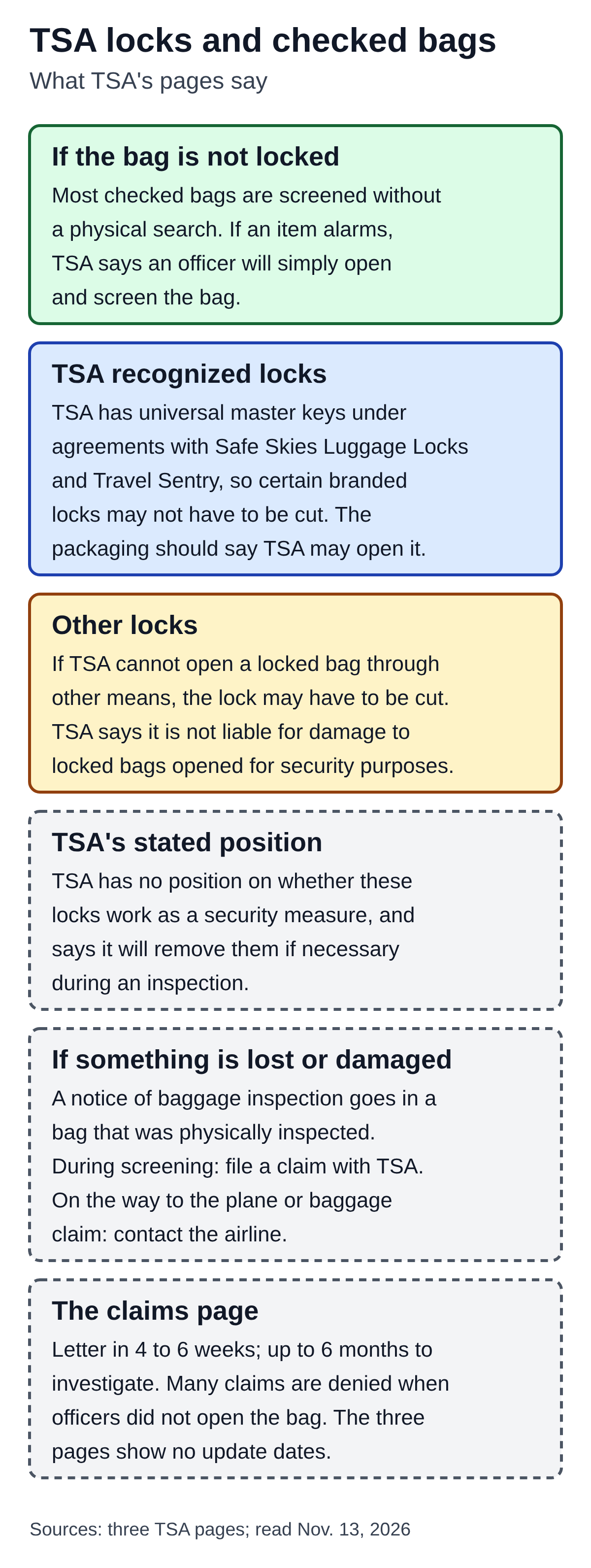
TSA’s pages do not forbid locking a checked bag, but they say a lock TSA cannot open may have to be cut, and that TSA is “not liable for damage caused to locked bags that must be opened for security purposes.” TSA also names “TSA recognized locks,” which TSA says it can open with universal “master” keys, so that those locks may not have to be cut, and whose packaging should say so. This article reads what three TSA pages say about locks and checked bags, and what the TSA claims page says if something is lost or damaged.
The three pages are TSA’s Security Screening page (its checked baggage section), the Travel Tips page (its “TSA recognized locks” section) and the Claims page. The wording is as of November 13, 2026, and none of the three pages shows an update date. This article is about checked bags only; for what TSA says at the checkpoint, see TSA Shoes Off and Laptops Out: What TSA Says. It does not cover firearms cases, airline rules for locks or bags, prices, or which lock models are sold.
What happens to a checked bag
TSA’s Security Screening page says TSA screens approximately 1.3 million checked bags a day for explosives and other dangerous items, and that “the majority of checked baggage is screened without the need for a physical bag search.” It also says TSA may inspect your checked baggage during screening, and that if your property is physically inspected, TSA will place a notice of baggage inspection inside your bag to inform you that an officer inspected it.
The Travel Tips page gives the same picture: technology generally lets TSA screen bags electronically without opening them, but “there are times when we need to physically inspect a piece of luggage.”
Unlocked, recognized lock, other lock
The two pages describe three situations. They are worded differently, so the table follows each page’s own words.
| Situation | What the pages say |
|---|---|
| Bag not locked | Travel Tips: if an item alarms, “our officer will simply open and screen the baggage.” |
| TSA recognized lock | Security Screening: TSA has universal “master” keys under agreements with Safe Skies Luggage Locks and Travel Sentry “so that certain branded locks may not have to be cut.” Travel Tips: the packaging indicates whether TSA can open the lock. |
| Another lock TSA cannot open | Travel Tips: if you lock your checked baggage and TSA “cannot open it through other means, then the locks may have to be cut.” |
TSA recognized locks
The Travel Tips page says TSA has worked with several companies to develop locks that security officers can open with universal “master” keys so that the locks may not have to be cut. It says these locks are available at most airports and many travel stores nationwide, and that the packaging indicates whether TSA can open them. The Security Screening page names the two programs behind the master keys, Safe Skies Luggage Locks and Travel Sentry, and says the locks are commercially available and the packaging “should indicate they may be opened by TSA officers.”
The pages do not list lock models or brands that qualify and do not say how to tell a recognized lock by sight. The only identifier they give is the packaging.
If TSA cannot open the lock
The Travel Tips page says that “for soft-sided baggage, this process will not damage your zippers or zipper pulls.” That is TSA’s own statement about cutting a lock; the page says nothing about hard-sided baggage and does not say how a lock is cut. In the same passage TSA says it is careful not to damage personal belongings, but is “not liable for damage caused to locked bags that must be opened for security purposes.” It says that if an officer opens your bag, a Notice of Baggage Inspection will be placed in it.
Two lines on the pages point in slightly different directions. Travel Tips says recognized locks are meant so that locks “may not have to be cut.” The Security Screening page says TSA “has no position on the validity or effectiveness of these product as a security measure and will be forced to remove these products if necessary during the inspection.” This article does not resolve how the two fit together.
The Travel Tips page also says officers are not the only reason a lock can go missing. Locks and bags can be damaged by airport conveyor belt systems, and it shows 244 locks pulled from under a baggage-handling conveyor belt at a New York airport over a period of one month.
Filing a claim for damage or loss
The Security Screening page splits responsibility by where the problem happened. If your property is lost or damaged during the screening process, you may file a claim with TSA. If it is lost or damaged during transport to the plane or to baggage claim, it says to contact your airline.
The Claims page says you may file a claim if you are injured or your property is lost or damaged during the screening process. After you submit a claim, it says, you receive an acknowledgment letter with instructions and a control number four to six weeks later, and you should save the control number because you need it to communicate with TSA and to check your status. The Federal Tort Claims Act governs how the claim is processed; if it is denied or not resolved within six months of the date it was properly presented to TSA, you may file suit in an appropriate U.S. District Court. The page asks you to allow up to six months to investigate, longer for claims that need a law enforcement investigation, and says the final decision to approve a claim rests with TSA.
The page also says that in many cases “claims are denied when an investigation determines that TSA officers did not open a bag for a physical inspection,” and it points readers to TSA recognized locks. It advises including receipts, appraisals and flight information, says to contact the airline for lost or missing baggage, and says to contact TSA’s lost and found for items left at the security checkpoint.
Screening at some airports is done by private companies instead of TSA. The Claims page tells travelers to select their airport from a list to file there and, on November 13, 2026, listed 20 airports, including San Francisco International and Kansas City International.
What the pages do not say
None of the three pages shows an update date. They do not say whether you should lock a checked bag, how often locks are cut, or what “other means” TSA uses before cutting a lock. They do not list lock brands or models, and they say nothing about hard-sided bags. They do not give the share of claims that are approved. Airline rules about locks or checked bags are not covered by any of the three pages.
Sources
All pages were read on November 13, 2026.
- TSA, “Security Screening,” checked baggage section (Inspection Notices, Claims and Locks paragraphs; the page shows no update date). https://www.tsa.gov/travel/security-screening
- TSA, “Travel Tips,” section “TSA recognized locks” (the page shows no update date). https://www.tsa.gov/travel/travel-tips
- TSA, “Claims” (the page shows no update date). https://www.tsa.gov/travel/security-screening/claims