Category: US dates, seasons and holidays

  • Federal Holidays in 2027: The Full List and Observed Dates

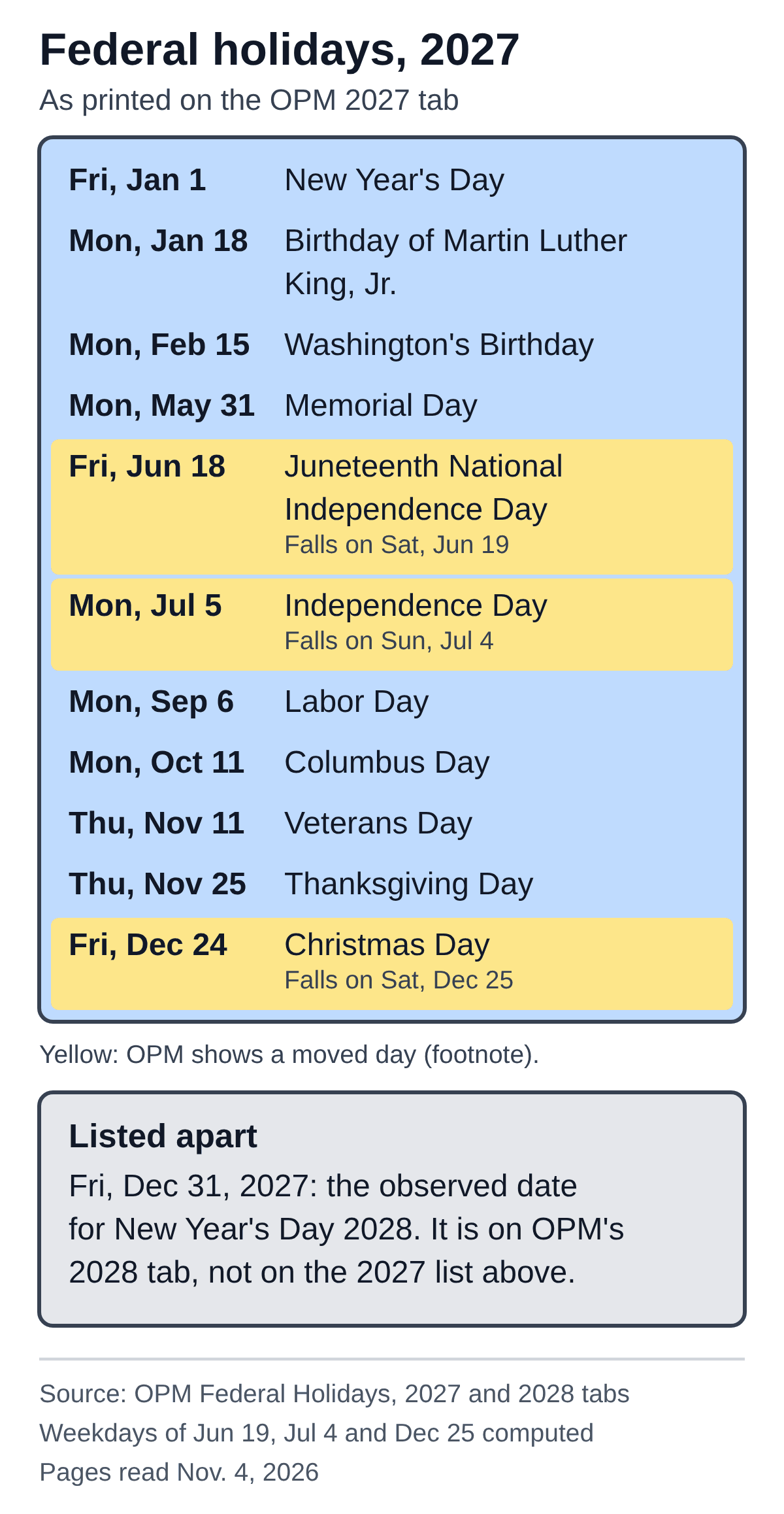
    The U.S. Office of Personnel Management (OPM) lists 11 federal holidays for 2027, from Friday, January 1 to Friday, December 24. Three of them are printed on a different day from their calendar date: Juneteenth on Friday, June 18, Independence Day on Monday, July 5 and Christmas Day on Friday, December 24.

    This article gives OPM’s 2027 list with the weekday of each date, the rule in federal law that sets each holiday, and the three moved days. It also keeps one more date, Friday, December 31, 2027, apart from the list, because OPM files it under 2028. It is about federal employees only. The facts are as of November 4, 2026, and come from the pages listed at the end. OPM’s page shows no update date.

    The 2027 list

    The table follows OPM’s “2027 Holiday Schedule.” The last column is the rule in section 6103(a) of title 5 of the United States Code, the law OPM names as the one that sets holidays for federal employees. OPM prints the day that is treated as the holiday, not always the calendar date, so the weekdays of the three calendar dates that were moved (June 19, July 4 and December 25) are computed from the calendar and are not OPM’s.

    OPM’s dateHolidayRule in 5 U.S.C. 6103(a)
    Friday, January 1New Year’s DayJanuary 1
    Monday, January 18Birthday of Martin Luther King, Jr.Third Monday in January
    Monday, February 15Washington’s BirthdayThird Monday in February
    Monday, May 31Memorial DayLast Monday in May
    Friday, June 18Juneteenth National Independence DayJune 19, a Saturday in 2027
    Monday, July 5Independence DayJuly 4, a Sunday in 2027
    Monday, September 6Labor DayFirst Monday in September
    Monday, October 11Columbus DaySecond Monday in October
    Thursday, November 11Veterans DayNovember 11
    Thursday, November 25Thanksgiving DayFourth Thursday in November
    Friday, December 24Christmas DayDecember 25, a Saturday in 2027
    Table of the 11 federal holidays on OPM's 2027 list, Friday, Jan. 1 to Friday, Dec. 24. Three are shown on a moved day: Juneteenth on Friday, June 18, Independence Day on Monday, July 5 and Christmas Day on Friday, Dec. 24. A separate box lists Friday, Dec. 31, 2027 as the observed date for New Year's Day 2028, from OPM's 2028 tab.

    OPM’s footnote on Washington’s Birthday says that name is the one in section 6103(a), and that OPM’s policy is to always refer to holidays by the names in the law. Other institutions may use other names. For Thanksgiving, see When Is Thanksgiving 2026 in the U.S.? How the Date Is Set for how the fourth Thursday is set.

    How the dates are set

    Six of the 11 holidays in the statute are set by a weekday rule: the birthdays of Martin Luther King, Jr. and Washington, Memorial Day, Labor Day, Columbus Day and Thanksgiving. The other five are set by a calendar date: New Year’s Day, Juneteenth National Independence Day, Independence Day, Veterans Day and Christmas Day. In 2027 the three moved days are all among the five that have a calendar date, because June 19, July 4 and December 25 fall on a weekend.

    The three moved days

    OPM’s footnote on those rows says that if a holiday falls on a Saturday, for most federal employees the preceding Friday will be treated as a holiday for pay and leave purposes, and that if it falls on a Sunday, the following Monday will be. It cites 5 U.S.C. 6103(b) for the Saturday rule and Section 3(a) of Executive Order 11582 for the Sunday rule. The explanation and the examples for 2026 to 2028 are in When a Federal Holiday Falls on a Weekend, What Changes?, which this article does not repeat.

    For 2027 that gives Friday, June 18 for Juneteenth, Monday, July 5 for Independence Day and Friday, December 24 for Christmas Day.

    The December 31, 2027 date

    OPM’s 2028 table starts with Friday, December 31, for New Year’s Day, marked with the same weekend footnote. New Year’s Day 2028, January 1, is a Saturday, so the Friday before it, December 31, 2027, is the observed date for New Year’s Day 2028. The date falls in 2027, but OPM does not print it on the 2027 tab, and this article does not count it among the 11 holidays above. The 2028 tab prints no year in that row; the year is worked out from the weekday.

    What this article does not cover

    This article does not cover what state or local governments, banks, the stock market, schools, the Postal Service or private employers do on these days. Each of them sets its own schedule, and this article uses no source for any of them. It also does not cover pay and leave details, other work schedules, or OPM’s “In Lieu Of” fact sheet. The statute also names Inauguration Day, January 20 of each fourth year after 1965, as a legal public holiday for certain employees; it is not a 2027 date and is not on OPM’s 2027 list. This article describes what OPM and the statute state on the date above and does not track changes to them.

    Sources

    The OPM page and the statute were read on November 4, 2026. The OPM page shows no update date. The statute text is from the 2024 edition of the U.S. Code on govinfo.gov.

  • When a Federal Holiday Falls on a Weekend, What Changes?

    For most federal employees, a federal holiday that falls on a Saturday is treated as a holiday on the Friday before, and one that falls on a Sunday is treated as a holiday on the Monday after. This is the rule the U.S. Office of Personnel Management (OPM) publishes for federal employees.

    This article explains that rule and shows the dates in OPM’s tables for 2026 to 2028. The facts are as of October 7, 2026, and come from the two sources listed at the end. It is about federal employees only, not about banks, schools, post offices or private employers.

    The rule

    OPM says most federal employees work a Monday through Friday schedule. For them, it says, a holiday that falls on a Saturday or Sunday usually is observed on the Friday before or the Monday after. OPM’s footnote says that for most federal employees the preceding Friday “will be treated as a holiday for pay and leave purposes” when the holiday falls on a Saturday, and the following Monday when it falls on a Sunday.

    Where the rule comes from

    For Saturday, OPM cites 5 U.S.C. 6103(b). That section says that instead of a holiday that occurs on a Saturday, the Friday immediately before is a legal public holiday for employees whose basic workweek is Monday through Friday. It applies to statutes on pay and leave.

    For Sunday, OPM cites Section 3(a) of Executive Order 11582 (February 11, 1971). The order is printed in the notes to the statute. It says that an employee whose basic workweek does not include Sunday, and who would ordinarily be excused from work on a holiday, is excused on the next workday when a holiday falls on a Sunday.

    Examples in OPM’s tables

    OPM’s tables mark these dates with a footnote. The weekday of each actual holiday date is computed from the calendar.

    HolidayFalls onOPM lists
    Independence Day 2026Saturday, July 4, 2026Friday, July 3, 2026
    Juneteenth 2027Saturday, June 19, 2027Friday, June 18, 2027
    Independence Day 2027Sunday, July 4, 2027Monday, July 5, 2027
    Christmas Day 2027Saturday, December 25, 2027Friday, December 24, 2027
    New Year’s Day 2028Saturday, January 1, 2028Friday, December 31, 2027

    OPM lists the New Year’s Day 2028 row under its 2028 tab, but the date it shows falls in 2027.

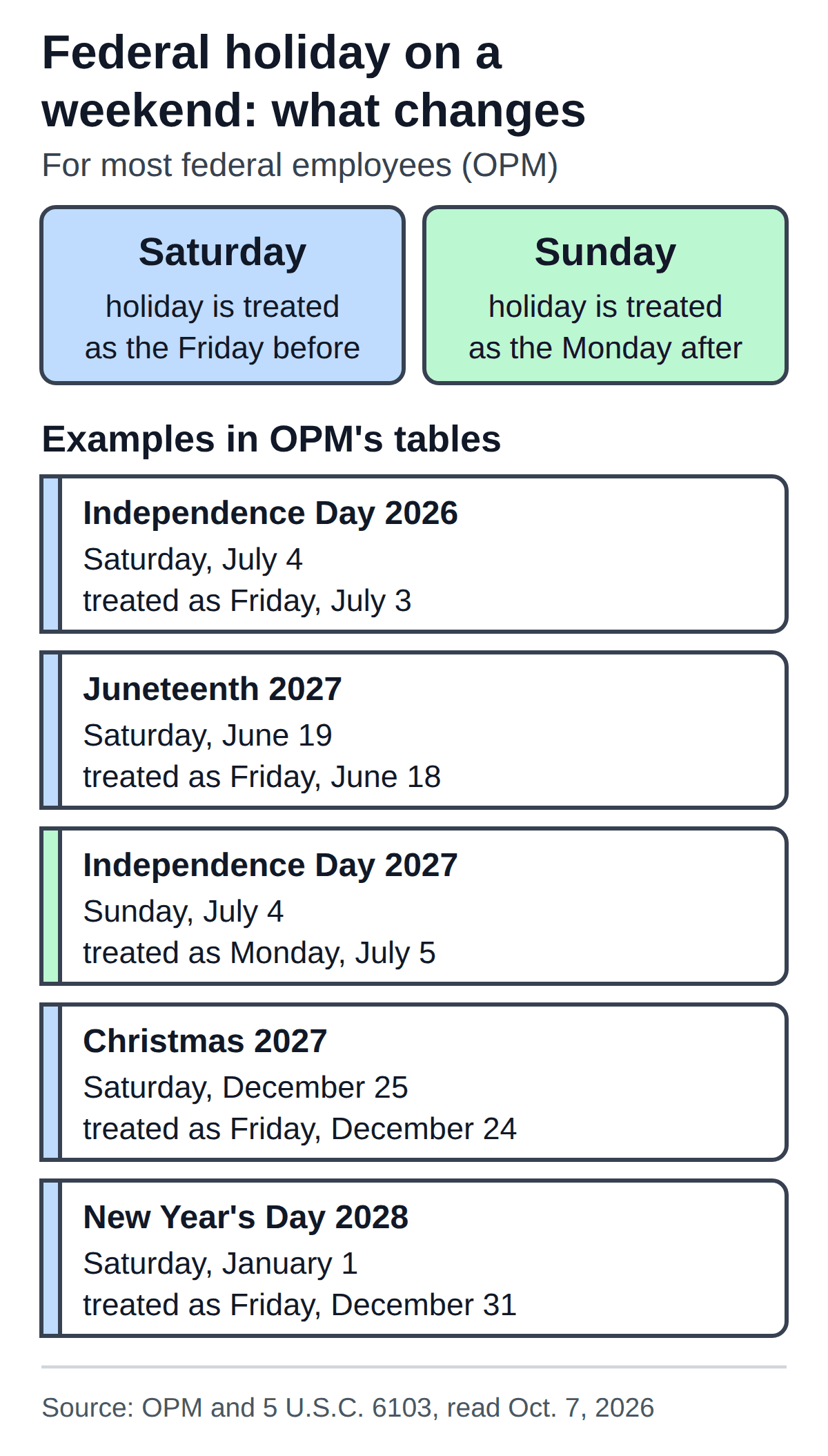
    Diagram of the federal-holiday weekend rule for most federal employees: Saturday holidays are observed Friday; Sunday holidays Monday. It shows OPM examples from 2026–2028, including July 4, 2026 observed July 3 and July 4, 2027 observed July 5.

    The three federal holidays still ahead in 2026 are Veterans Day on Wednesday, November 11, Thanksgiving Day on Thursday, November 26, and Christmas Day on Friday, December 25. All three fall on weekdays, so OPM’s 2026 table lists them on their own dates.

    The limits of the rule

    The rule is for federal employees. OPM says it applies to most of them, and the statute has separate rules for employees whose basic workweek is not Monday through Friday. OPM also has a fact sheet titled “Federal Holidays – ‘In Lieu Of’ Determination,” which this article does not summarize.

    What this article does not cover

    This article does not cover what state or local governments, banks, schools, the Postal Service or private employers do when a holiday falls on a weekend. Each of them sets its own schedule, and this article uses no source for any of them. It also does not cover pay and leave details, other work schedules, or Inauguration Day. This article describes what the two sources state on the date above and does not track changes to them.

    Sources

    Both pages were checked on October 7, 2026. The OPM page shows no update date. The statute text is from the 2023 edition of the U.S. Code on govinfo.gov.

  • When Is Thanksgiving 2026 in the U.S.? How the Date Is Set

    Thanksgiving 2026 in the U.S. is Thursday, November 26. Federal law sets Thanksgiving Day as “the fourth Thursday in November,” so the date is not the same every year.

    This article explains the rule, using two U.S. government sources listed at the end. The facts are as of October 7, 2026. It is about the U.S. holiday, not Canada’s.

    The date, year by year

    OPM’s federal holiday tables list these dates for Thanksgiving Day:

    YearThanksgiving Day
    2024Thursday, November 28
    2025Thursday, November 27
    2026Thursday, November 26
    2027Thursday, November 25
    2028Thursday, November 23
    2029Thursday, November 22
    2030Thursday, November 28

    Each of these dates is the fourth Thursday of its November.

    How the rule gives November 26

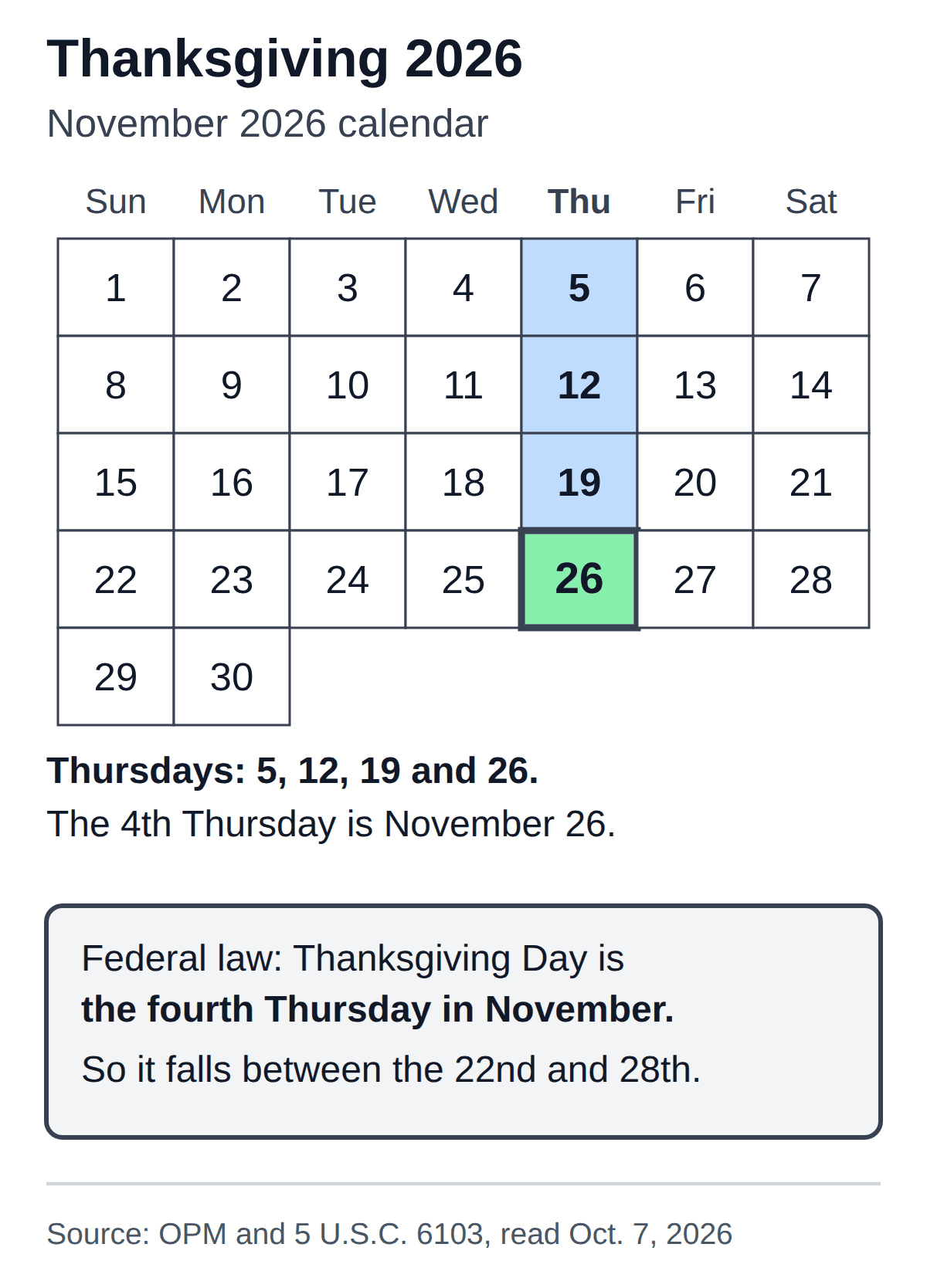
    The law’s list of legal public holidays reads “Thanksgiving Day, the fourth Thursday in November.” November 1, 2026 is a Sunday, so the Thursdays in November 2026 are the 5th, 12th, 19th and 26th. The fourth one is the 26th.

    Diagram of the November 2026 calendar with the four Thursdays marked: the 5th, 12th, 19th and 26th. The fourth Thursday, November 26, is highlighted as Thanksgiving Day. A note says federal law sets Thanksgiving Day as the fourth Thursday in November, so it falls between the 22nd and 28th.

    Why the date moves

    The first Thursday of any November falls between the 1st and the 7th. The fourth Thursday comes three weeks later, so it always falls between the 22nd and the 28th. That is arithmetic on the law’s wording, not a statement from OPM. The table above shows both ends of the range: November 22 in 2029, and November 28 in 2024 and 2030.

    What “federal holiday” means here

    OPM says federal law (5 U.S.C. 6103) establishes the public holidays on its pages “for Federal employees.” The statute calls them “legal public holidays.” This article does not say what private employers, schools, state governments, banks or stores do on that day. Each of them sets its own schedule.

    What this article does not cover

    This article does not cover the history of Thanksgiving, traditions, travel, or store and school closings. It does not cover Canada. It does not cover the day after Thanksgiving, which is not on OPM’s list of federal holidays. This article describes what the sources state on the date above and does not track changes to them.

    Sources

    Both pages were checked on October 7, 2026. The OPM page shows no update date. The statute text is from the 2023 edition of the U.S. Code on govinfo.gov. OPM’s current tables cite the same section.

  • When Is the First Day of Winter in 2026? Two Answers

    Winter 2026 has two start dates: Tuesday, December 1, and Monday, December 21. December 1 is the first day of meteorological winter. December 21 is the winter solstice, which marks the start of astronomical winter.

    Which one is “the first day of winter” depends on the calendar being used. This article explains both, using two U.S. government sources listed at the end. The facts are as of October 7, 2026.

    The two answers

    CalendarUsed byWinter 2026 starts
    MeteorologicalMeteorologists and climatologists (NOAA)Tuesday, December 1
    AstronomicalThe solstice (U.S. Naval Observatory)Monday, December 21
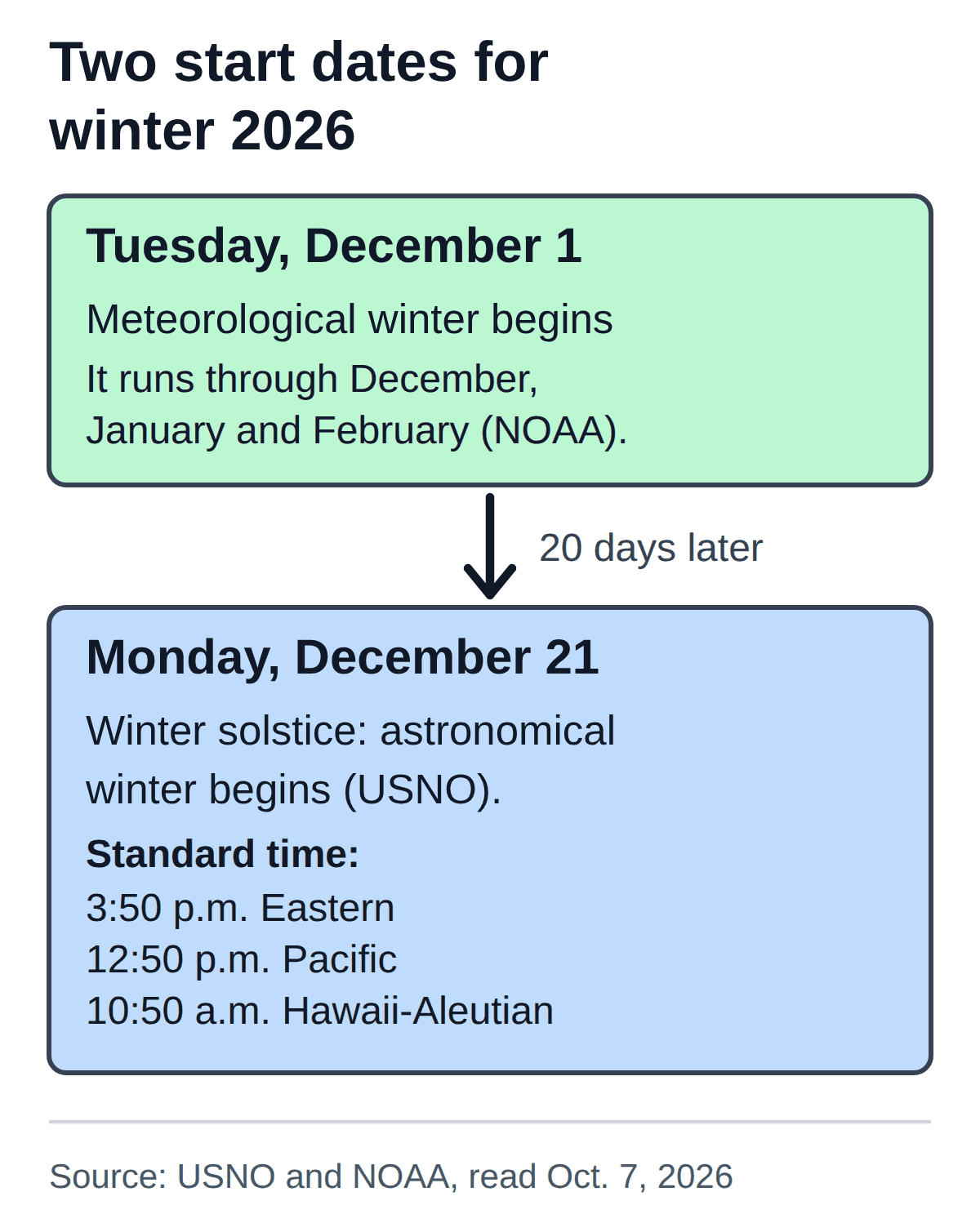
    Diagram of the two start dates of winter 2026. Tuesday, December 1: meteorological winter begins and runs through December, January and February. Monday, December 21: the winter solstice, when astronomical winter begins, at 3:50 p.m. Eastern, 12:50 p.m. Pacific and 10:50 a.m. Hawaii-Aleutian, all in standard time.

    December 21: the winter solstice

    The U.S. Naval Observatory (USNO) says that “the times of the solstices mark the beginning of summer and winter.” Its data service gives the December 2026 solstice at 20:50 UTC on December 21. In U.S. standard time zones, that moment is still December 21:

    Time zoneTime of the solstice, December 21
    Eastern Standard Time3:50 p.m.
    Central Standard Time2:50 p.m.
    Mountain Standard Time1:50 p.m.
    Pacific Standard Time12:50 p.m.
    Alaska Standard Time11:50 a.m.
    Hawaii-Aleutian Standard Time10:50 a.m.

    The National Oceanic and Atmospheric Administration (NOAA) describes the astronomical seasons as based on the position of Earth in relation to the sun. NOAA also says the winter solstice in the Northern Hemisphere falls “on or around December 22.” That is a general statement. The USNO figure above is the specific one for 2026.

    USNO adds that seasons depend on the hemisphere, and that the names of the solstices and equinoxes follow the Northern Hemisphere. This article covers the Northern Hemisphere only.

    December 1: meteorological winter

    NOAA says meteorologists and climatologists divide the year into groups of three months based on the annual temperature cycle and the calendar. For the Northern Hemisphere, NOAA lists meteorological winter as December, January and February. That makes December 1 its first day.

    NOAA gives its reason: the meteorological seasons follow the civil calendar and are more consistent in length, so seasonal statistics are easier to calculate from monthly ones. NOAA gives the length of meteorological winter as 90 days in a non-leap year.

    Why the two dates differ

    NOAA’s short answer is that astronomical seasons are based on the position of Earth in relation to the sun, while meteorological seasons are based on the annual temperature cycle. NOAA adds that the lengths of the astronomical seasons vary between 89 and 93 days, which would make it hard to compare seasonal statistics from year to year.

    What this article does not cover

    This article does not forecast the weather, does not say how cold or snowy winter will be, and does not say which definition is the right one. Each source uses its own. It also does not cover the Southern Hemisphere.

    Sources

    Both pages were checked on October 7, 2026. The USNO page shows no update date. The NOAA page shows “Updated date March 10, 2023.”

  • When Does Daylight Saving Time End in the U.S. in 2026?

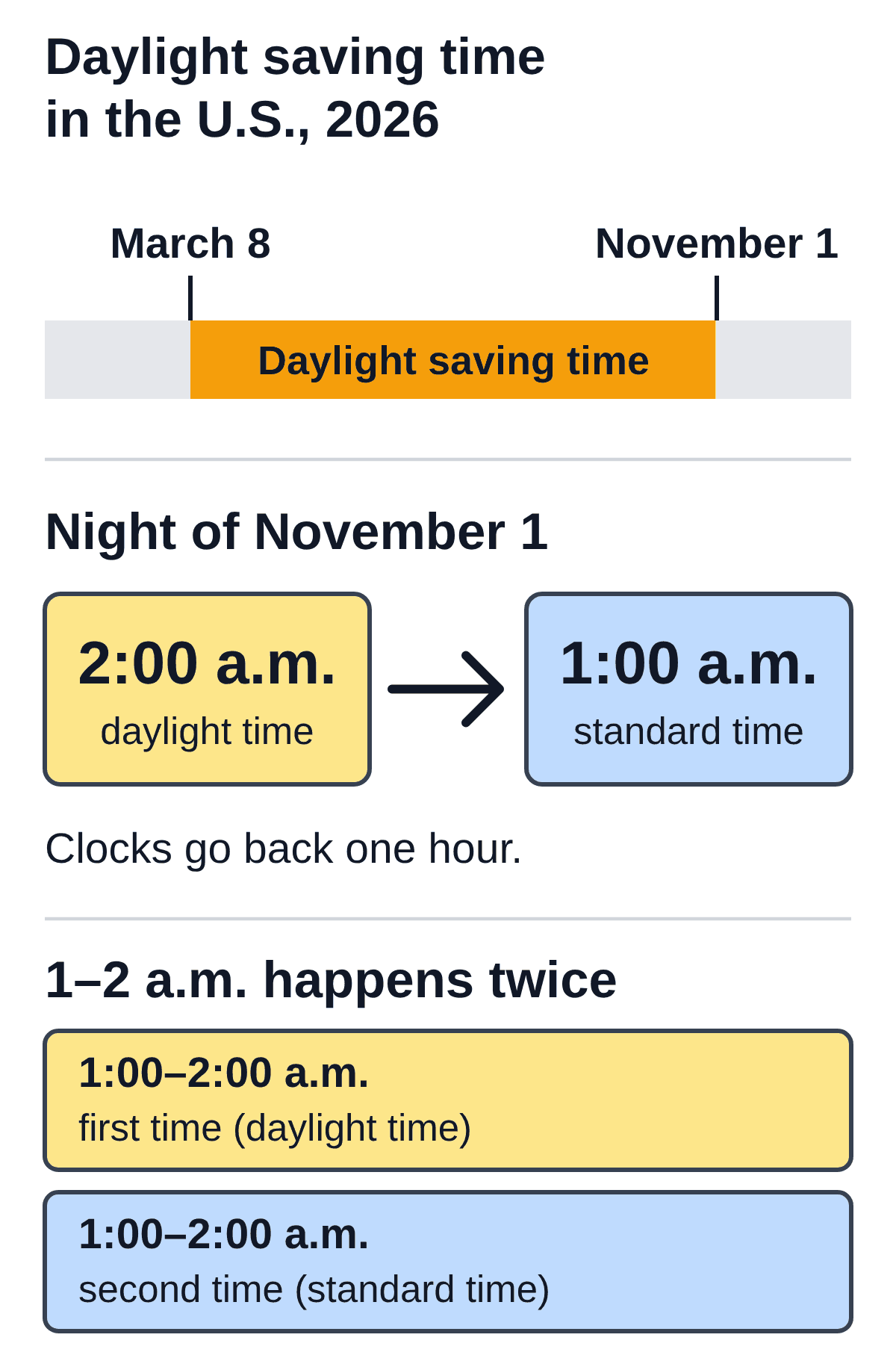
    In the United States, daylight saving time ends on Sunday, November 1, 2026, at 2:00 a.m. local time. At that moment, clocks go back to 1:00 a.m.

    This article covers the U.S. rule only. The facts below are as of October 6, 2026, and come from federal sources listed at the end.

    What happens at 2:00 a.m. on November 1

    When local clocks reach 2:00 a.m., they move back one hour to 1:00 a.m. That means the hour from 1:00 to 2:00 a.m. happens twice that night.

    Daylight saving time began this year on March 8, 2026, when clocks moved ahead from 2:00 a.m. to 3:00 a.m.

    Diagram of U.S. daylight saving time in 2026 from March 8 to November 1, and the clock change on November 1: 2:00 a.m. daylight time becomes 1:00 a.m. standard time, so the hour from 1:00 to 2:00 a.m. happens twice.

    The rule behind the date

    Federal law sets daylight saving time to run from 2:00 a.m. on the second Sunday of March to 2:00 a.m. on the first Sunday of November (15 U.S.C. § 260a). In 2026, those Sundays are March 8 and November 1. The National Institute of Standards and Technology (NIST) cites the Energy Policy Act of 2005 for the current rule.

    Where clocks do not change

    The U.S. Department of Transportation (DOT) says these places do not observe daylight saving time:

    PlaceObserves daylight saving time?
    HawaiiNo
    American SamoaNo
    GuamNo
    Northern Mariana IslandsNo
    Puerto RicoNo
    The Virgin IslandsNo
    ArizonaNo, for most of the state

    NIST’s list is almost the same. It does not mention the Northern Mariana Islands. For Arizona, NIST says the Navajo Indian Reservation is the exception and does observe daylight saving time.

    Who decides

    DOT oversees the nation’s time zones and the uniform observance of daylight saving time. DOT says it does not have the power to repeal or change daylight saving time. This article describes the rule as federal sources state it today and does not track proposals to change it.

    Can a state stay on standard time?

    Federal law allows a state to exempt itself from observing daylight saving time by state law. DOT says that states do not have the authority to choose permanent daylight saving time.

    Sources

    All pages were checked on October 6, 2026.