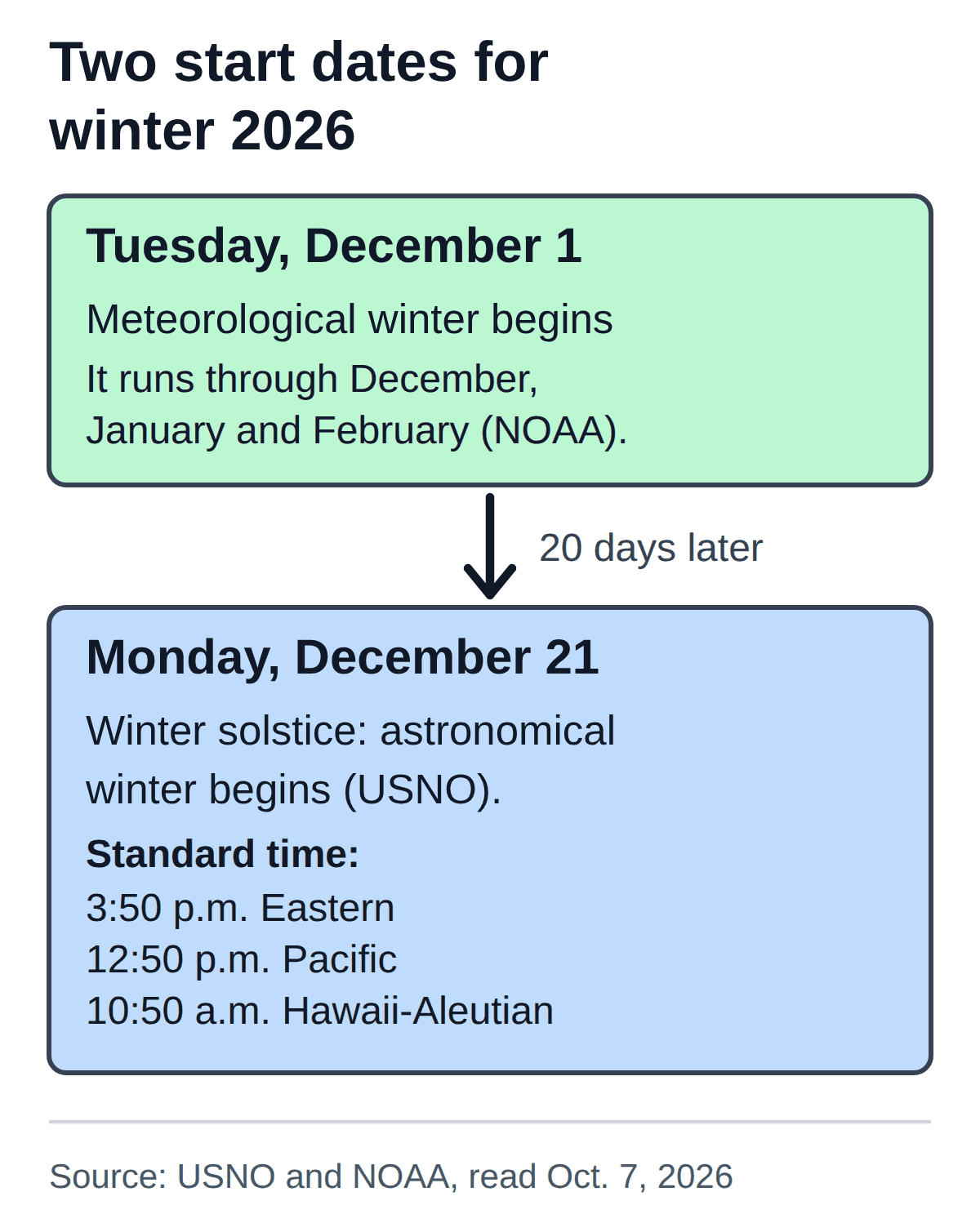
Winter 2026 has two start dates: Tuesday, December 1, and Monday, December 21. December 1 is the first day of meteorological winter. December 21 is the winter solstice, which marks the start of astronomical winter.
Which one is “the first day of winter” depends on the calendar being used. This article explains both, using two U.S. government sources listed at the end. The facts are as of October 7, 2026.
The two answers
| Calendar | Used by | Winter 2026 starts |
|---|---|---|
| Meteorological | Meteorologists and climatologists (NOAA) | Tuesday, December 1 |
| Astronomical | The solstice (U.S. Naval Observatory) | Monday, December 21 |
December 21: the winter solstice
The U.S. Naval Observatory (USNO) says that “the times of the solstices mark the beginning of summer and winter.” Its data service gives the December 2026 solstice at 20:50 UTC on December 21. In U.S. standard time zones, that moment is still December 21:
| Time zone | Time of the solstice, December 21 |
|---|---|
| Eastern Standard Time | 3:50 p.m. |
| Central Standard Time | 2:50 p.m. |
| Mountain Standard Time | 1:50 p.m. |
| Pacific Standard Time | 12:50 p.m. |
| Alaska Standard Time | 11:50 a.m. |
| Hawaii-Aleutian Standard Time | 10:50 a.m. |
The National Oceanic and Atmospheric Administration (NOAA) describes the astronomical seasons as based on the position of Earth in relation to the sun. NOAA also says the winter solstice in the Northern Hemisphere falls “on or around December 22.” That is a general statement. The USNO figure above is the specific one for 2026.
USNO adds that seasons depend on the hemisphere, and that the names of the solstices and equinoxes follow the Northern Hemisphere. This article covers the Northern Hemisphere only.
December 1: meteorological winter
NOAA says meteorologists and climatologists divide the year into groups of three months based on the annual temperature cycle and the calendar. For the Northern Hemisphere, NOAA lists meteorological winter as December, January and February. That makes December 1 its first day.
NOAA gives its reason: the meteorological seasons follow the civil calendar and are more consistent in length, so seasonal statistics are easier to calculate from monthly ones. NOAA gives the length of meteorological winter as 90 days in a non-leap year.
Why the two dates differ
NOAA’s short answer is that astronomical seasons are based on the position of Earth in relation to the sun, while meteorological seasons are based on the annual temperature cycle. NOAA adds that the lengths of the astronomical seasons vary between 89 and 93 days, which would make it hard to compare seasonal statistics from year to year.
What this article does not cover
This article does not forecast the weather, does not say how cold or snowy winter will be, and does not say which definition is the right one. Each source uses its own. It also does not cover the Southern Hemisphere.
Sources
Both pages were checked on October 7, 2026. The USNO page shows no update date. The NOAA page shows “Updated date March 10, 2023.”
- U.S. Naval Observatory, “Earth’s Seasons – Equinoxes, Solstices, Perihelion, and Aphelion” (data service, year 2026). https://aa.usno.navy.mil/data/Earth_Seasons
- NOAA National Centers for Environmental Information, “Meteorological Versus Astronomical Seasons.” https://www.ncei.noaa.gov/news/meteorological-versus-astronomical-seasons