Category: Airport security rules

  • Can You Bring Holiday Food Through TSA? What TSA Says About Thanksgiving Dishes

    TSA’s Food page lists pies, cakes, cookies and cooked meat as allowed in both carry-on and checked bags. For gravy, jam, maple syrup and sauces it allows a carry-on only in containers of 3.4 ounces (100 ml) or less. TSA’s liquids page says the 3.4-ounce limit applies to each container, not to a total, and that these items go in a quart-sized bag. TSA’s description of the 3-1-1 rule in a 2025 local release adds that each liquid or semi-liquid item must be in a container of 3.4 ounces or less and fit into a single quart-sized, clear, resealable plastic bag. TSA’s local Thanksgiving releases of November 2026 list solid dishes such as pies, turkey, stuffing and casseroles for carry-on bags, and say cranberry sauce, gravy, canned goods in liquid, jams, jellies and maple syrup go in checked bags when they are liquid or spreadable and over 3.4 ounces. The Food page speaks to containers of 3.4 ounces or less in a carry-on and the releases to foods over 3.4 ounces, so the two statements cover different sizes. This article gives each with its own condition.

    This article covers what TSA says about holiday food in three places: the Food list on TSA’s “What Can I Bring?” pages; eight local TSA releases about Thanksgiving travel, seven dated November 23, 2026 (Salt Lake City, Phoenix Sky Harbor, Jacksonville, Dallas Fort Worth, Denver, Boston Logan and Hartsfield-Jackson Atlanta) and one dated November 18, 2026 (Harry Reid International Airport), whose food lists match; and TSA’s “Liquids, Aerosols, and Gels Rule” page, used only to explain what the 3.4-ounce limit refers to. All of them were read on November 24, 2026, and the Food page and the Liquids page show no date. On that day TSA’s press-release list showed no national Thanksgiving release, only these local ones. The article also compares the 2026 releases with a 2025 local release from Harrisburg International Airport. It does not cover airline rules, food import rules, alcohol or food safety.
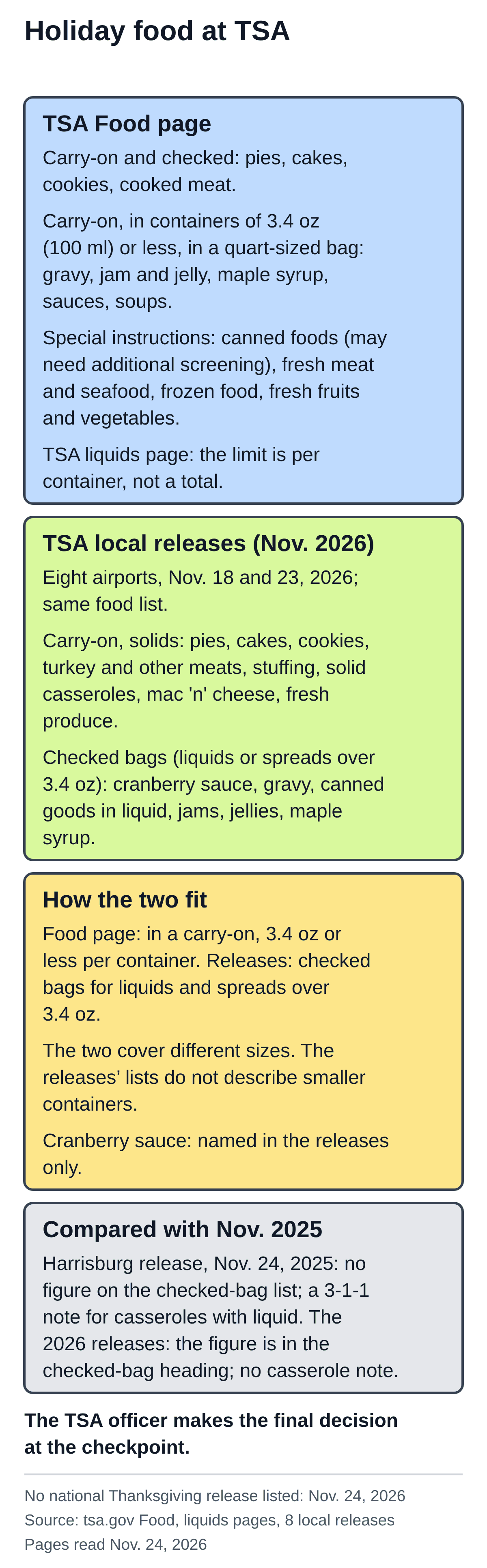
    Diagram of what TSA's Food page and TSA's November 2026 local Thanksgiving releases say about holiday food. TSA Food page: pies, cakes, cookies and cooked meat allowed in carry-on and checked bags; gravy, jam, maple syrup, sauces and soups allowed in a carry-on in containers of 3.4 oz (100 ml) or less, in a quart-sized bag, a limit TSA's liquids page applies to each container, not to a total; canned foods may need additional screening. Local releases dated Nov. 18 and 23, 2026, with the same list: solid items such as pies, turkey, stuffing and casseroles in carry-on bags; cranberry sauce, gravy, canned goods in liquid, jams, jellies and maple syrup in checked bags when liquid or spreadable and over 3.4 oz. The Food page speaks to 3.4 oz or less in a carry-on and the releases to over 3.4 oz, so they cover different sizes; the releases' lists do not describe smaller containers. The TSA officer decides.

    What TSA’s Food page says

    The Food page lists 59 items. Each has a carry-on value and a checked-bag value. None of the items is named cranberry sauce, stuffing, casserole or turkey. These are the rows that matter most for holiday food, with the values as the page shows them:

    Item on the Food pageCarry-onChecked
    Pies and CakesYesYes
    CookiesYesYes
    Cooked Meat, Seafood and Vegetable (No Liquid)YesYes
    Bread; Candy; Spices (dry)YesYes
    Fresh Fruits and VegetablesYes (Special Instructions)Yes
    Fresh Meat and Seafood; Frozen FoodYes (Special Instructions)Yes
    GravyYes (Less than or equal to 3.4oz/100 ml allowed)Yes
    Jam and Jelly; Maple SyrupYes (Less than or equal to 3.4oz/100 ml allowed)Yes
    Salsa and Sauces; SoupsYes (Less than or equal to 3.4oz/100 ml allowed)Yes
    Canned FoodsYes (Special Instructions)Yes

    Several rows say that solid food items (not liquids or gels) can be transported in either carry-on or checked bags. The Fresh Fruits and Vegetables row says this applies within the continental United States, and adds that passengers flying from Hawaii, Puerto Rico or the U.S. Virgin Islands to the mainland cannot take most fresh fruits and vegetables. This article does not go further into that point.

    For fresh meat and frozen food, the page says that if the food is packed with ice or ice packs, they must be completely frozen when brought through screening, and that partially melted ice or ice packs with liquid at the bottom will not be permitted. For canned foods, the page says they could require additional screening that might result in the item not being allowed through the checkpoint, and TSA suggests packing them in a checked bag, shipping them or leaving them at home.

    The Food page writes the limit as “Yes (Less than or equal to 3.4oz/100 ml allowed)” and does not say what the 3.4 ounces is measured against. TSA’s “Liquids, Aerosols, and Gels Rule” page does. It says you are allowed a quart-sized bag of liquids, aerosols, gels, creams and pastes in a carry-on, limited to travel-sized containers that are 3.4 ounces (100 milliliters) or less per item, and that items in containers larger than 3.4 ounces or 100 milliliters go in checked baggage. The rule is about the size of each container, not a total for the trip. The page does not say anything about a larger container that is only partly full, and this article does not either.

    The Liquids page does not say whether the quart-sized bag must be clear or resealable. The 2025 Harrisburg release, described below, words the same rule this way: each liquid or semi-liquid item must be in a container of 3.4 ounces or less and fit into a single quart-sized, clear, resealable plastic bag. So for gravy, jam and jelly, maple syrup, sauces and soups in a carry-on, the Food page’s “Yes” comes with two conditions: a container of 3.4 ounces (100 ml) or less, and the quart-sized bag.

    What TSA’s November 2026 local releases say

    The eight releases carry the same food list. Seven of them put it under the heading “TSA holiday food guidelines: Carry-on vs. checked bags”; Phoenix Sky Harbor’s release calls it “Thanksgiving food travel tips” and words the opening sentence a little differently, with the same meaning. The opening says solid items are permitted in carry-on bags, but any liquid, spreadable or pourable foods exceeding 3.4 ounces must be packed in checked luggage.

    Under “Allowed in carry-on bags (solids),” the releases list: baked goods (holiday pies, cakes, cookies and brownies); meats (turkey, ham, chicken or steak, cooked, uncooked or frozen); stuffing (boxed mixes or prepared stuffing); casseroles (solid holiday casseroles that hold their shape); mac ‘n’ cheese (cooked in a pan, or dry box ingredients); and fresh produce (raw potatoes, yams, greens, apples, cranberries and citrus).

    Under “Must be packed in checked bags (Liquids/spreads over 3.4 oz.),” they list: cranberry sauce (homemade jellied sauce or canned varieties); gravy (in jars, cans or plastic containers); canned goods (canned fruits or vegetables packed in liquid or syrup); and preserves (jams, jellies and maple syrup). The releases’ lists do not separately describe containers of 3.4 ounces or less.

    The releases also say that ice packs used to keep holiday foods cold must be completely frozen when passing through security, and that slushy or partially melted ice packs will not be permitted. They are local releases, and only these eight were read. This article does not say what other airports’ releases contain.

    Compared with the November 2025 Harrisburg release

    On November 24, 2025, TSA at Harrisburg International Airport (MDT) published a local release with a similar holiday food list. The two sets of lists are close. These are the points where the wording differs:

    TopicHarrisburg release, Nov. 24, 2025Local releases, Nov. 2026
    How the limit is wordedItems that “can spill, spread, spray, pump, or pour” and are larger than 3.4 ounces go in checked luggage; no figure beside the checked-bag itemsLiquid, spreadable or pourable foods exceeding 3.4 ounces go in checked luggage; the checked-bag list is headed “Liquids/spreads over 3.4 oz.”
    Cranberry sauceChecked: “Homemade or canned, as it is spreadable”Checked: homemade jellied sauce or canned varieties
    CasserolesSolid: carry-on or checked; casseroles with liquid or semi-liquid parts must follow the 3-1-1 liquids ruleSolid casseroles that hold their shape in carry-on; no casserole sentence about the 3-1-1 rule
    Candy and spicesListed as carry-on examplesNot listed
    Ice packsPermitted, frozen solidCompletely frozen; slushy or partially melted ice packs not permitted

    The 2026 releases do not say whether the 2025 wording still applies, and this article does not treat the 2025 text as current.

    The Food page and the 2026 releases, item by item

    The Food page and the releases state different things about these items:

    ItemTSA Food pageLocal releases, Nov. 2026
    GravyCarry-on: Yes, in containers of 3.4 oz (100 ml) or less, in the quart-sized bag. Checked: YesChecked list (liquids or spreads over 3.4 oz): gravy in jars, cans or plastic containers
    Jam and jelly; maple syrupCarry-on: Yes, in containers of 3.4 oz (100 ml) or less, in the quart-sized bag. Checked: YesChecked list (over 3.4 oz): preserves (jams, jellies and maple syrup)
    Canned goodsCanned Foods: carry-on Yes (Special Instructions), which means they could require additional screening and TSA suggests a checked bag, shipping or leaving them at home; checked YesChecked list (over 3.4 oz): canned fruits or vegetables packed in liquid or syrup
    Cranberry sauceNo row on the pageChecked list (over 3.4 oz): homemade jellied sauce or canned varieties

    The Food page says what is allowed in a carry-on: containers of 3.4 ounces or less, in the quart-sized bag, and it shows “Yes” for checked bags. The releases say what to pack in checked bags: liquids and spreads over 3.4 ounces. The two statements cover different sizes. The releases’ lists do not separately describe containers of 3.4 ounces or less, and this article does not read that silence as a rule. The 2025 Harrisburg list showed no figure beside these items, so the 2026 heading states the size more clearly. For the 3-1-1 rule itself, see What Is the TSA 3-1-1 Liquids Rule? What’s Exempt?.

    The releases also name items the Food page has no row for: turkey, stuffing, casseroles, mac ‘n’ cheese and cranberry sauce. The Food page’s closest rows are Cooked Meat, Seafood and Vegetable (No Liquid), which allows carry-on and checked bags, and Soups, which allows 3.4 ounces (100 ml) or less in a carry-on. This article does not match the releases’ dishes to those rows.

    The releases list fresh produce, and meats that are “uncooked, or frozen,” under items allowed in carry-on bags. The Food page marks Fresh Fruits and Vegetables, Fresh Meat and Seafood and Frozen Food “Yes (Special Instructions),” and the instructions it gives for them are the Hawaii, Puerto Rico and U.S. Virgin Islands note, the ice rule above and, on the Fresh Meat and Seafood row, a dry ice note.

    Who decides at the checkpoint

    The Food page says the final decision rests with the TSA officer on whether an item is allowed through the checkpoint. Its rows for pies and cakes and cookies also say TSA officers may instruct travelers to separate items such as foods and powders from carry-on bags so they do not clutter bags and obstruct clear images on the X-ray machine. The Food page also says “Contact AskTSA if your item is not listed.”

    What this article does not cover

    It does not cover airline rules, rules for bringing food into another country or into Hawaii beyond the one sentence above, alcohol, food safety, recipes or advice on how to pack. It describes what the TSA pages and releases listed under Sources state on the dates above and does not track changes to them. It does not say what a TSA officer will decide for a particular dish.

    Sources

    The Food page, the Liquids, Aerosols, and Gels Rule page, the press-release list and the eight 2026 releases were read on November 24, 2026. The 2025 Harrisburg release was read on November 4 and again on November 24, 2026. The Food page and the Liquids page show no update date.

  • Can You Lock a Checked Bag? What TSA Says About TSA Locks

    TSA’s pages do not forbid locking a checked bag, but they say a lock TSA cannot open may have to be cut, and that TSA is “not liable for damage caused to locked bags that must be opened for security purposes.” TSA also names “TSA recognized locks,” which TSA says it can open with universal “master” keys, so that those locks may not have to be cut, and whose packaging should say so. This article reads what three TSA pages say about locks and checked bags, and what the TSA claims page says if something is lost or damaged.

    The three pages are TSA’s Security Screening page (its checked baggage section), the Travel Tips page (its “TSA recognized locks” section) and the Claims page. The wording is as of November 13, 2026, and none of the three pages shows an update date. This article is about checked bags only; for what TSA says at the checkpoint, see TSA Shoes Off and Laptops Out: What TSA Says. It does not cover firearms cases, airline rules for locks or bags, prices, or which lock models are sold.

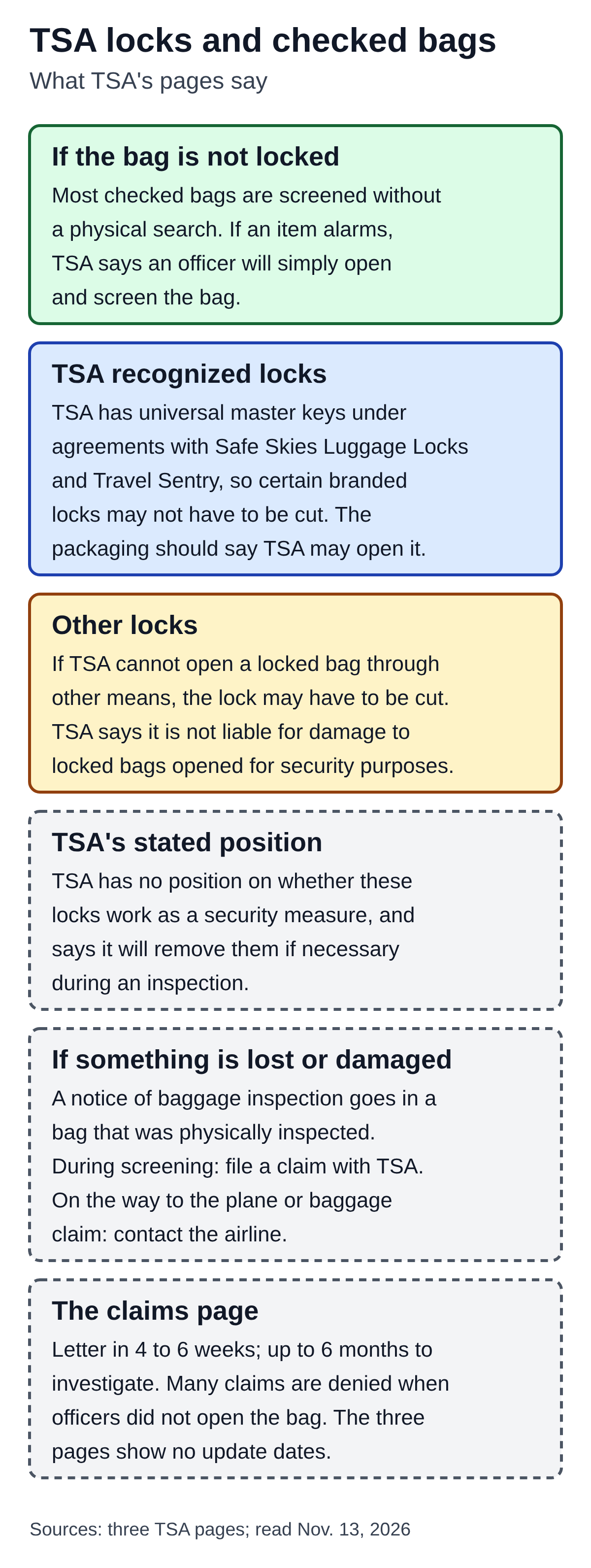
    Diagram of what TSA's pages say about locking a checked bag, from TSA's Security Screening page, TSA's Travel Tips page and TSA's Claims page. Bag not locked: most checked bags are screened without a physical search; if an item alarms, TSA says an officer will simply open and screen the bag. TSA recognized locks: TSA has universal master keys under agreements with Safe Skies Luggage Locks and Travel Sentry, so certain branded locks may not have to be cut; the packaging should say TSA may open the lock. Other locks: if TSA cannot open a locked bag through other means, the lock may have to be cut; TSA says it is not liable for damage to locked bags opened for security purposes. TSA's stated position: TSA has no position on whether these locks work as a security measure and says it will remove them if necessary during an inspection. Lost or damaged: a notice of baggage inspection goes in a bag that was physically inspected; for loss or damage during screening, file a claim with TSA; for loss or damage on the way to the plane or baggage claim, contact the airline. Claims page: an acknowledgment letter comes four to six weeks after filing, TSA allows up to six months to investigate, and many claims are denied when officers did not open the bag. The three pages show no update dates. Sources read Nov. 13, 2026.

    What happens to a checked bag

    TSA’s Security Screening page says TSA screens approximately 1.3 million checked bags a day for explosives and other dangerous items, and that “the majority of checked baggage is screened without the need for a physical bag search.” It also says TSA may inspect your checked baggage during screening, and that if your property is physically inspected, TSA will place a notice of baggage inspection inside your bag to inform you that an officer inspected it.

    The Travel Tips page gives the same picture: technology generally lets TSA screen bags electronically without opening them, but “there are times when we need to physically inspect a piece of luggage.”

    Unlocked, recognized lock, other lock

    The two pages describe three situations. They are worded differently, so the table follows each page’s own words.

    SituationWhat the pages say
    Bag not lockedTravel Tips: if an item alarms, “our officer will simply open and screen the baggage.”
    TSA recognized lockSecurity Screening: TSA has universal “master” keys under agreements with Safe Skies Luggage Locks and Travel Sentry “so that certain branded locks may not have to be cut.” Travel Tips: the packaging indicates whether TSA can open the lock.
    Another lock TSA cannot openTravel Tips: if you lock your checked baggage and TSA “cannot open it through other means, then the locks may have to be cut.”

    TSA recognized locks

    The Travel Tips page says TSA has worked with several companies to develop locks that security officers can open with universal “master” keys so that the locks may not have to be cut. It says these locks are available at most airports and many travel stores nationwide, and that the packaging indicates whether TSA can open them. The Security Screening page names the two programs behind the master keys, Safe Skies Luggage Locks and Travel Sentry, and says the locks are commercially available and the packaging “should indicate they may be opened by TSA officers.”

    The pages do not list lock models or brands that qualify and do not say how to tell a recognized lock by sight. The only identifier they give is the packaging.

    If TSA cannot open the lock

    The Travel Tips page says that “for soft-sided baggage, this process will not damage your zippers or zipper pulls.” That is TSA’s own statement about cutting a lock; the page says nothing about hard-sided baggage and does not say how a lock is cut. In the same passage TSA says it is careful not to damage personal belongings, but is “not liable for damage caused to locked bags that must be opened for security purposes.” It says that if an officer opens your bag, a Notice of Baggage Inspection will be placed in it.

    Two lines on the pages point in slightly different directions. Travel Tips says recognized locks are meant so that locks “may not have to be cut.” The Security Screening page says TSA “has no position on the validity or effectiveness of these product as a security measure and will be forced to remove these products if necessary during the inspection.” This article does not resolve how the two fit together.

    The Travel Tips page also says officers are not the only reason a lock can go missing. Locks and bags can be damaged by airport conveyor belt systems, and it shows 244 locks pulled from under a baggage-handling conveyor belt at a New York airport over a period of one month.

    Filing a claim for damage or loss

    The Security Screening page splits responsibility by where the problem happened. If your property is lost or damaged during the screening process, you may file a claim with TSA. If it is lost or damaged during transport to the plane or to baggage claim, it says to contact your airline.

    The Claims page says you may file a claim if you are injured or your property is lost or damaged during the screening process. After you submit a claim, it says, you receive an acknowledgment letter with instructions and a control number four to six weeks later, and you should save the control number because you need it to communicate with TSA and to check your status. The Federal Tort Claims Act governs how the claim is processed; if it is denied or not resolved within six months of the date it was properly presented to TSA, you may file suit in an appropriate U.S. District Court. The page asks you to allow up to six months to investigate, longer for claims that need a law enforcement investigation, and says the final decision to approve a claim rests with TSA.

    The page also says that in many cases “claims are denied when an investigation determines that TSA officers did not open a bag for a physical inspection,” and it points readers to TSA recognized locks. It advises including receipts, appraisals and flight information, says to contact the airline for lost or missing baggage, and says to contact TSA’s lost and found for items left at the security checkpoint.

    Screening at some airports is done by private companies instead of TSA. The Claims page tells travelers to select their airport from a list to file there and, on November 13, 2026, listed 20 airports, including San Francisco International and Kansas City International.

    What the pages do not say

    None of the three pages shows an update date. They do not say whether you should lock a checked bag, how often locks are cut, or what “other means” TSA uses before cutting a lock. They do not list lock brands or models, and they say nothing about hard-sided bags. They do not give the share of claims that are approved. Airline rules about locks or checked bags are not covered by any of the three pages.

    Sources

    All pages were read on November 13, 2026.

  • TSA Shoes Off and Laptops Out: What TSA Says

    What applies at your checkpoint depends on the screening you get and on the TSA officer’s instructions. TSA announced in July 2025 that passengers at domestic airports can keep their shoes on. For laptops, TSA’s pages say that in standard screening large electronics go into a bin, that laptops are allowed to stay in the bag where CT equipment is used, and that PreCheck travelers do not need to remove them. TSA’s Security Screening page tells travelers to listen to the instructions of the TSA officer.

    This article covers what eight TSA pages say about shoes and large electronics: the national press release of July 8, 2025, the Travel Checklist, the Laptops, Tablets and Steel Toe Boots item pages, the Computed Tomography page, a local release of July 13, 2026 about CT units at Juneau, and the Security Screening page. The wording is as of November 9, 2026. It does not cover belts, jackets or liquids in detail, which airport has which equipment, how a particular checkpoint is set up, children, travelers with medical needs or international airports.

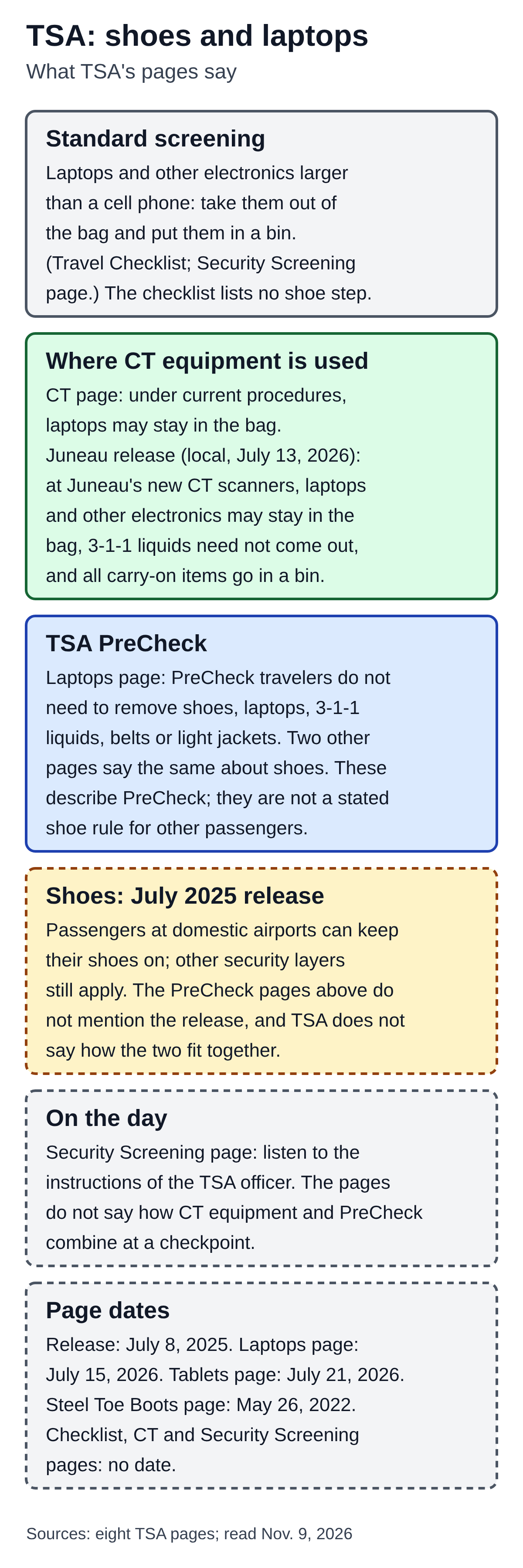
    Diagram of what TSA's pages say about shoes and large electronics at the checkpoint. Standard screening: laptops and other electronics larger than a cell phone come out of the bag into a bin, per TSA's Travel Checklist and Security Screening page; the checklist lists no shoe step. Where CT equipment is used: the CT page says laptops are allowed to remain in the bag under current procedures; a July 13, 2026 local release says that at Juneau's new CT scanners laptops and other electronics may stay in the bag, 3-1-1 liquids need not be removed, and all carry-on items go into a bin. TSA PreCheck: the Laptops page says PreCheck travelers do not need to remove shoes, laptops, 3-1-1 liquids, belts or light jackets; two other pages say the same about shoes; these sentences describe PreCheck and are not a stated shoe rule for other passengers. Shoes: TSA's July 8, 2025 release says passengers at domestic airports can keep their shoes on, and other security layers still apply; the PreCheck pages do not mention the release, and TSA does not say how the two fit together. On the day: the Security Screening page says to listen to the instructions of the TSA officer; the pages do not say how CT equipment and PreCheck combine at a checkpoint. Dates: release July 8, 2025; Laptops page July 15, 2026; Tablets page July 21, 2026; Steel Toe Boots page May 26, 2022; the checklist, CT and Security Screening pages show no date. Sources read Nov. 9, 2026.

    What the pages say, situation by situation

    CT is a type of screening equipment and TSA PreCheck is a screening program, so the rows below are not three lanes a traveler picks between. The pages read here do not say how CT equipment and PreCheck combine at a given checkpoint.

    SituationLaptops and other large electronicsShoesWhere it comes from
    Standard screeningTake electronics larger than a cell phone out of the bag and put them in a binThe checklist lists no shoe step; the Security Screening page says standard screening requires removing all items and placing them on the X-ray belt, without naming shoes; the July 2025 release says shoes can stay onTravel Checklist (no date); Security Screening page (no date); Laptops page; July 8, 2025 release
    Where CT equipment is usedCT page: laptops are allowed to remain in the bag. Juneau release: at Juneau’s new CT scanners, laptops and other electronics may stay in the bag and 3-1-1 liquids need not be removedNot addressed on the CT page or the Juneau release; the July 2025 release covers domestic airportsCT page (no date); July 13, 2026 Juneau release (local)
    TSA PreCheckPreCheck travelers do not need to remove laptopsPreCheck travelers do not need to remove shoes; this describes PreCheck and does not state a shoe rule for other passengersLaptops page, Last Updated July 15, 2026; Steel Toe Boots page; Security Screening page

    Shoes: what TSA’s pages say

    TSA’s national press release of July 8, 2025, headed “DHS to End ‘Shoes-Off’ Travel Policy,” says the Homeland Security Secretary announced a policy that allows passengers traveling through domestic airports to keep their shoes on while passing through security screening at TSA checkpoints. Its subhead says passengers can now keep their shoes on at TSA security checkpoints. The release adds that other parts of TSA’s layered approach still apply and that passengers must still clear identity verification, Secure Flight vetting and other processes.

    The release does not say whether an officer can still ask a traveler to take off shoes, for example for additional screening, and this article does not fill that gap.

    Three other TSA pages describe what PreCheck travelers do not need to do. The Laptops page (Last Updated on July 15, 2026) and the Steel Toe Boots page (Last Updated on May 26, 2022) both say TSA PreCheck travelers do not need to remove shoes, laptops, 3-1-1 liquids, belts or light jackets. The Security Screening page, which shows no date, says that with PreCheck you do not need to remove your shoes, laptops, liquids, belts and light jackets, and adds that TSA uses unpredictable security measures throughout the airport and no individual is guaranteed expedited screening. These sentences describe PreCheck. They do not state a shoe requirement for other passengers, and they do not mention the July 2025 release.

    The same Security Screening page says that standard screening requires that you remove all items and place them on the X-ray belt for screening; that sentence does not name shoes. The Travel Checklist lists steps “In Standard Screening Lane” (remove the 3-1-1 liquids bag and place it in the bin, empty the pockets and remove bulky jewelry, and remove personal electronic devices larger than a cell phone), lists no step about shoes, and shows no update date. Its packing tips mention shoes only as one layer in a bag packed in layers.

    TSA’s pages do not say how this wording fits with the July 2025 release, and this article does not say which wording controls.

    On the day: the officer’s instructions

    In the food paragraph of its carry-on screening section, TSA’s Security Screening page says to listen to the instructions of the TSA officer, and it says a TSA officer will be available to guide you through the process. The page also says officers may instruct travelers to separate other items, such as foods and powders, from carry-on bags. That page says procedures can change from time to time. Because the pages read here do not say how the wording above fits together, this article’s advice is simply to follow the instructions of the officer at your checkpoint.

    Laptops and other large electronics in standard screening

    The checklist and the Security Screening page say that travelers will be asked to remove personal electronic devices larger than a cell phone from the carry-on bag and put them in a bin with nothing on or under them for X-ray screening, and they give laptops, tablets, e-readers and handheld game consoles as examples. The Security Screening page adds that this does not include items such as hair dryers, electric shavers or electric toothbrushes. The Laptops page lists carry-on bags “Yes” and checked bags “Yes,” and says to remove the laptop from the bag and place it in a separate bin for X-ray screening.

    The Tablets page (Last Updated on July 21, 2026) lists carry-on bags “Yes” and checked bags “Yes” and points to the FAA regulations for portable electronic devices. It has no instruction about taking a tablet out of the bag, while the checklist and the Security Screening page name tablets among the devices to remove.

    Where CT equipment is used

    TSA’s Computed Tomography page describes CT as the latest checkpoint X-ray scanning equipment for carry-on bags, which builds a 3-D image of a bag’s contents, and says that if a bag requires further screening, officers will inspect it. It says the goal is, in the future, to keep laptops and 3-1-1 liquids inside the bag during screening, and that under current screening procedures for this technology, laptops are allowed to remain inside the bag. The page shows no update date and gives no bin instruction.

    A local TSA release of July 13, 2026 covers the two new CT machines at Juneau International Airport only. It says passengers using those machines are permitted to leave laptops and other electronic devices in their carry-on bags, and that passengers screened in security lanes with CT units do not need to remove their travel-sized 3-1-1 liquids. It also says that with the new CT scanners all carry-on items, including roller bags, need to be placed into a bin; that CT units have a slightly smaller entry tunnel, so not all larger carry-on bags fit; and that TSA recommends checking large carry-on items. Those are statements about the Juneau machines. The pages read here do not say whether CT units at other airports work the same way.

    More on the liquids rule is in What Is the TSA 3-1-1 Liquids Rule? What’s Exempt?, and more on PreCheck is in What Is TSA PreCheck? What It Changes at the Checkpoint.

    What the pages do not say

    The pages read here do not list which airports, lanes or checkpoints have CT units, and they do not say how CT equipment and PreCheck work together. The Juneau release is a local release about one airport. The checklist, the CT page and the Security Screening page show no date. The Laptops page, which describes shoes only for PreCheck, is dated a year after the July 2025 release; the Steel Toe Boots page is dated before it. TSA says on its Security Screening page that it adjusts processes and procedures and that travelers may notice changes from time to time.

    Sources

    All pages were read on November 9, 2026.

  • Can You Bring Deodorant on a Plane? What TSA Says by Type

    Yes, in both carry-on and checked bags, with size limits for sprays and liquids. TSA’s pages list solid deodorant as allowed in carry-on and checked bags and show no size limit. For aerosol deodorant and liquid deodorant, TSA lists carry-on bags as “Yes” with 3.4 ounces (100 ml) or less allowed, and checked bags as “Yes.” TSA’s general liquids rule page states the 3.4-ounce limit per item, which this article reads as per container.

    This article covers what three TSA “What Can I Bring?” pages say (Deodorant (Solid), Deodorant (aerosol) and Deodorant (liquid)), what TSA’s “Liquids, Aerosols, and Gels Rule” page says about the 3.4-ounce size, and what the FAA rule they point to, 49 CFR 175.10(a)(1), says about toiletries in checked bags. The wording is as of November 9, 2026. Two of the deodorant pages carry a 2023 date and one a 2017 date, and the article gives each date; the liquids rule page shows no date. It does not cover other toiletries, gel or roll-on products, antiperspirant, airline rules, other countries or any one brand.

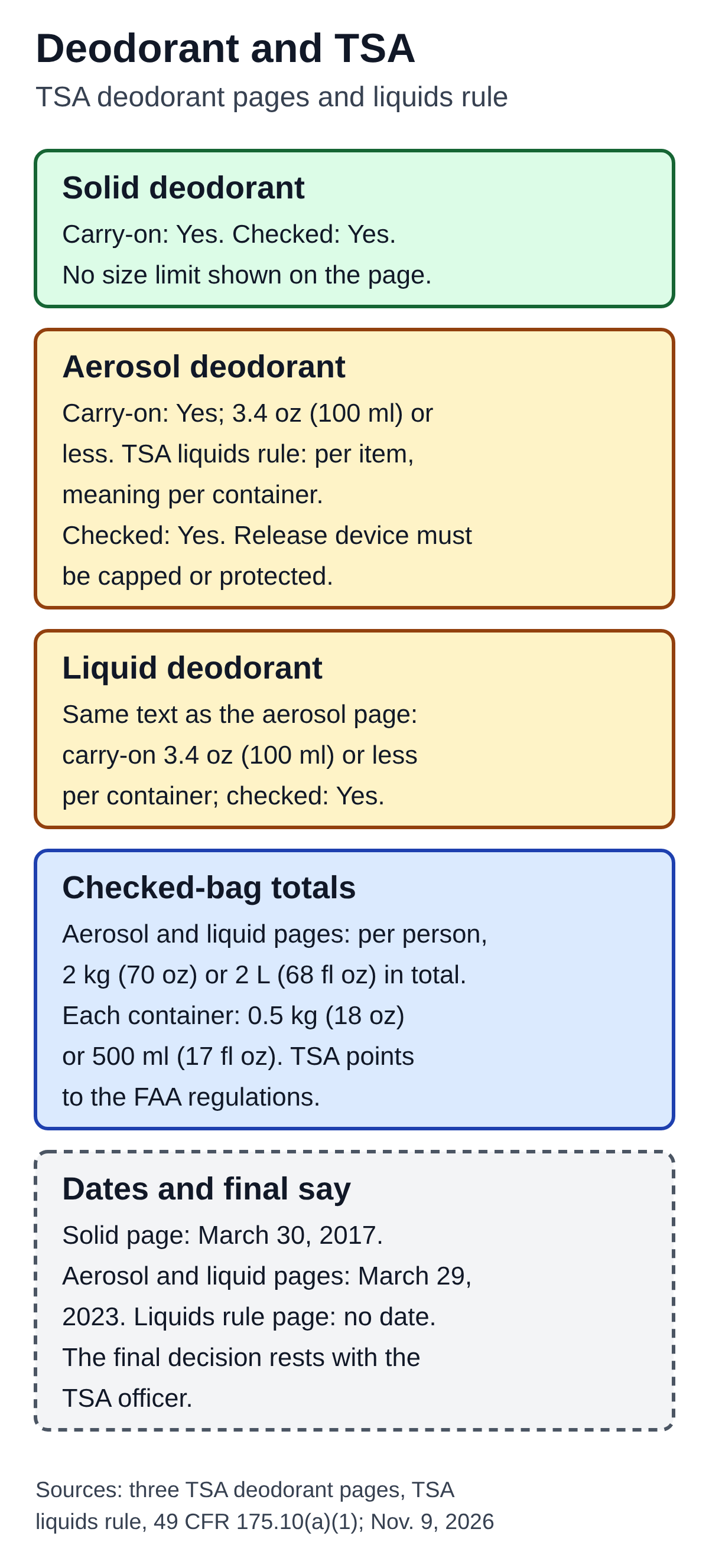
    Diagram of what TSA says about deodorant on a plane, from three TSA deodorant pages, TSA's liquids rule page and the FAA rule in 49 CFR 175.10(a)(1). Solid deodorant: carry-on yes, checked yes; the page shows no size limit. Aerosol deodorant: carry-on yes, 3.4 ounces (100 ml) or less allowed, which TSA's liquids rule page states as a limit per item, meaning per container; checked yes; release devices must be protected by caps or other suitable means. Liquid deodorant: the page has the same text as the aerosol page. Checked-bag totals on the aerosol and liquid pages: 2 kg (70 ounces) or 2 L (68 fluid ounces) per person in total, and no more than 0.5 kg (18 ounces) or 500 ml (17 fluid ounces) per container. Page dates: solid March 30, 2017; aerosol and liquid March 29, 2023; the liquids rule page shows no date. The final decision rests with the TSA officer. Sources read Nov. 9, 2026.

    The three pages in one table

    Type of deodorantTSA: carry-on bagsTSA: checked bagsWhat the page addsPage date
    SolidYesYesNo size limit or other instruction on the pageMarch 30, 2017
    AerosolYes (3.4 oz / 100 ml or less allowed; per container, per TSA’s liquids rule page)YesChecked-bag totals; release device must be protectedMarch 29, 2023
    LiquidYes (3.4 oz / 100 ml or less allowed; per container, per TSA’s liquids rule page)YesSame text as the aerosol pageMarch 29, 2023

    Solid deodorant

    TSA’s Deodorant (Solid) page lists carry-on bags “Yes” and checked bags “Yes.” It shows no size limit, no checked-bag totals and no other instruction. It is the oldest of the three pages (last updated March 30, 2017).

    Aerosol and liquid deodorant in carry-on

    TSA’s Deodorant (aerosol) and Deodorant (liquid) pages carry the same header and the same text. Both list carry-on bags as “Yes (Less than or equal to 3.4oz/100 ml allowed)” and checked bags as “Yes.” Both were last updated on March 29, 2023. The deodorant pages do not say what the 3.4 ounces applies to.

    TSA’s “Liquids, Aerosols, and Gels Rule” page does. It says you are allowed to bring a quart-sized bag of liquids, aerosols, gels, creams and pastes in your carry-on bag and through the checkpoint, limited to travel-sized containers of 3.4 ounces (100 milliliters) or less per item, and to pack containers larger than 3.4 ounces in checked baggage. Read together, the 3.4-ounce figure on the deodorant pages is the size limit for each container (“per item”) carried in a carry-on bag. That page shows no update date. The deodorant pages themselves do not mention the quart-sized bag. More on the rule is in What Is the TSA 3-1-1 Liquids Rule? What’s Exempt?.

    Aerosol and liquid deodorant in a checked bag

    The aerosol and liquid pages say the FAA limits the total amount of restricted medicinal and toiletry articles, including aerosols, in checked baggage. The total aggregate quantity per person cannot exceed 2 kg (70 ounces) or 2 L (68 fluid ounces), and the capacity of each container must not exceed 0.5 kg (18 ounces) or 500 ml (17 fluid ounces). The pages end that paragraph with “See the FAA regulations for more information.”

    The FAA rule these pages point to appears to be 49 CFR 175.10(a)(1), which the eCFR shows as up to date as of November 5, 2026. It covers non-radioactive medicinal and toilet articles for personal use, including aerosols, carried in carry-on and checked baggage, and it states the same aggregate quantity (2 kg or 2 L per person) and the same container capacity (0.5 kg or 500 ml). It also says the release of gas must not cause extreme annoyance or discomfort to crew members so as to prevent the correct performance of assigned duties. The TSA pages do not cite this paragraph by number, so this article does not say that TSA applies exactly this text.

    Release devices on aerosols

    Both the aerosol and the liquid page say permitted aerosol release devices (button or nozzle) must be protected by caps or other suitable means to prevent accidental release. 49 CFR 175.10(a)(1) says the release devices on aerosols must be protected by a cap or other suitable means to prevent inadvertent release. The Solid page does not mention release devices.

    What the pages do not say

    TSA’s What Can I Bring? item search for “deodorant” returns exactly these three pages, so there is no separate TSA page for gel deodorant or roll-on deodorant, and this article says nothing about them. None of the pages says how many deodorants you may carry, and none says anything about a brand or ingredients. TSA says on each page that the final decision rests with the TSA officer on whether an item is allowed through the checkpoint.

    Sources

    All pages were read on November 9, 2026.

  • Can You Bring a Razor on a Plane? What TSA Says About Each Type

    It depends on the type of razor. TSA’s pages list disposable razors and electric razors as allowed in both carry-on and checked bags. For a safety razor, TSA says it is allowed through the checkpoint without the blade, and for razor blades that are not in a cartridge, TSA says they are prohibited in carry-on bags and allowed in checked bags.

    This article covers what four TSA “What Can I Bring?” pages say: Disposable Razor, Safety Razor With Blades (allowed without blade), Razor-Type Blades and Electric Razors. The wording is as of November 9, 2026. Three of the four pages carry dates from 2017 or 2023, and the article gives each date. It does not cover straight razors, shaving cream, other sharp objects, airline rules or other countries.

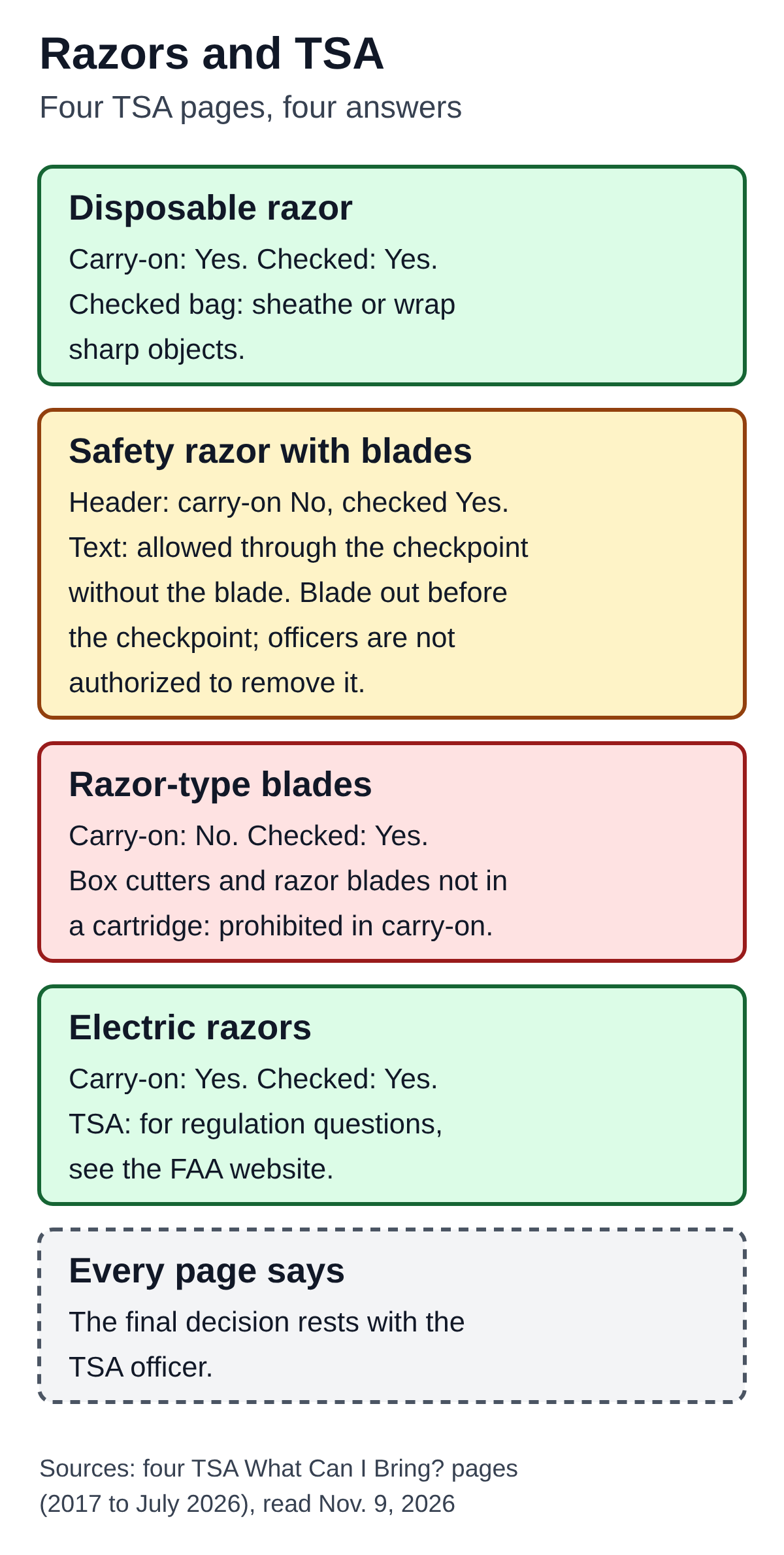
    Diagram of what TSA says about razors on a plane, from four TSA pages. Disposable razor: carry-on yes, checked yes; sharp objects in checked bags should be sheathed or wrapped. Safety razor with blades: header says carry-on no, checked yes; text says it is allowed through the checkpoint without the blade, the blade must be removed before the checkpoint, and officers are not authorized to remove it. Razor-type blades: carry-on no, checked yes; razor blades not in a cartridge are prohibited in carry-on. Electric razors: carry-on yes, checked yes; for regulation questions TSA points to the FAA website. The final decision rests with the TSA officer. Sources: four TSA What Can I Bring pages, dated May 4, 2017, June 22, 2023, May 4, 2017 and July 14, 2026; read Nov. 9, 2026.

    The four pages in one table

    Type of razorTSA: carry-on bagsTSA: checked bagsWhat the page addsPage date
    Disposable razorYesYesSharp objects in checked bags should be sheathed or securely wrappedMay 4, 2017
    Safety razor with blades (allowed without blade)No (header line)YesAllowed through the checkpoint without the blade; the blade must be removed before the checkpoint; officers are not authorized to remove itJune 22, 2023
    Razor-type bladesNoYesBox cutters and razor blades not in a cartridge are prohibited in carry-onMay 4, 2017
    Electric razorsYesYes“If you have questions regarding regulations, please see the FAA website.”July 14, 2026

    Disposable razors

    TSA’s Disposable Razor page lists carry-on bags “Yes” and checked bags “Yes.” Its only other instruction is the line TSA puts on its sharp-object pages for checked bags: any sharp objects in checked bags should be sheathed or securely wrapped to prevent injury to baggage handlers and inspectors. The page does not mention cartridges or a limit on how many razors you can carry.

    Safety razors

    TSA’s page for a safety razor with blades is titled “Safety Razor With Blades (allowed without blade).” Its header line says “Carry On Bags: No” and “Checked Bags: Yes.” Its text says a safety razor is allowed through the screening checkpoint without the blade, that the blade must be removed before entering the checkpoint, and that TSA officers are not authorized to remove the blades from the holder. So, as TSA writes it, the razor can go through the checkpoint when the blade is already out. The page says no more about a razor that still has its blade at the checkpoint than that officers are not authorized to take the blade out. The page also repeats the line about wrapping sharp objects in checked baggage.

    Loose razor blades

    TSA’s Razor-Type Blades page lists carry-on bags “No” and checked bags “Yes.” It says box cutters and razor blades not in a cartridge are prohibited in carry-on. The page names only blades that are not in a cartridge; it says nothing about blades that are.

    Electric razors

    TSA’s Electric Razors page lists carry-on bags “Yes” and checked bags “Yes” and adds one sentence: “If you have questions regarding regulations, please see the FAA website.” It is the only one of the four pages that shows a 2026 date (July 14, 2026). The page does not mention batteries. This article does not read any FAA page, so it says nothing about battery rules for electric razors.

    Packing razors in a checked bag

    The pages for disposable razors, safety razors and razor-type blades all say that any sharp objects in checked bags (the safety razor page says “checked baggage”) should be sheathed or securely wrapped to prevent injury to baggage handlers and inspectors. The electric razor page does not include that line.

    What the pages do not say

    None of the four pages mentions straight razors. A search for “razor” in TSA’s What Can I Bring? item list returns exactly these four pages and none about straight razors, so the article says nothing about them. None of the pages gives a limit on the number of razors or blades. TSA says on each page that the final decision rests with the TSA officer on whether an item is allowed through the checkpoint. Shaving cream is a different item with its own TSA page and is a liquids and aerosols question, covered in What Is the TSA 3-1-1 Liquids Rule? What’s Exempt?.

    Sources

    All four pages were read on November 9, 2026.

  • Can You Bring a Vape on a Plane? What TSA and the FAA Say

    TSA and the FAA both say vapes and other electronic smoking devices go in carry-on baggage, not in checked bags. TSA’s page lists them as “Carry On Bags: Yes (Special Instructions)” and “Checked Bags: No.” The FAA’s PackSafe page says they must be carried on one’s person or in carry-on baggage, and that passengers must take effective measures to prevent accidental activation of the heating element.

    This article covers what four official sources say about vapes, e-cigarettes, vape pens and similar devices: TSA’s “Electronic Cigarettes and Vaping Devices” page, the FAA’s PackSafe page for the same devices, an FAA news item from 2020, and the federal regulation they cite, 49 CFR 175.10(a)(19). The wording is as of November 6, 2026. It does not cover airline policies, other countries, cannabis products or age limits.

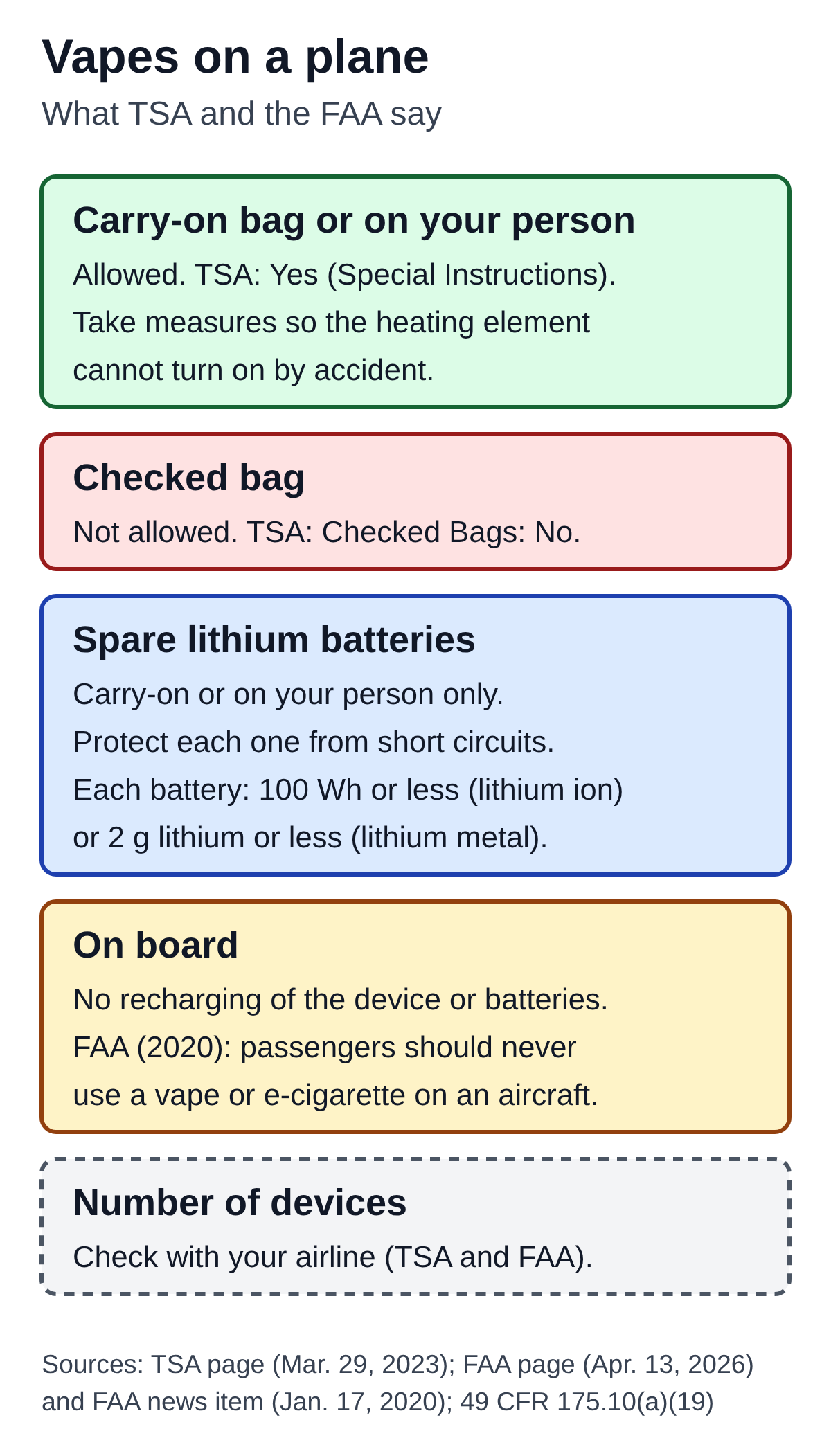
    Diagram of what TSA and the FAA say about vapes on a plane. Carry-on bag or on your person: allowed; TSA: Yes (Special Instructions); take measures so the heating element cannot turn on by accident. Checked bag: not allowed; TSA: Checked Bags: No. Spare lithium batteries: carry-on or on your person only; protect each one from short circuits; each battery 100 Wh or less (lithium ion) or 2 g lithium or less (lithium metal). On board: no recharging of the device or batteries; FAA (2020): passengers should never use a vape or e-cigarette on an aircraft. Number of devices: check with your airline (TSA and FAA). Sources: TSA page (Mar. 29, 2023); FAA page (Apr. 13, 2026); FAA news item (Jan. 17, 2020); 49 CFR 175.10(a)(19).

    What the sources say, in one table

    QuestionWhat the sources say
    In a carry-on bag or on your person?TSA: carry-on “Yes (Special Instructions).” FAA and the regulation: devices must be carried on one’s person or in carry-on baggage
    In a checked bag?TSA: “Checked Bags: No.” The regulation: on one’s person or in carry-on baggage “only”
    Spare lithium batteries?FAA and the regulation: on one’s person or in carry-on baggage only, each protected from short circuits
    Battery size?TSA, FAA and the regulation: each lithium ion battery 100 Wh or less; each lithium metal battery 2 grams of lithium or less
    Charging on board?FAA and the regulation: recharging the devices or batteries on board is not permitted
    Using it on board?FAA news item, January 17, 2020: passengers “should never use” vapes or e-cigarettes on an aircraft
    How many devices?TSA and FAA: check with your airline on any limits on the number of devices

    Carry-on only

    TSA’s page says electronic smoking devices are allowed only in carry-on baggage. The FAA’s page says the devices must be carried on one’s person or in carry-on baggage, and the regulation says the same with the word “only.” In a 2020 news item, the FAA said vapes, e-cigarettes and spare lithium batteries must be placed in carry-on luggage only, and described the devices as hazardous materials when transported on aircraft. It added that they contain lithium batteries that pose a fire risk.

    Preventing accidental activation

    TSA says passengers are required to take effective measures to prevent accidental activation of the heating element and points to the FAA regulations for examples. The FAA’s page, which describes these devices as battery powered with a heating element that vaporizes liquid, lists examples that include, but are not limited to: removing the battery from the device; separating the battery from the heating coil; putting the device in a protective case; using a protective cover, safety latch or locking device on the heating coil activation button; and electronics in the device designed to prevent accidental activation, such as requiring the device to be powered on before the coil button works.

    Spare batteries

    The FAA and the regulation say spare lithium batteries must also be carried on one’s person or in carry-on baggage only, and must be individually protected so they cannot short-circuit. The FAA lists these methods: leaving the batteries in their retail packaging, covering the battery terminals with tape, using a battery case, using a battery sleeve in a camera bag, or putting them snugly in a plastic bag or protective pouch. TSA, the FAA and the regulation all give the same size limits: each lithium ion battery 100 watt-hours (Wh) or less, and each lithium metal battery 2 grams of lithium or less. The rules for spare batteries in general, including power banks, are covered in Can You Bring a Power Bank on a Plane? TSA and FAA Rules.

    Charging and use on board

    The FAA’s page and the regulation say recharging the devices or their batteries on board the aircraft is not permitted. On use, the FAA’s January 17, 2020 news item says that just as passengers are not allowed to smoke cigarettes on an aircraft, they should never use their vapes or e-cigarettes on an aircraft, and calls it “a federal offense.” That is a statement in a 2020 FAA news item. It does not cite a regulation, so this article does not name one.

    What the pages do not say

    TSA and the FAA both say to check with your airline on any limits on the number of devices a passenger can carry for personal use; neither gives a number. None of the pages read mentions e-liquid or refill bottles, and none names disposable vapes as a separate type, so this article does not say anything about them. TSA also says the officer makes the final decision on whether an item goes through the checkpoint.

    Sources

    All four sources were read on November 6, 2026.

  • Can You Bring a Lighter on a Plane? What TSA and the FAA Say

    For a disposable or Zippo-type lighter, the FAA says one lighter per passenger, in a carry-on bag or on one’s person, and TSA lists carry-on bags as allowed. For checked bags the two differ: TSA says lighters without fuel are allowed and lighters with fuel are prohibited unless they adhere to a Department of Transportation (DOT) exemption, while the FAA’s chart says “Not allowed in Checked Bags.” This article could not confirm a current DOT permit, so it does not say whether that exemption applies today. Both list torch lighters as not allowed in carry-on or checked bags.

    This article covers what TSA’s and the FAA’s pages say. The wording is as of October 29, 2026, and comes from the eight pages listed at the end. TSA’s pages carry different update dates: July 14, 2026 (disposable and Zippo lighters), November 4, 2024 (arc and electronic lighters) and October 10, 2024 (torch lighters, lighter fluid and lithium battery powered lighters). It describes the rules and does not give advice on what to pack.

    What the FAA and TSA say, by type of lighter

    Type of lighterFAA page, chart and 49 CFR 175.10TSA page
    Disposable (butane) and Zippo-type (liquid absorbed in a lining): carry-onOne per passenger, in carry-on or on one’s person. The regulation: on one’s person or in carry-on baggage onlyCarry-on: Yes
    Disposable and Zippo-type: checked bagsThe chart says “Not allowed in Checked Bags”“Yes (Special Instructions)”: without fuel allowed; with fuel prohibited unless a DOT exemption applies. A current DOT permit was not confirmed
    Arc, electronic and other lithium battery poweredCarry-on only, with measures to prevent unintentional activation and no recharging on boardArc and electronic page: carry-on “Yes (Special Instructions)”, checked No. Lithium battery powered page: carry-on Yes, checked No
    TorchNot allowed in the cabin or in checked baggageCarry-on: No. Checked: No
    Unabsorbed liquid fuel (desk, table and antique wick lighters)Forbidden. The regulation: not permitted on one’s person, in carry-on or in checked baggage (other than liquefied gas)No separate TSA page was read for this type
    Lighter fluid and refillsThe regulation: lighter fuel and lighter refills not permitted on one’s person, in carry-on or in checked baggageLighter fluid: carry-on No, checked No
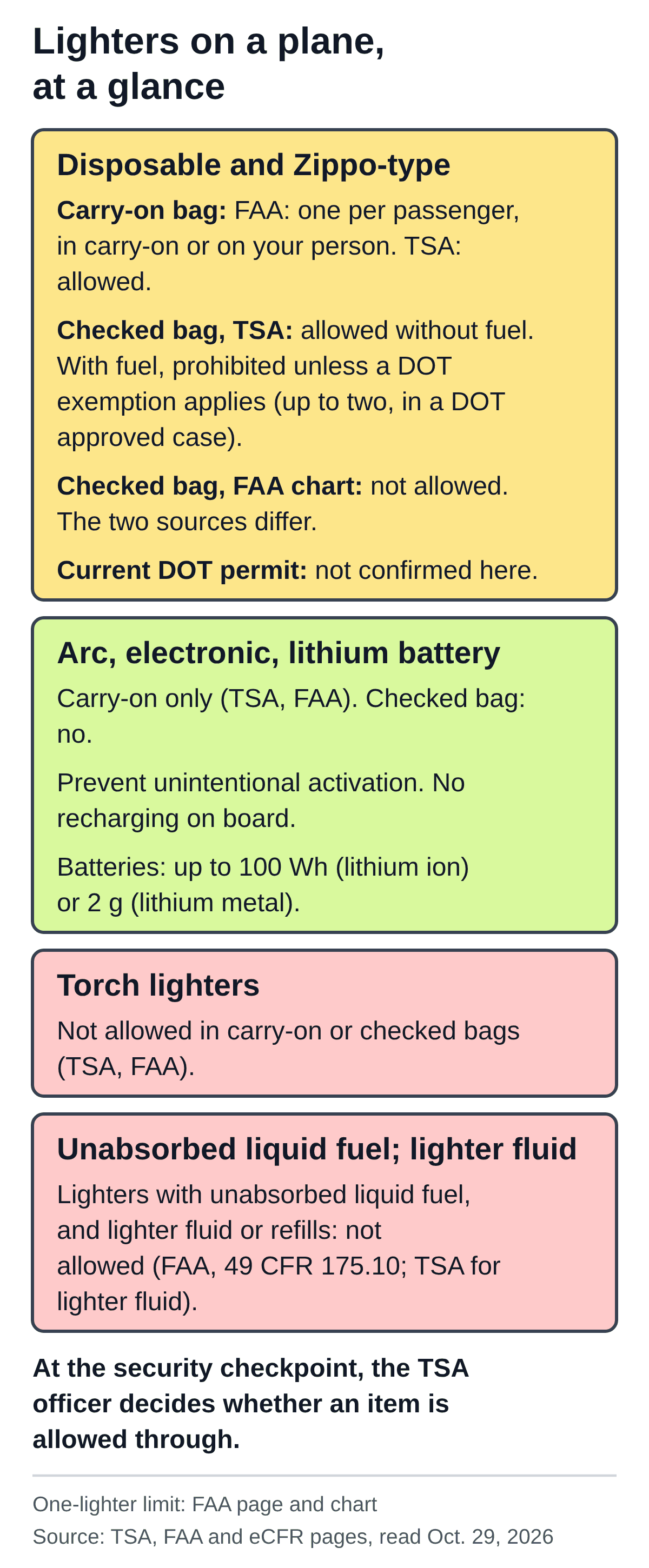
    Diagram of what TSA and the FAA say about lighters on a plane. Disposable and Zippo-type: carry-on allowed, one per passenger (FAA). Checked bags: TSA allows lighters without fuel and prohibits fueled ones unless a DOT exemption applies; the FAA chart says not allowed; a current DOT permit was not confirmed. Arc, electronic and lithium battery lighters: carry-on only. Torch lighters, lighters with unabsorbed liquid fuel and lighter fluid: not allowed. At the security checkpoint, the TSA officer decides whether an item goes through.

    Disposable and Zippo-type lighters

    The FAA’s page groups absorbed-liquid lighters and butane lighters, with Zippo-type and disposable lighters as its examples, and limits them to one lighter per passenger in carry-on or on one’s person. The FAA adds that when a carry-on bag is checked at the gate or at planeside, any lighter in the carry-on must be removed from the bag and kept with the passenger in the aircraft cabin.

    The regulation, 49 CFR 175.10(a)(2), covers a lighter intended for use by an individual when carried on one’s person or in carry-on baggage only. TSA’s page lists “Disposable and Zippo” lighters as “Yes” for carry-on bags.

    How many lighters

    The FAA’s page and its chart, updated November 14, 2025, both say one lighter per passenger for absorbed-liquid and butane lighters. The regulation says “a lighter” in the singular. TSA’s page for disposable and Zippo lighters does not state a number. This article therefore attributes the one-lighter limit to the FAA and the regulation.

    Checked bags: where TSA’s and the FAA’s wording differs

    TSA’s page for disposable and Zippo lighters lists checked bags as “Yes (Special Instructions).” The instructions have two parts. Lighters without fuel are allowed in checked bags. Lighters with fuel are prohibited in checked bags unless they adhere to the Department of Transportation exemption, which TSA says allows up to two fueled lighters if properly enclosed in a DOT approved case.

    The FAA’s chart, updated November 14, 2025, says “Not allowed in Checked Bags” in its lighters row. The FAA’s web page describes these lighters as carried in a carry-on bag or on one’s person, the regulation says the same, and the FAA’s pages do not mention the exemption. So for checked bags, TSA’s page gives a conditional answer and the FAA’s chart does not allow them. This article shows both and does not choose between them.

    What this article could not confirm. TSA’s page does not name the exemption, the approval behind it or the cases that qualify, and the FAA’s pages do not mention it. This article did not find a permit document that it could confirm as current, so it does not say whether the exemption applies today, does not explain how it works and does not say that a particular case qualifies. TSA’s page, the FAA’s page and chart, and the regulation all allow a disposable or Zippo-type lighter in a carry-on bag.

    Arc, electronic and other lithium battery powered lighters

    TSA has two pages for these lighters. The page for arc, electronic and e-lighters lists carry-on as “Yes (Special Instructions)” and checked bags as No. The page for lithium battery powered lighters lists carry-on as Yes and checked bags as No, and has no further text.

    TSA’s arc and electronic page says measures must be taken to prevent unintentional activation of the heating element while on board. Its examples are removing the battery from the lighter, placing the lighter into a protective case, and using a protective cover, safety latch or locking device on the activation button. Each lithium ion battery must not exceed 100 Wh, and each lithium metal battery must not exceed 2 grams of lithium. Recharging the device or its batteries on board is not permitted.

    The FAA’s page says lithium battery powered lighters (it lists Tesla coil, flux, arc and double arc lighters) are allowed in carry-on only, with the same activation measures, battery limits and no recharging on board. The regulation adds that the batteries must meet the tests in the UN Manual of Tests and Criteria, Part III, Subsection 38.3, and that the lighters must have a safety cap or similar protection against unintentional activation. For the rules on power banks, see the TSA and FAA rules for power banks.

    Torch lighters

    TSA lists torch lighters as No for carry-on bags and No for checked bags. Its page describes them as making a thin, needle-like flame that is hotter (reaching 2,500 F) and more intense than the flame from common lighters. The FAA’s page says torch lighters are not allowed in the cabin or in checked baggage under both the Hazardous Materials Regulations and TSA security rules, and its chart lists torch lighters as not allowed in carry-on or checked bags.

    One naming detail: the FAA’s page lists “butane lighters” among the other names for torch lighters, while its entry for butane lighters, with disposable lighters as an example, allows one per passenger. TSA’s torch page does not use that name. This article uses “torch lighter” for the kind TSA describes as making a thin, needle-like flame.

    Lighters with unabsorbed liquid fuel, and lighter fluid

    The FAA’s page says lighters that use liquid fuel but do not have an absorbent lining, such as desk and table lighters and antique wick lighters, are forbidden. The regulation says lighter fuel, lighter refills and lighters containing unabsorbed liquid fuel (other than liquefied gas) are not permitted on one’s person or in carry-on or checked baggage. TSA’s page for lighter fluid lists carry-on bags as No and checked bags as No.

    The TSA officer

    TSA’s pages say the final decision rests with the TSA officer on whether an item is allowed through the checkpoint. That statement is about screening at the security checkpoint. TSA’s page for disposable and Zippo lighters also says that questions about regulations can be taken to the FAA’s website.

    What this article does not cover

    This article does not cover matches, e-cigarettes and vaping devices, camping stoves, butane canisters, mailing a lighter, other countries’ rules, any airline’s own policy, or how to pack a lighter. It describes what the eight pages state on the date above and does not track changes to them.

    Sources

    All eight pages were checked on October 29, 2026. The FAA chart is a PDF.

  • Can You Bring Alcohol on a Plane? What TSA and the FAA Say

    TSA says alcoholic beverages are allowed in checked bags and in carry-on bags, but carry-on amounts are limited to 3.4 oz (100 ml). In checked bags, TSA says beverages with more than 24% but not more than 70% alcohol are limited to 5 liters (1.3 gallons) per passenger and must be in unopened retail packaging. TSA lists alcoholic beverages with more than 70% alcohol (over 140 proof) as not allowed in either carry-on or checked bags.

    This article covers what TSA’s and the FAA’s pages say. The wording is as of October 13, 2026, and comes from the five pages listed at the end. It describes the rules and does not give advice on what to pack.

    What TSA says for carry-on and checked bags

    WhereWhat TSA says
    Carry-on bagAllowed in amounts of 3.4 oz (100 ml) or less
    Checked bag, 24% alcohol or lessNot subject to limitations (TSA sets no separate alcohol limit for checked bags)
    Checked bag, more than 24% but not more than 70% alcoholLimited to 5 liters (1.3 gallons) per passenger, in unopened retail packaging
    Carry-on or checked bag, more than 70% alcohol (over 140 proof)Not allowed

    For carry-on bags, TSA’s page adds that mini bottles of alcohol must be able to comfortably fit into a single quart-sized bag. For the general carry-on liquids rule, see the TSA 3-1-1 liquids rule.

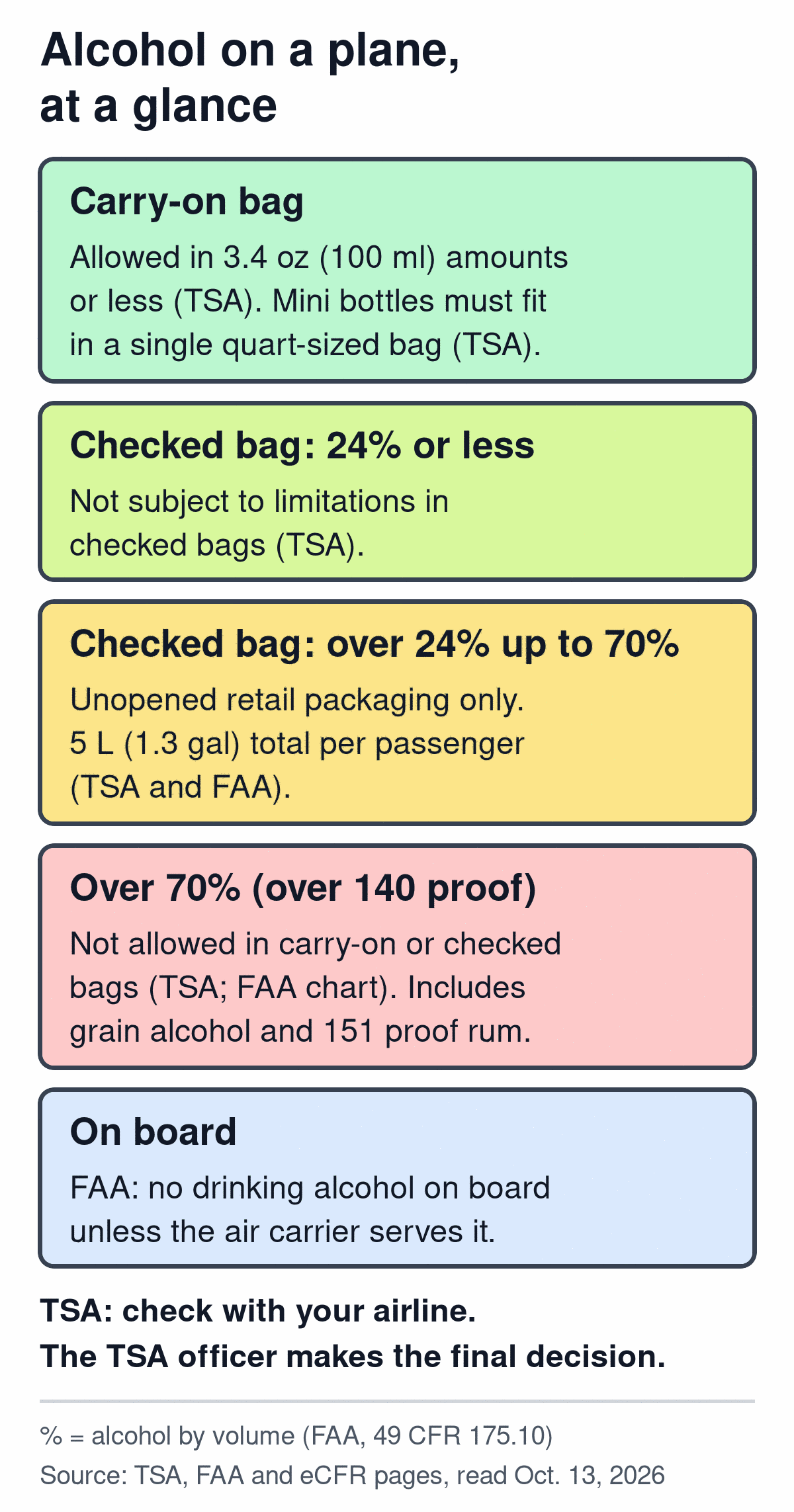
    Diagram of what TSA and the FAA say about alcohol on a plane. Carry-on: 3.4 oz (100 ml) or less. Checked bag: 24% alcohol or less is not subject to limitations; over 24% up to 70% needs unopened retail packaging and 5 liters total per passenger. Over 70% (over 140 proof): not allowed in carry-on or checked bags. On board: no drinking alcohol unless the air carrier serves it. Check with your airline.

    The 5-liter limit is a total per passenger

    For beverages with more than 24% but not more than 70% alcohol by volume (up to 140 proof), the FAA’s PackSafe pages say they must be in unopened retail packaging, with a limit of 5 liters per packaging and 5 liters in total per passenger. The regulation says the same: unopened retail packagings not exceeding 5 liters, and a total net quantity per person of 5 liters. So the 5 liters is a total for each passenger, not a limit per bottle. TSA’s page words it as 5 liters (1.3 gallons) per passenger for checked bags. A footnote on the FAA’s page says liquids, gels and aerosols in carry-on baggage are further limited to 100-ml (3.4 oz) containers at the TSA security checkpoint.

    Beverages with 24% alcohol or less

    TSA’s page says beverages with 24% alcohol or less are not subject to limitations in checked bags. That is TSA’s statement about checked bags only. It does not change the carry-on limit above, and it does not speak for any airline’s own policy. The regulation, 49 CFR 175.10(a)(4), covers beverages with not more than 24% alcohol by volume and does not state a quantity limit for them.

    Beverages with more than 70% alcohol

    TSA has a separate “What can I bring?” entry for alcoholic beverages over 140 proof. It defines them as alcoholic beverages with more than 70% alcohol (over 140 proof), including grain alcohol and 151 proof rum, and lists both carry-on bags and checked bags as “No.” The FAA’s PackSafe chart, updated November 14, 2025, has a row for alcoholic beverages over 140 proof, defined as greater than 70% alcohol by volume (more than 140 proof), and marks them as not allowed in carry-on or checked bags. The FAA’s separate web page on alcoholic beverages has the same heading and refers to the regulation, but its text does not state a rule. The regulation’s exception covers beverages up to 70% alcohol by volume.

    Drinking alcohol on board

    TSA says FAA regulations prohibit travelers from consuming alcohol on board an aircraft unless it is served by a flight attendant. The FAA’s page says passengers may not drink alcohol on board unless it is served by the air carrier. TSA adds that flight attendants are not permitted to serve a passenger who is intoxicated.

    Your airline and the TSA officer

    TSA says to check with your airline before bringing any alcoholic beverages on board. TSA’s pages also say the final decision rests with the TSA officer on whether an item is allowed through the checkpoint.

    What this article does not cover

    This article does not cover duty-free purchases, flights arriving from other countries, any airline’s own policy, or state and foreign laws about alcohol. It does not cover alcohol carried for sale, how to pack bottles, or how much to bring. This article describes what the five pages state on the date above and does not track changes to them.

    Sources

    All five pages were checked on October 13, 2026. The FAA chart is a PDF.

  • What Is TSA PreCheck? What It Changes at the Checkpoint

    TSA PreCheck is a TSA program that offers eligible travelers a speedier security experience in dedicated lanes across the U.S. TSA says that in a PreCheck lane you leave electronics and 3-1-1 liquids in your bag and leave on belts, light jackets and shoes. TSA also says no individual is guaranteed expedited screening.

    This article covers what TSA’s pages say. The wording is as of October 7, 2026, and comes from the three TSA pages listed at the end. It describes the program and does not recommend enrolling.

    What TSA says changes in a PreCheck lane

    ItemWhat TSA says with TSA PreCheck
    ElectronicsLeave in your bag
    Liquids in 3-1-1 bagsLeave in your bag (see the TSA 3-1-1 liquids rule)
    Belts, light jackets and shoesLeave on

    TSA’s FAQ adds that if a PreCheck lane is not available, a traveler with a PreCheck boarding pass may be able to keep 3-1-1 liquids and laptops in the bag and shoes and light jackets on in the standard lane. It says eligible passengers should check with the TSA officer on duty.

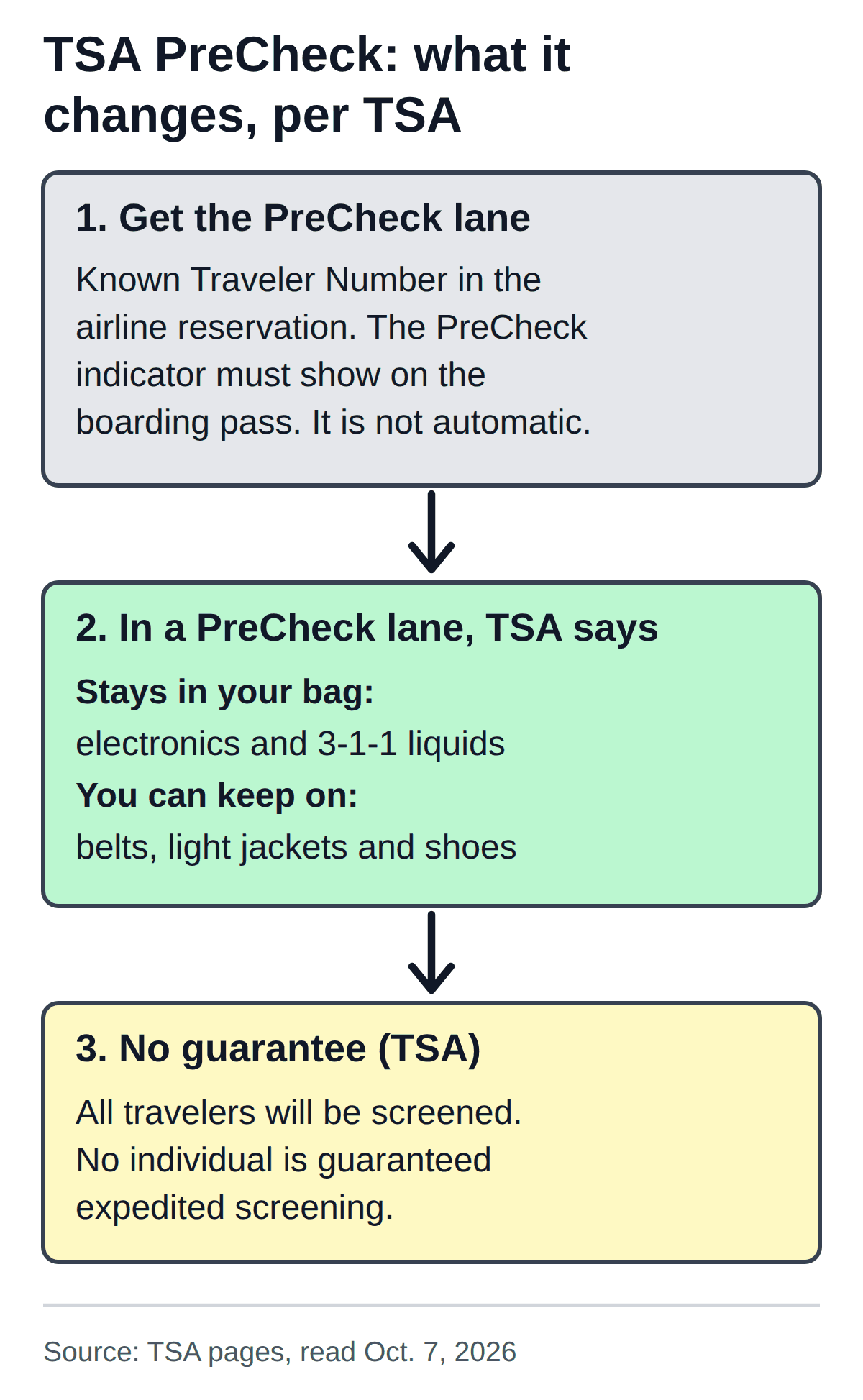
    Diagram of what TSA PreCheck changes, according to TSA, in three steps. Step 1: to get the PreCheck lane, a Known Traveler Number goes in the airline reservation and the PreCheck indicator must show on the boarding pass; benefits are not automatic. Step 2: in a PreCheck lane, electronics and 3-1-1 liquids stay in your bag, and you can keep belts, light jackets and shoes on. Step 3: all travelers will be screened, and no individual is guaranteed expedited screening.

    It is not guaranteed

    TSA says it uses unpredictable security measures, both seen and unseen, throughout the airport. It says all travelers will be screened, and no individual is guaranteed expedited screening. TSA’s FAQ gives the same answer to the question of whether an eligible traveler is guaranteed expedited screening: no.

    How the PreCheck lane works at the airport

    TSA says PreCheck benefits are not automatic. A Known Traveler Number (KTN) goes in the KTN field of the airline reservation, and TSA says the name on the reservation must match the name used at enrollment and the date of birth must be correct. TSA says the PreCheck indicator must be displayed on the boarding pass before a traveler can use the PreCheck lane.

    TSA also says that showing a Global Entry, NEXUS or SENTRI card, or a PreCheck approval notification, does not give access to the lane. TSA says Global Entry, NEXUS and SENTRI members use their PASS ID as the KTN, and it still has to be in the airline reservation.

    Children and families

    TSA says children 17 and under can join an adult in the PreCheck lane. Its FAQ gives the conditions. Anyone 18 and older needs their own KTN. Children 12 and under can join an adult in the lane, and the indicator does not have to be on their own boarding pass. Children 13 to 17 can join only when the indicator appears on their own boarding pass, which requires being on the same reservation as an adult whose boarding pass has it. TSA also says a parent who escorts a child through security with a gate pass is directed to standard screening.

    Membership and enrollment providers

    TSA says PreCheck memberships last five years and that it has three authorized enrollment providers: CLEAR, IDEMIA and Telos. This article does not cover prices, offers or how to enroll.

    What this article does not cover

    This article does not cover prices, renewal, enrollment steps or who is eligible. It does not say whether PreCheck is worth having, and it does not compare it with Global Entry or other programs. It does not cover TSA PreCheck Touchless ID, flights from the U.S. to other countries, or how the standard lane works for travelers without PreCheck. This article describes what TSA’s pages state on the date above and does not track changes to them.

    Sources

    All three pages were checked on October 7, 2026. None of them shows an update date.

  • Do You Need a REAL ID to Fly? What TSA Accepts

    No—not necessarily. You need an ID on TSA’s list, and a REAL ID-compliant state license or ID is one option. TSA says adults 18 and older must show valid identification at the airport checkpoint. A U.S. passport is also on the list. A state license or ID card must be REAL ID compliant to be on the list.

    This article covers what TSA’s pages say. The wording is as of October 7, 2026, and comes from the three TSA pages listed at the end. TSA says its list “is subject to change without notice” and encourages travelers to check it again before traveling.

    What TSA says about REAL ID

    TSA says REAL ID enforcement began on May 7, 2025. It says that as of that date, state-issued driver’s licenses and IDs that are not REAL ID compliant are no longer accepted as valid identification at airports. TSA’s REAL ID page says that a traveler using a state-issued driver’s license or ID card for a domestic flight must use one that is REAL ID compliant. TSA’s identification page also lists other acceptable forms of ID, including a U.S. passport.

    TSA’s identification page says that passengers should either travel with an acceptable alternative form of ID, like a passport, or enroll for a state-issued REAL ID through their state Department of Motor Vehicles (DMV). If you are not sure whether your ID complies with REAL ID, TSA says to check with your state DMV. TSA also says a temporary driver’s license is not an acceptable form of identification.

    Examples of IDs on TSA’s list

    TSA’s list has many more entries than these. The examples below are taken from it.

    IDWhat TSA says
    State-issued REAL ID-compliant driver’s license or ID cardOn the list
    State-issued Enhanced Driver’s License or Enhanced IDOn the list
    State-issued license or ID that is not REAL ID compliantNo longer accepted at airports as of May 7, 2025
    Temporary driver’s licenseNot acceptable
    U.S. passport or U.S. passport cardOn the list
    DHS trusted traveler card (Global Entry, NEXUS, SENTRI, FAST)On the list
    U.S. Department of Defense ID, including IDs issued to dependentsOn the list
    Permanent resident cardOn the list
    Photo ID issued by a federally recognized Tribal NationOn the list
    Mobile driver’s licenseTSA accepts certain ones issued by states approved for federal use; the mobile license must be based on a REAL ID, an Enhanced Driver’s License or an Enhanced ID
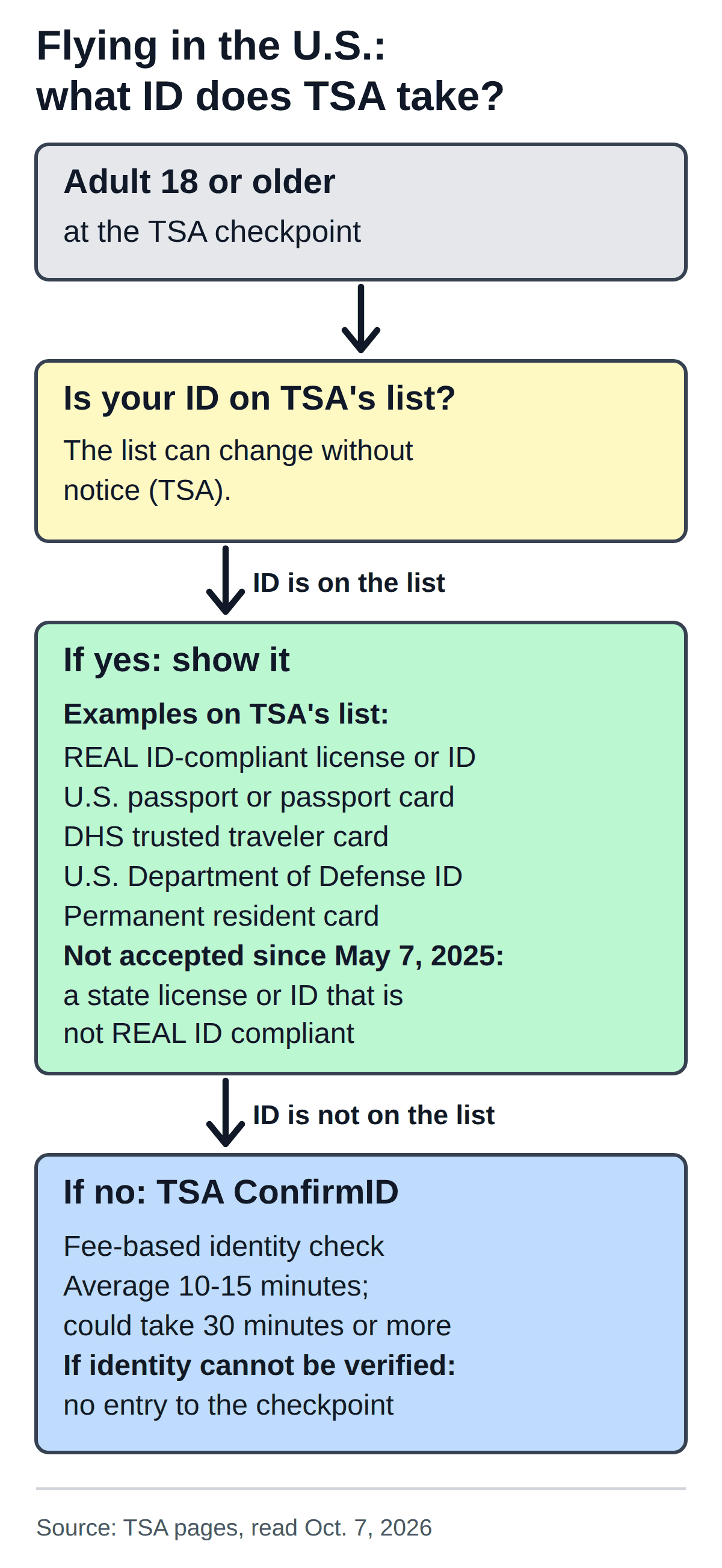
    Flowchart of what ID TSA takes. An adult 18 or older checks whether the ID is on TSA's list, which can change without notice. If yes, show it; examples are a REAL ID-compliant license or ID, a U.S. passport or passport card, and a DHS trusted traveler card. Since May 7, 2025, a state license or ID that is not REAL ID compliant is not accepted. If the ID is not on the list, the fee-based TSA ConfirmID option averages 10 to 15 minutes and could take 30 minutes or more; if identity cannot be verified, there is no entry to the checkpoint.

    Expired ID and children

    TSA says it currently accepts expired ID up to two years after expiration, for the forms of identification on its list.

    TSA says it does not require children under 18 to provide identification when traveling within the United States. It adds that unaccompanied minors who are eligible for TSA PreCheck must show an acceptable ID to receive expedited screening, and it tells families to contact the airline about its own ID requirements for travelers under 18.

    If you do not have an acceptable ID

    TSA says that starting February 1, 2026, a traveler who cannot provide an acceptable ID at a checkpoint has the option to pay a fee to use TSA ConfirmID, and that TSA will then attempt to verify the traveler’s identity. TSA describes ConfirmID as a fee-based service. It says the process takes an average of 10 to 15 minutes, but could take 30 minutes or more. TSA also says that if your identity cannot be verified, you will not be allowed to enter the screening checkpoint.

    What this article does not cover

    This article does not cover how to get a REAL ID, because the steps depend on the state; TSA’s REAL ID page links each state’s plan. It does not cover international travel, airline ID rules, access to federal facilities, immigration status, or the fee for ConfirmID. It does not list every ID TSA accepts and does not cover digital ID programs beyond the mobile license condition above. It gives no advice on what to do. This article describes what TSA’s pages state on the date above and does not track changes to them.

    Sources

    All three pages were checked on October 7, 2026. None of them shows an update date.