TSA and the FAA both say vapes and other electronic smoking devices go in carry-on baggage, not in checked bags. TSA’s page lists them as “Carry On Bags: Yes (Special Instructions)” and “Checked Bags: No.” The FAA’s PackSafe page says they must be carried on one’s person or in carry-on baggage, and that passengers must take effective measures to prevent accidental activation of the heating element.
This article covers what four official sources say about vapes, e-cigarettes, vape pens and similar devices: TSA’s “Electronic Cigarettes and Vaping Devices” page, the FAA’s PackSafe page for the same devices, an FAA news item from 2020, and the federal regulation they cite, 49 CFR 175.10(a)(19). The wording is as of November 6, 2026. It does not cover airline policies, other countries, cannabis products or age limits.
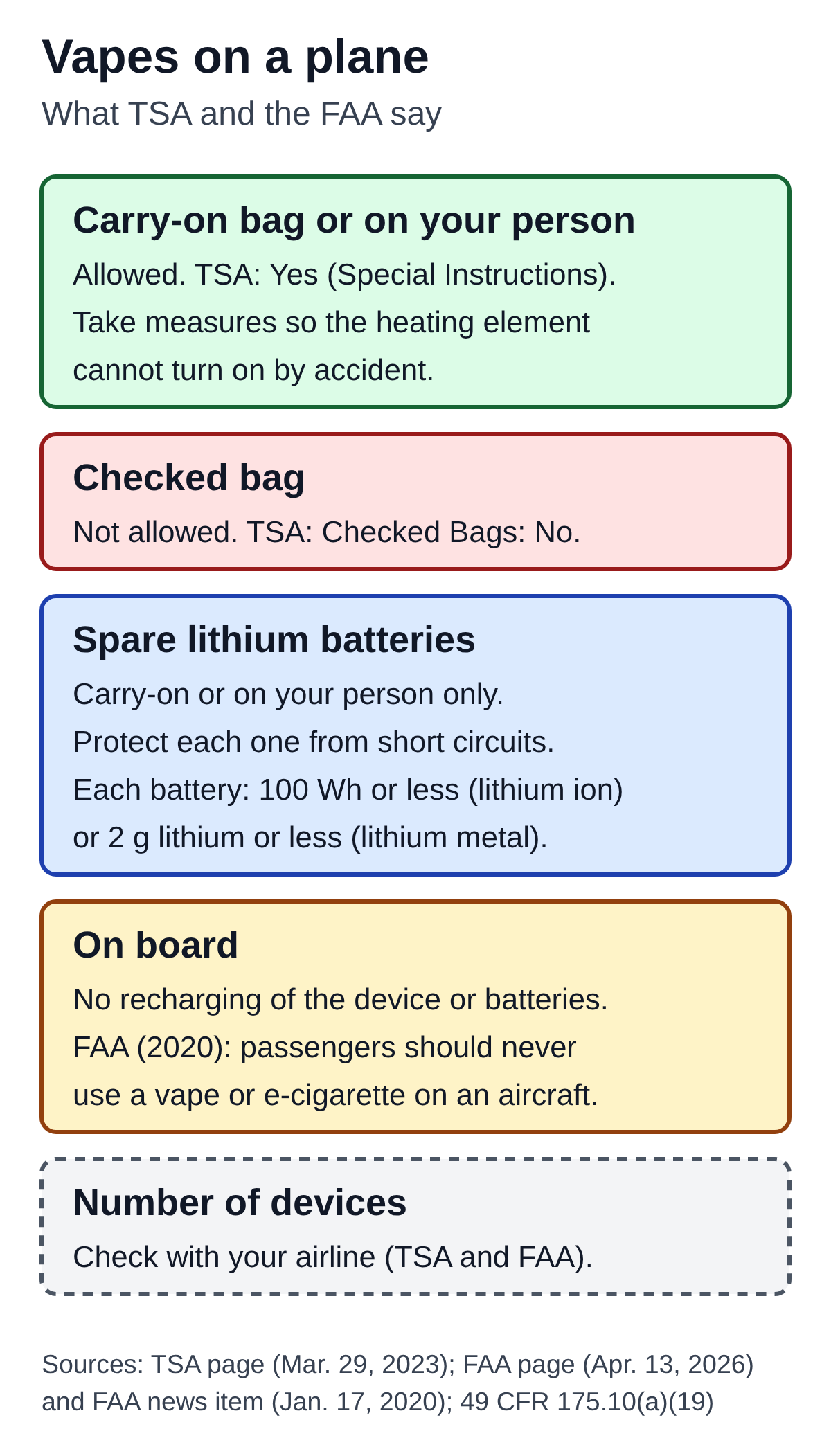
What the sources say, in one table
| Question | What the sources say |
|---|---|
| In a carry-on bag or on your person? | TSA: carry-on “Yes (Special Instructions).” FAA and the regulation: devices must be carried on one’s person or in carry-on baggage |
| In a checked bag? | TSA: “Checked Bags: No.” The regulation: on one’s person or in carry-on baggage “only” |
| Spare lithium batteries? | FAA and the regulation: on one’s person or in carry-on baggage only, each protected from short circuits |
| Battery size? | TSA, FAA and the regulation: each lithium ion battery 100 Wh or less; each lithium metal battery 2 grams of lithium or less |
| Charging on board? | FAA and the regulation: recharging the devices or batteries on board is not permitted |
| Using it on board? | FAA news item, January 17, 2020: passengers “should never use” vapes or e-cigarettes on an aircraft |
| How many devices? | TSA and FAA: check with your airline on any limits on the number of devices |
Carry-on only
TSA’s page says electronic smoking devices are allowed only in carry-on baggage. The FAA’s page says the devices must be carried on one’s person or in carry-on baggage, and the regulation says the same with the word “only.” In a 2020 news item, the FAA said vapes, e-cigarettes and spare lithium batteries must be placed in carry-on luggage only, and described the devices as hazardous materials when transported on aircraft. It added that they contain lithium batteries that pose a fire risk.
Preventing accidental activation
TSA says passengers are required to take effective measures to prevent accidental activation of the heating element and points to the FAA regulations for examples. The FAA’s page, which describes these devices as battery powered with a heating element that vaporizes liquid, lists examples that include, but are not limited to: removing the battery from the device; separating the battery from the heating coil; putting the device in a protective case; using a protective cover, safety latch or locking device on the heating coil activation button; and electronics in the device designed to prevent accidental activation, such as requiring the device to be powered on before the coil button works.
Spare batteries
The FAA and the regulation say spare lithium batteries must also be carried on one’s person or in carry-on baggage only, and must be individually protected so they cannot short-circuit. The FAA lists these methods: leaving the batteries in their retail packaging, covering the battery terminals with tape, using a battery case, using a battery sleeve in a camera bag, or putting them snugly in a plastic bag or protective pouch. TSA, the FAA and the regulation all give the same size limits: each lithium ion battery 100 watt-hours (Wh) or less, and each lithium metal battery 2 grams of lithium or less. The rules for spare batteries in general, including power banks, are covered in Can You Bring a Power Bank on a Plane? TSA and FAA Rules.
Charging and use on board
The FAA’s page and the regulation say recharging the devices or their batteries on board the aircraft is not permitted. On use, the FAA’s January 17, 2020 news item says that just as passengers are not allowed to smoke cigarettes on an aircraft, they should never use their vapes or e-cigarettes on an aircraft, and calls it “a federal offense.” That is a statement in a 2020 FAA news item. It does not cite a regulation, so this article does not name one.
What the pages do not say
TSA and the FAA both say to check with your airline on any limits on the number of devices a passenger can carry for personal use; neither gives a number. None of the pages read mentions e-liquid or refill bottles, and none names disposable vapes as a separate type, so this article does not say anything about them. TSA also says the officer makes the final decision on whether an item goes through the checkpoint.
Sources
All four sources were read on November 6, 2026.
- TSA, “Electronic Cigarettes and Vaping Devices,” What Can I Bring? (page shows “Last Updated on March 29, 2023”). https://www.tsa.gov/travel/security-screening/whatcanibring/items/electronic-cigarettes-and-vaping-devices
- FAA PackSafe, “Electronic Cigarettes, Vaping Devices” (page shows “Last updated: Monday, April 13, 2026”). https://www.faa.gov/hazmat/packsafe/e-cigarettes-vaping
- FAA, “Vapes on a Plane?” news item dated January 17, 2020. https://www.faa.gov/newsroom/vapes-plane
- eCFR, 49 CFR 175.10(a)(19) (page shows “up to date as of 11/04/2026”). https://www.ecfr.gov/current/title-49/subtitle-B/chapter-I/subchapter-C/part-175/subpart-A/section-175.10