Yes, but only in a carry-on bag. TSA says power banks are not allowed in checked luggage. The FAA limits a spare battery or power bank to 100 watt hours (Wh) per battery, and says larger batteries of 101 to 160 Wh need airline approval.
This article covers what TSA’s and the FAA’s pages say. The wording is as of October 7, 2026, and comes from the three pages listed at the end. Your airline may have stricter rules of its own.
Where a power bank goes
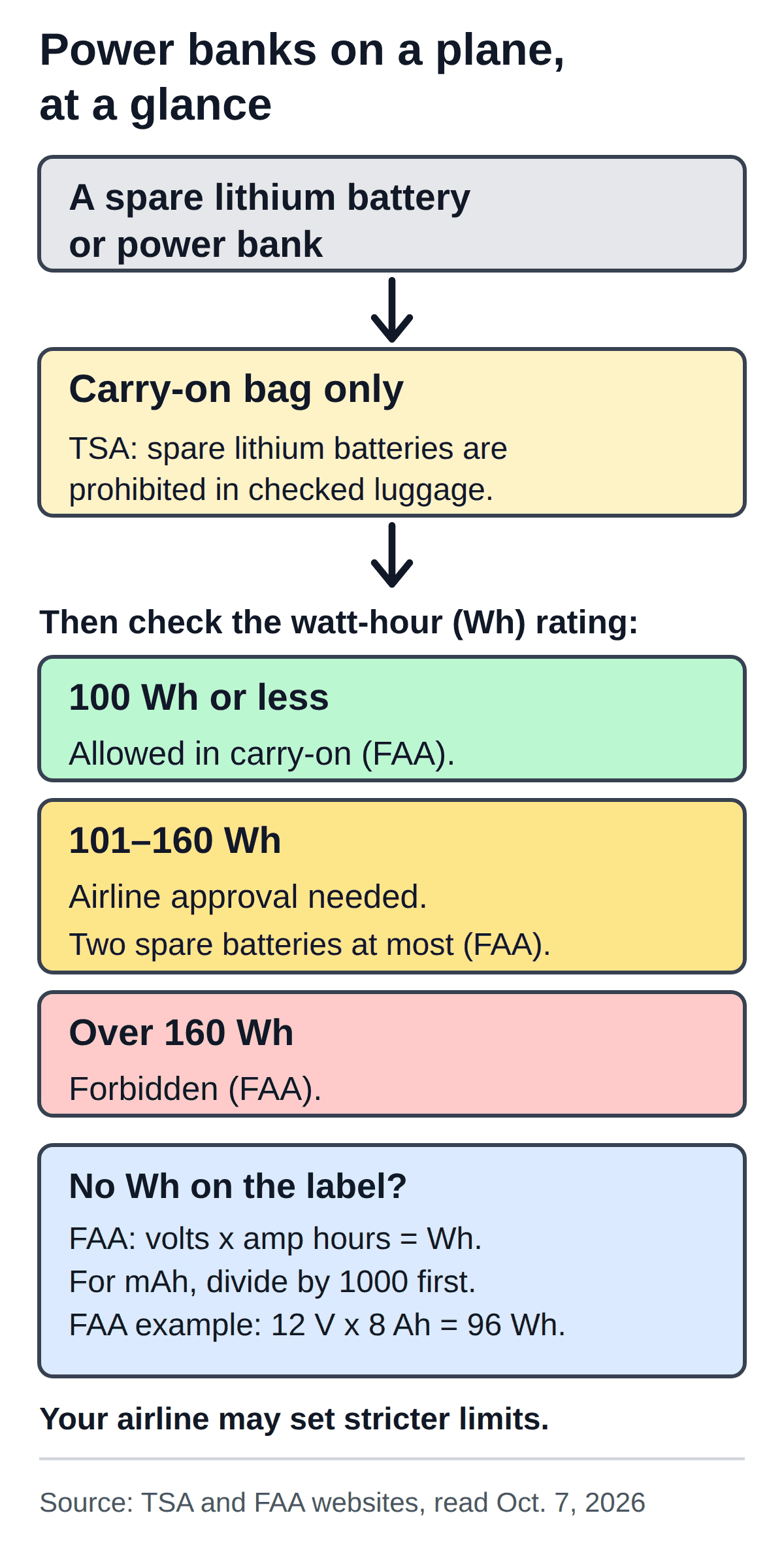
TSA says portable chargers and power banks containing a lithium ion battery must be packed in carry-on bags. It adds that spare lithium batteries, which include both power banks and phone chargers, are prohibited in checked luggage. The FAA’s table agrees: carry-on yes, checked bags no, and the battery must be protected from damage and short circuit.
How big a power bank can be
The FAA says a spare battery or power bank is limited to 100 Wh per battery. With airline approval, a passenger may also carry up to two spare larger lithium-ion batteries of 101 to 160 Wh. TSA’s page on batteries over 100 Wh says the same thing, and says the limit is two of those larger batteries per person.
| Battery rating | What the FAA says |
|---|---|
| Up to 100 Wh | Allowed in carry-on |
| 101 to 160 Wh | Needs airline approval; two spare batteries per person at most |
| Over 160 Wh | Forbidden |
The FAA’s FAQ also says there is no limit on the number of rechargeable batteries under 100 Wh carried for personal use. Batteries carried for sale or distribution are prohibited.
How to find the watt-hour number
The FAA says a battery’s Wh should be marked on the battery. If it is not, multiply the volts (V) by the amp hours (Ah). For a rating in milliamp hours (mAh), divide by 1000 to get amp hours first, then multiply by the volts. The FAA’s example is a 12-volt battery rated at 8 Ah, which is 96 Wh (12 x 8 = 96).
Your airline may be stricter
The FAA says that TSA, individual airline and international rules may at times be more restrictive than its own. It adds that many airlines may have stricter limits on how many power banks a passenger can carry, regardless of Wh capacity, and tells passengers to check with their airline before traveling.
At the checkpoint, TSA says the final decision rests with the TSA officer on whether an item is allowed through.
The FAA also says damaged or recalled batteries must not be carried aboard an aircraft unless the battery has been removed or otherwise made safe.
What this article does not cover
This article does not cover using a power bank during a flight, any airline’s own policy, international flights, other battery types such as lithium metal batteries or e-cigarettes, or wheelchair batteries. It does not recommend products. Liquids have their own TSA rule, covered in the TSA 3-1-1 liquids rule. This article describes what the agencies’ pages state on the date above and does not track changes to them.
Sources
All three pages were checked on October 7, 2026. TSA’s “Power Banks” page shows “Last Updated on May 14, 2025.” TSA’s page on batteries over 100 watt hours shows “Last Updated on March 29, 2023.” The FAA page shows “Last updated: Friday, October 2, 2026.”
- TSA, “Power Banks.” https://www.tsa.gov/travel/security-screening/whatcanibring/items/power-banks
- TSA, “Lithium batteries with more than 100 watt hours.” https://www.tsa.gov/travel/security-screening/whatcanibring/items/lithium-batteries-more-100-watt-hours
- FAA PackSafe, “Airline Passengers and Batteries.” https://www.faa.gov/hazmat/packsafe/airline-passengers-and-batteries