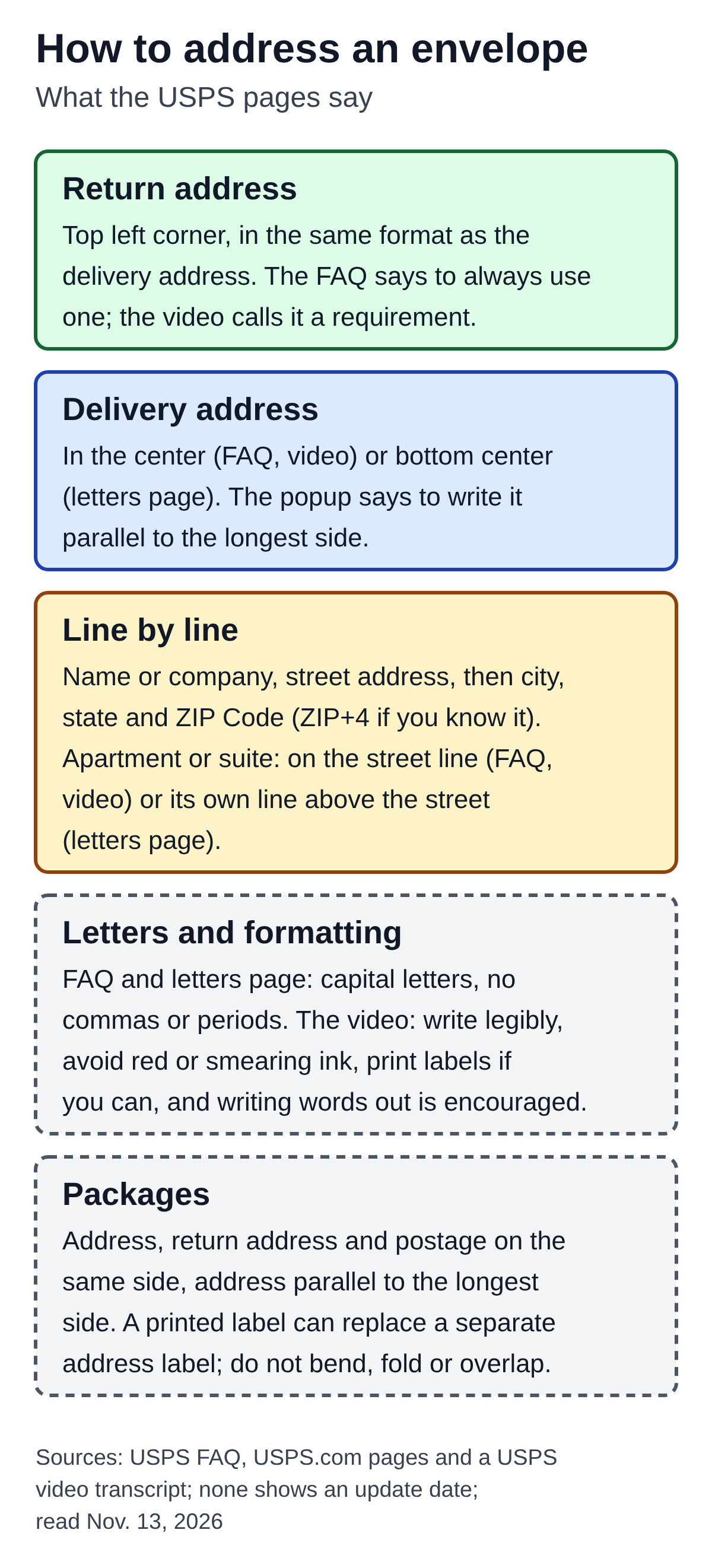
USPS’s pages agree on the basics: put the return address in the top left corner, put the delivery address in the middle of the envelope (one page says “bottom center”), and end the address with the city, state and ZIP Code, using ZIP+4 if you know it. They differ on smaller points, such as where an apartment number goes and whether to write words out or abbreviate.
This article covers what five USPS pages say: the FAQ “Addressing Mailpieces” (Article 000008202), the USPS.com page “How to Send a Letter or Postcard,” the short USPS.com popup on addressing an envelope, the transcript of the USPS video “How to Address a Package,” and step 4 of the USPS.com page “How to Prepare & Send a Package.” None of the five shows an update date. The wording is as of November 13, 2026. The article shows where the pages differ instead of choosing one. It gives no postage prices (the letters page lists some, and they are not used here), and it leaves out the FAQ’s rules for mailers who get automation discounts.
Where each part goes
In the table below, each row names the page that makes the statement.
| Part | What the page says | Page |
|---|---|---|
| Return address | Top left corner | Letters page |
| Return address | Upper-left corner on the front of the envelope | Popup |
| Return address | “Above and to the left of” the recipient’s address | Video transcript |
| Delivery address | “Center of envelope” | FAQ |
| Delivery address | “Bottom center” of the envelope | Letters page |
| Delivery address | “In the center” | Video transcript |
| Delivery address | Parallel to the longest side of the envelope | Popup |
| Postage | Upper right corner | FAQ |
The pages do not say how far from the edge anything should sit, so “center” and “bottom center” are left as each page states them.
Line by line
The letters page lists four lines for both the return and the delivery address: the full name or company name, the apartment or suite number, the full street address, and the city, state and ZIP+4 Code (it also says to include the ZIP+4 Code “whenever possible”). The FAQ describes the same parts with one difference in order: it prefers the apartment, suite, room or floor number on the same line as, and after, the street address, and says the line above the street address is also allowed, “not below.” The video transcript agrees with the FAQ that the number “can be added on the same line.” So the pages allow the apartment number on the street line (FAQ, video), on its own line above the street (letters page and FAQ), but not below it (FAQ).
The FAQ also says to use two-letter state abbreviations and a ZIP+4 Code “if known,” and otherwise the ZIP Code, so the instruction when the ZIP+4 is not known is to use the five-digit ZIP Code. The video transcript points to the USPS.com Look Up a ZIP Code tool if the ZIP+4 is unknown. The FAQ says that leaving the ZIP Code off “causes unnecessary delay because it will require manual look-up.” For street directions such as north or south, the FAQ says to “always use applicable directionals,” and the video says directional words “are required.”
A fictional example
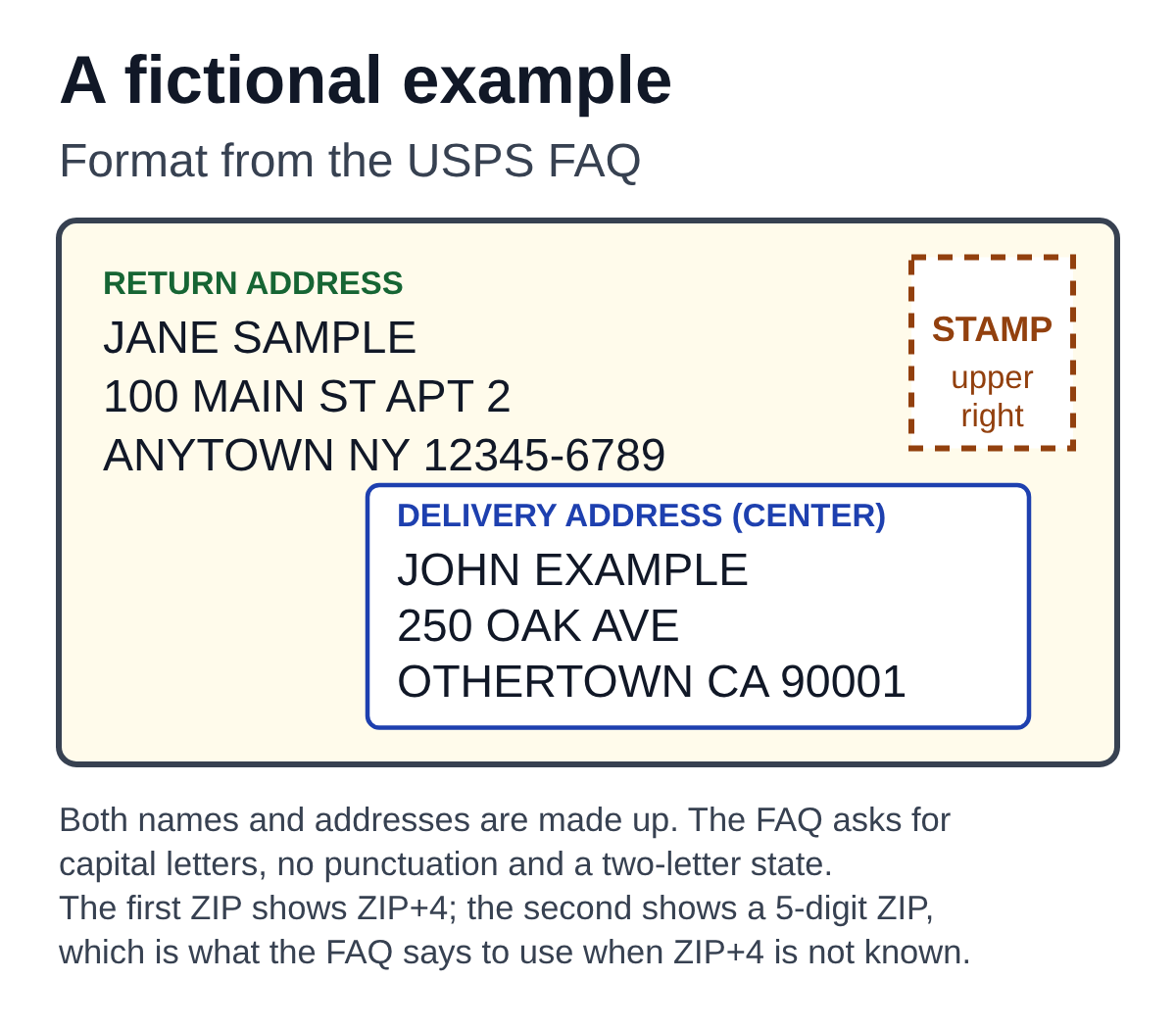
The picture below shows one envelope laid out the way the FAQ describes it. The names and addresses are made up. The return address (Jane Sample) is in the top left corner, the stamp is in the upper right corner, and the delivery address (John Example) is in the center. Both are in capital letters with no punctuation, two-letter states, and the apartment number on the street line after the street address. The return address shows a ZIP+4 Code; the delivery address shows only a five-digit ZIP Code, which is what the FAQ says to use when the ZIP+4 is not known. If you prefer the letters page’s layout, the apartment number goes on its own line above the street address, and that page puts the delivery address “bottom center” instead of in the center.
Capital letters, punctuation and abbreviations
The FAQ says: “Use all CAPS, spaces between words, no punctuation, and left justify the margin.” The letters page says to print neatly in capital letters and not to use commas or periods, with a pen or permanent marker. The video transcript does not mention capital letters. It says to write legibly, that USPS scanners “can decipher most handwriting styles and printed font types,” and to avoid red pen or ink that smears. For typed or printed addresses, the FAQ suggests 10, 12 or 14 point type.
On abbreviations the pages lean different ways. The FAQ says to “always use applicable abbreviated locators,” such as APT, ST and AVE. The video transcript says the shortened forms for street, road, drive and avenue can be used, “but writing the words is encouraged.”
The return address
The FAQ’s first guideline is “Always use a return address,” because an undeliverable letter can then be returned. The video transcript calls the return address “a requirement.” Further down, the FAQ says a return address is “required on certain types of mail” and points to the Domestic Mail Manual for the list. The pages do not reconcile “always” and “a requirement” with “certain types of mail,” so the article leaves them side by side.
The FAQ adds a rule dated December 14, 2023: USPS no longer accepts items shipped domestically with a foreign return address, and “domestic shipments can only have a domestic return address.” A foreign address can only be used when shipping an item internationally, with the appropriate customs form.
Packages and labels
The popup says the address, return address and postage should all be on the same side of the package, and warns that if it is improperly addressed, it “might get returned to you.” The USPS.com package page says to write the address parallel to the longest side and to make sure the return address, the delivery address and the postage fit on the same side. It adds that a printed shipping label can be used instead of a separate address label, that all labels go on the same side, and that labels should not be bent, folded or overlapped. For stamps on an envelope, see our Forever stamp article.
Postcards and special addresses
For postcards, the letters page says to write the delivery address in the space provided, on the same side as the message and the stamp. The same page has short sections for special addresses. A Puerto Rico address with an urbanization code (URB) is written on four lines. The U.S. Virgin Islands abbreviation is “VI,” not “US VI” or “USA VI.” For military and diplomatic addresses (APO, FPO and DPO) in another country, the page says not to include the city or country name, but to include unit and box numbers if they are assigned. The page links to more details on secondary addresses and on military addresses, which this article did not read.
What the pages do not say
None of the five pages shows an update date. The FAQ gives no date at all, and the letters page, popup and video transcript give none. The FAQ mixes consumer guidance with rules for mailers (automation discounts, barcode areas, precanceled stamps, Periodicals and nonprofit mail), and this article leaves the mailer rules out. No page says what happens to an envelope addressed in lowercase or with punctuation; the popup says only that an improperly addressed package “might get returned to you.” The video transcript does not mention capital letters, while the FAQ and the letters page ask for them, and the pages do not explain the difference.
Sources
- USPS FAQ, “Addressing Mailpieces” (Article 000008202, no update date): https://faq.usps.com/articles/Knowledge/Addressing-Mailpieces
- USPS.com, “How to Send a Letter or Postcard” (no update date): https://www.usps.com/ship/letters.htm
- USPS.com, address an envelope popup (no update date): https://www.usps.com/send/address-an-envelope-popup.htm
- USPS video transcript, “How to Address a Package” (no update date): https://www.usps.com/assets/transcripts/usps-how-to-address-a-package.txt
- USPS.com, “How to Prepare & Send a Package,” step 4 (no update date): https://www.usps.com/ship/packages.htm