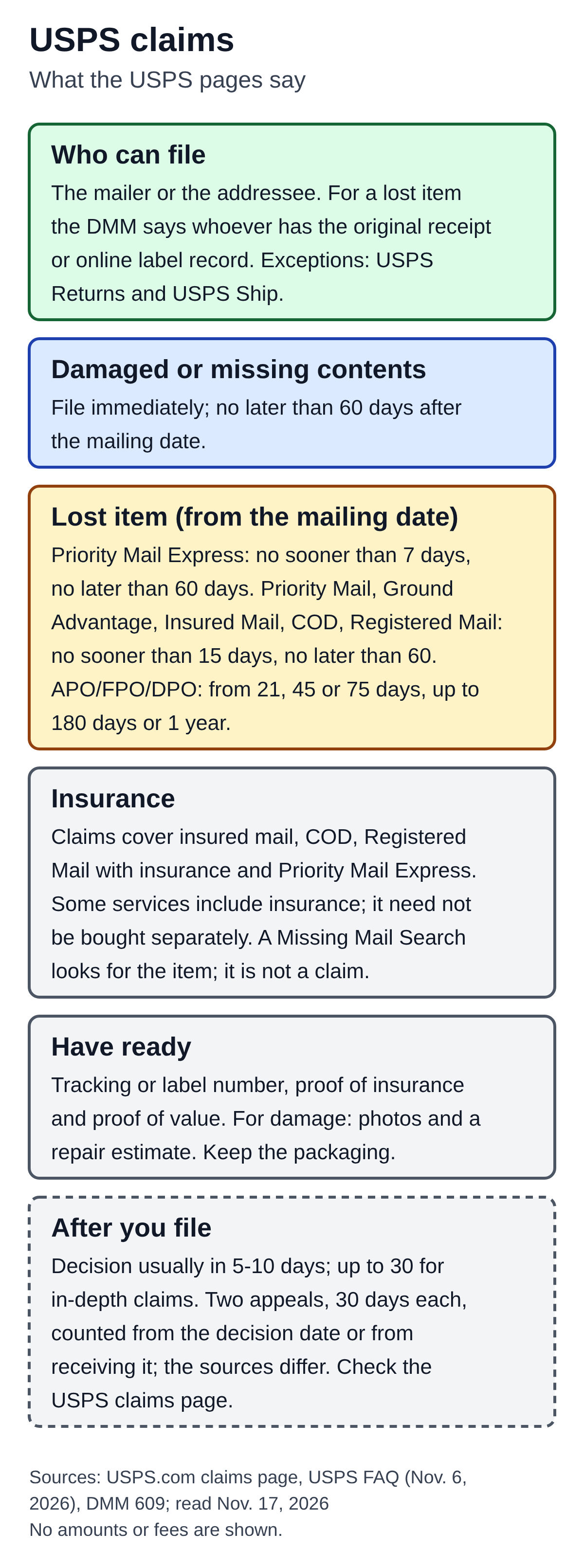
USPS says a claim for damaged mail or missing contents can be filed immediately but no later than 60 days after the mailing date, and a claim for an item that never arrives has a window set by service. For Priority Mail and USPS Ground Advantage, USPS’s chart says to file no sooner than 15 days and no later than 60 days after mailing.
This article compares what three official sources say about a domestic insurance claim: the USPS.com page “File a Claim” (no update date), the USPS FAQ “Domestic Claims – The Basics” (Article 000006089, dated November 6, 2026) and section 609 of the Domestic Mail Manual (DMM), “Filing Indemnity Claims for Loss or Damage” (no update date). It also uses one line from USPS.com’s “Shipping Insurance and Delivery Services” page. The wording is as of November 17, 2026. The sources overlap but are not identical, and the article shows where they differ instead of choosing one. It gives no prices, fees or payment limits. It does not cover international claims, bulk claims, or Priority Mail Express details. For a search for mail that has not arrived, see our Missing Mail article, which covers the search and points to USPS’s claims page.
Who can file
USPS.com says: “Either the sender or the recipient may file a claim for insured mail that is lost, arrived damaged, or was missing contents. The person filing must have the original mailing receipt.” The FAQ says either the mailer or the addressee may file for a damaged or missing article. If the mailer files for a damaged article that is still with the recipient, the FAQ says the recipient must keep the article and its container until the claim is resolved. If both file, payment goes to the party who submits first and whose claim is approved.
The DMM is more specific. For damaged articles or missing contents, either the mailer or the addressee may file. For lost articles, it says either one may file if they have “the original retail mailing receipt” or the online label record or computer printout. It also lists cases with a single eligible filer: only the account holder for insured USPS Returns packages, only the mailer when the mailer added and paid for insurance on USPS Returns packages, and only the mailer for insured or collect on delivery (COD) parcels paid using USPS Ship. The FAQ adds that claims without a mailing receipt can be filed, but payment may be limited; the DMM likewise says that if only the outer packaging is submitted as evidence of insurance, indemnity can be limited. Both give dollar limits by service, which this article does not repeat.
When to file
All three sources split the rule in two. For damaged mail or missing contents: file immediately, and no later than 60 days from the mailing date. USPS.com says the filing period “is based on the mailing date on your receipt.” For a lost item, USPS.com says: “file a claim in the time period for the service you used.” The chart on USPS.com and in the FAQ gives each service a “File After” (or “No Sooner Than”) day and a “File Before” (or “No Later Than”) day, counted from the mailing date.
| Service in the chart | No sooner than | No later than |
|---|---|---|
| Priority Mail Express | 7 days | 60 days |
| Priority Mail Express COD | 15 days | 60 days |
| Priority Mail | 15 days | 60 days |
| USPS Ground Advantage | 15 days | 60 days |
| Insured Mail | 15 days | 60 days |
| Collect on Delivery (COD) | 15 days | 60 days |
| Registered Mail and Registered COD | 15 days | 60 days |
| APO/FPO Priority Mail Express Military Service | 21 days | 180 days |
| APO/FPO/DPO Insured Mail and Registered Mail | 45 days | 1 year |
| APO/FPO/DPO Insured Mail (surface only) | 75 days | 1 year |
The three sources do not match in every detail. The DMM chart lumps domestic Priority Mail into one row, “Insured Mail (including Priority Mail under 503.4.2),” and has no separate domestic Ground Advantage row; USPS.com and the FAQ list Priority Mail and USPS Ground Advantage as separate rows with the same numbers. The FAQ marks three rows with an asterisk: bulk claims submitted through the Business Customer Gateway should be filed no sooner than 15 days. USPS.com’s insurance page says, for Priority Mail and Ground Advantage, that when an item is lost you should file “no later than 60 days from the date of mailing,” and gives no opening day; the claims page gives the day 15 opening. The pages do not say why a lost-item claim cannot be filed sooner, or when an item counts as lost.
Does the item need insurance?
USPS.com says eligible items include Priority Mail Express items and other insured mail, COD items, and Registered Mail with insurance, and that “your insurance may have been included with the USPS service or purchased separately.” USPS.com’s insurance page says Priority Mail and USPS Ground Advantage include insurance (the page gives the amount) when the domestic shipment has an applicable USPS Tracking barcode; the tracking status article explains tracking statuses, and our Priority Mail vs. Ground Advantage article compares the two services. DMM section 503 says: “Except for Priority Mail pieces with included insurance, no insurance coverage is provided when purchasing Certified Mail.” Our Certified Mail article covers that service.
Insurance does not have to be bought separately: as quoted above, it may have been included with the service. The claims the sources describe are for insured mail, COD items, Registered Mail with insurance and Priority Mail Express items (USPS.com’s list of eligible items and DMM 609.1.1), so the insurance requirement below applies to those; COD and Registered Mail rules are only touched on in this article. What the sources rule out is a claim for an item with no insurance at all. USPS.com says USPS “may not legally pay compensation for uninsured lost or damaged articles.” The FAQ says that “if insurance is not purchased at the time of mailing,” USPS “is unable to honor any requests to be compensated”; the same FAQ lists Priority Mail and USPS Ground Advantage as including insurance in the price of postage, and this article does not reconcile the two wordings. Your receipt or label record is what shows whether the package was insured (see below). A Missing Mail Search, which USPS.com offers for uninsured mail that is missing or delayed, is a search for the item and not a claim for payment.
What to have ready
USPS.com lists a tracking or label number (13 to 34 characters, found on your online label record, package label, mailing receipt or sales receipt), evidence of insurance, proof of value, and for damage, proof of damage. Evidence of insurance can be the original mailing receipt, the outer packaging showing the sender’s and addressee’s names and addresses and the proper insured label, or a printed electronic online label record. Proof of value can be a sales receipt, a paid invoice or bill of sale, a statement of value or repair estimate from a reputable dealer, a credit card statement, or a printout of an online transaction that shows the purchaser, seller, price, date, item and that the transaction is completed.
Two points differ between sources. USPS.com says “the original mailing receipt” is needed; the DMM says that for insured and COD mail, a photocopy of the original mailing receipt is acceptable. And where USPS.com lists a printed online label record as evidence of insurance on its own, the DMM says that for a label bought online the printout must identify the tracking number, postage paid, insurance fee paid, declared value, mailing date, origin ZIP Code and delivery ZIP Code, and that a postmarked original mailing receipt or an electronic shipment acceptance scan followed by a valid acceptance or physical scan must also be available as evidence of mailing. For a mailed claim form with several extra services, the DMM says to provide original receipts for all of them.
For damage, USPS.com asks for photos that clearly show the extent of damage and, for damaged claims, an estimate of repair costs from a reputable dealer. It says to save the original packaging and everything in it until the claim is settled, not to throw out damaged items even after photographing them, not to reship items that were not damaged, and that you may be asked to take the entire package to a Post Office for inspection. The FAQ and the DMM say that if the claim is for missing contents or damage, the addressee must keep the mailing container, damaged articles, packaging and contents, and that failure to make them available when USPS asks in writing “will result in denial of the claim.”
How to file and what happens next
USPS.com says online is the fastest and easiest way: log in or create a free USPS.com account, and you can save a claim to finish later. If you cannot file online, a paper Domestic Claim Form can be requested by phone. The FAQ says you can add up to 10 items to one online claim if they share a tracking number, that proof of value and proof of insurance are required, and that saved online claims “will be deleted after 3 days, if not submitted”; USPS.com gives no deletion period for saved claims.
USPS.com says USPS usually sends claims decisions “within 5-10 days.” The FAQ gives the same range for most claims and adds that claims requiring in-depth processing, such as high claim amounts, can take up to 30 days. After approval, USPS.com says payment should arrive in 7-10 business days, and that USPS “does not pay a claim higher than an item’s actual value.” A claim can be paid in part or denied; the decision letter lists the reasons.
For a partly paid or denied claim, there are two appeals, but the sources count the 30 days differently. USPS.com says you may file an appeal “within 30 days of receiving the decision,” and a second appeal “within 30 days of the date you received the appeal denial.” The FAQ says a first appeal is “within 30 days of the date of the original decision” and a final appeal to the Consumer Advocate is “within 30 days of the date of the second denial.” The DMM (section 609.6) says a customer may appeal “within 30 days from the date of the original decision,” and for the final review says only “within 30 days,” without saying from when. Whether “receiving” and “date of” mean the same day is not stated, and this article does not say which wording applies. Anyone close to a limit may want to count from the decision date and to check the current wording on the USPS claims page, which the DMM names for filing appeals.
On refunds, the FAQ says postage reimbursement is included with the claim payment if the item was lost or not delivered, and that insurance fees “are not reimbursed.” USPS.com sends postage and fee refunds to a separate page, which this article did not read; our USPS refunds article covers that page and the refund rules in the Domestic Mail Manual.
Cases that are limited or not paid
The DMM’s list of nonpayable situations includes: evidence of insurance coverage not provided; loss or damage that occurred after delivery by USPS; a claim based solely on sentimental rather than actual value; perishable contents that froze, melted, spoiled or deteriorated; damage to articles not properly wrapped for protection; and an article so fragile it could not be carried safely in the mail regardless of packaging. The FAQ adds special cases. For airline tickets, you may only file for the cost of a Lost Ticket Report. Gift cards and similar items such as lottery tickets are not paid. Cash and negotiable items have their own, lower limit (Registered Mail is the exception), and checks are not treated as cash. Collectibles need a receipt, invoice or statement of value from a reputable dealer. The DMM section on claims has more cases than this article lists.
What the sources do not say
USPS.com says its instructions “do not include all the details and exceptions” in the DMM, so this article does not cover every case either. Neither USPS.com nor the DMM shows an update date. None of the sources says how many claims are approved, or when an item counts as lost. They give different pictures of the receipt requirement, as shown above. The FAQ points to DMM section 609 for more on payable claims; this article read section 609 and the one sentence of section 503 quoted above, not the other DMM sections it cites.
Sources
- USPS.com, “File a Claim” (no update date): https://www.usps.com/help/claims.htm
- USPS FAQ, “Domestic Claims – The Basics” (Article 000006089, Nov. 6, 2026): https://faq.usps.com/s/article/Domestic-Claims-The-Basics
- USPS, Domestic Mail Manual, 609 “Filing Indemnity Claims for Loss or Damage” (no update date): https://pe.usps.com/text/dmm300/609.htm
- USPS.com, “Shipping Insurance and Delivery Services” (no update date; used for one line on included insurance and one on the 60-day wording): https://www.usps.com/ship/insurance-extra-services.htm
- USPS, Domestic Mail Manual, 503 “Additional Mailing Services” (no date; used for one sentence on Certified Mail and insurance): https://pe.usps.com/text/dmm300/503.htm