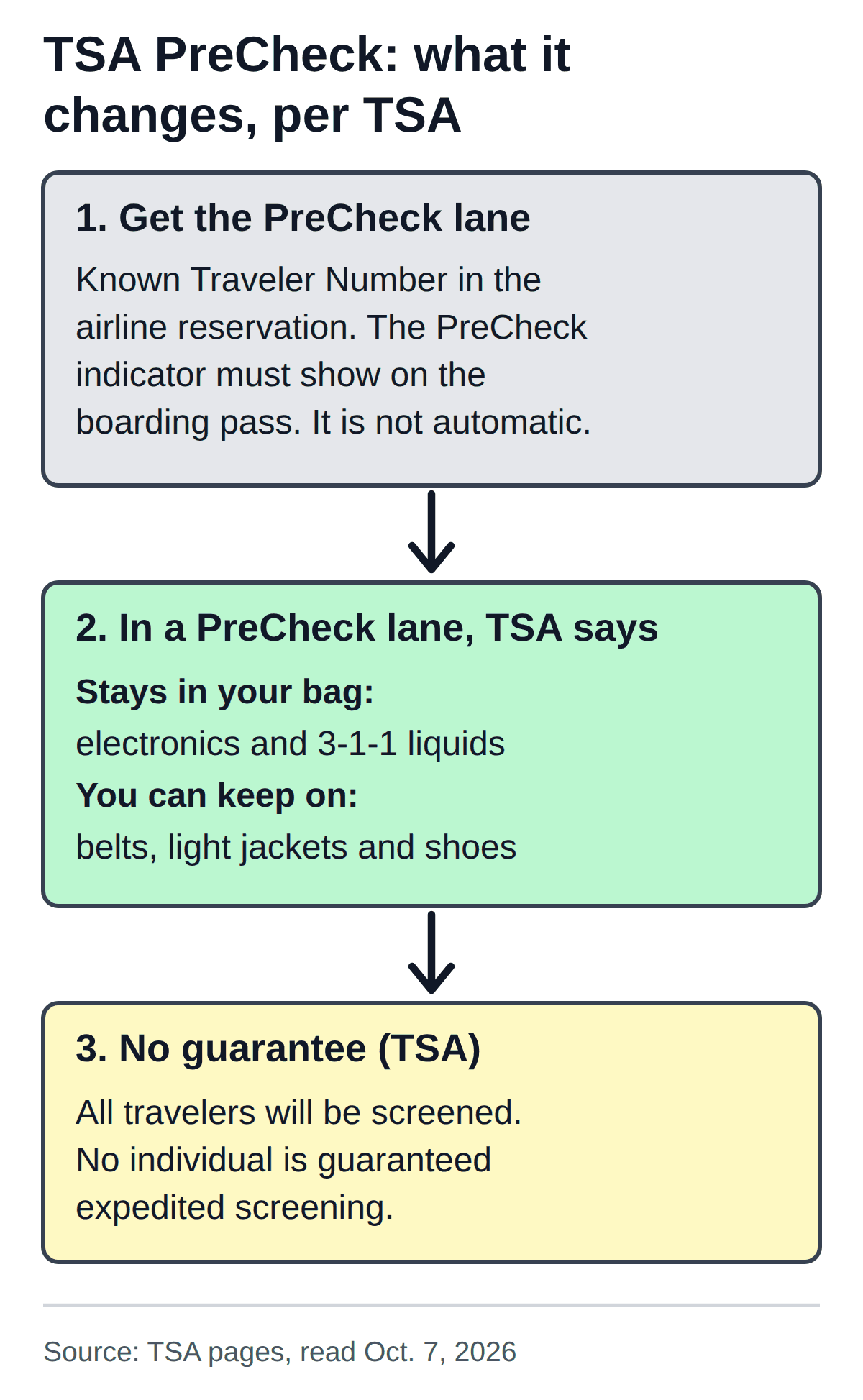
TSA PreCheck is a TSA program that offers eligible travelers a speedier security experience in dedicated lanes across the U.S. TSA says that in a PreCheck lane you leave electronics and 3-1-1 liquids in your bag and leave on belts, light jackets and shoes. TSA also says no individual is guaranteed expedited screening.
This article covers what TSA’s pages say. The wording is as of October 7, 2026, and comes from the three TSA pages listed at the end. It describes the program and does not recommend enrolling.
What TSA says changes in a PreCheck lane
| Item | What TSA says with TSA PreCheck |
|---|---|
| Electronics | Leave in your bag |
| Liquids in 3-1-1 bags | Leave in your bag (see the TSA 3-1-1 liquids rule) |
| Belts, light jackets and shoes | Leave on |
TSA’s FAQ adds that if a PreCheck lane is not available, a traveler with a PreCheck boarding pass may be able to keep 3-1-1 liquids and laptops in the bag and shoes and light jackets on in the standard lane. It says eligible passengers should check with the TSA officer on duty.
It is not guaranteed
TSA says it uses unpredictable security measures, both seen and unseen, throughout the airport. It says all travelers will be screened, and no individual is guaranteed expedited screening. TSA’s FAQ gives the same answer to the question of whether an eligible traveler is guaranteed expedited screening: no.
How the PreCheck lane works at the airport
TSA says PreCheck benefits are not automatic. A Known Traveler Number (KTN) goes in the KTN field of the airline reservation, and TSA says the name on the reservation must match the name used at enrollment and the date of birth must be correct. TSA says the PreCheck indicator must be displayed on the boarding pass before a traveler can use the PreCheck lane.
TSA also says that showing a Global Entry, NEXUS or SENTRI card, or a PreCheck approval notification, does not give access to the lane. TSA says Global Entry, NEXUS and SENTRI members use their PASS ID as the KTN, and it still has to be in the airline reservation.
Children and families
TSA says children 17 and under can join an adult in the PreCheck lane. Its FAQ gives the conditions. Anyone 18 and older needs their own KTN. Children 12 and under can join an adult in the lane, and the indicator does not have to be on their own boarding pass. Children 13 to 17 can join only when the indicator appears on their own boarding pass, which requires being on the same reservation as an adult whose boarding pass has it. TSA also says a parent who escorts a child through security with a gate pass is directed to standard screening.
Membership and enrollment providers
TSA says PreCheck memberships last five years and that it has three authorized enrollment providers: CLEAR, IDEMIA and Telos. This article does not cover prices, offers or how to enroll.
What this article does not cover
This article does not cover prices, renewal, enrollment steps or who is eligible. It does not say whether PreCheck is worth having, and it does not compare it with Global Entry or other programs. It does not cover TSA PreCheck Touchless ID, flights from the U.S. to other countries, or how the standard lane works for travelers without PreCheck. This article describes what TSA’s pages state on the date above and does not track changes to them.
Sources
All three pages were checked on October 7, 2026. None of them shows an update date.
- TSA, “TSA PreCheck.” https://www.tsa.gov/precheck
- TSA, “TSA PreCheck FAQ.” https://www.tsa.gov/precheck/faq
- TSA, “How to use TSA PreCheck benefits.” https://www.tsa.gov/precheck/benefits