USPS Certified Mail is an Extra Service that gives the sender a mailing receipt and, if requested, electronic verification that an item was delivered or that a delivery attempt was made. The USPS FAQ says it is bought at the time of mailing, requires a signature, and can go with Priority Mail or First-Class Mail. The FAQ names the addressee as the signer; the Domestic Mail Manual (DMM) says the recipient signs and prints a name unless an electronic signature is used, and that delivery may go to another person at some addresses, such as a hotel or an apartment house, when the sender has not restricted delivery.
This article covers what USPS’s pages say. The wording is as of October 29, 2026, and comes from the five USPS pages listed at the end. It describes the service. It does not give advice on whether to use it, and it does not discuss legal effect.
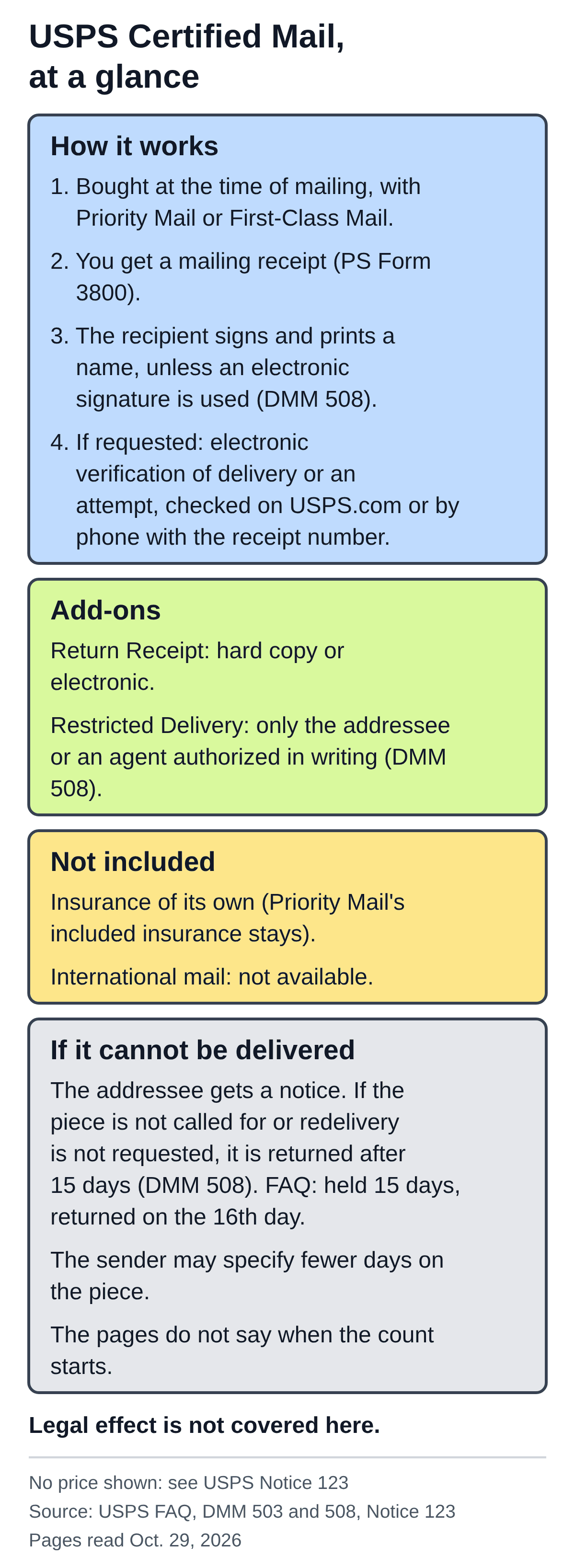
What Certified Mail is
The USPS FAQ calls Certified Mail a numbered Extra Service that can be bought at the time of mailing at a Post Office. The Domestic Mail Manual (DMM) says Certified Mail is dispatched and handled in transit as ordinary mail, and the FAQ says the item travels at the speed of the mail class it is bought with.
What you get
A mailing receipt. The FAQ says the sender gets a mailing receipt as confirmation an item was sent (PS Form 3800, “Receipt for Certified Mail”). In plain terms, Form 3800 has a green label that goes on the item and a receipt for the sender. The DMM says the label goes above the delivery address and to the right of the return address (to the left of the address on parcels), and that the sender writes the name and complete address of the recipient on the form. If a postmarked receipt is requested, the USPS employee round-dates the receipt to show when the item was accepted. Otherwise, the DMM says the sender detaches the receipt, marks the date and mails the item. The number on the receipt is the one used to look up the item’s status.
Delivery information, if requested. USPS says Certified Mail provides electronic verification that an item was delivered or that a delivery attempt was made. The FAQ says the status can be retrieved on USPS.com by entering the number shown on the mailing receipt, by telephone using that number, or by bulk electronic file transfer for mailers who send USPS an electronic manifest. The DMM gives 1-800-222-1811 as the telephone number.
A signature. USPS’s pages word this point in several ways. The FAQ says Certified Mail requires a signature from the addressee. DMM 503 says USPS keeps a record of delivery that includes the recipient’s signature, and that a delivery record can be obtained by buying a return receipt at the time of mailing. USPS.com says the signature of the person who accepts the mailing comes with the service when it is combined with Return Receipt.
DMM 508 says who may receive the item. For Certified Mail in general, it says a mailpiece may not be opened or given to the recipient before the recipient signs and prints his or her name on the form or label, unless an electronic signature is used as described in 503.1.8a, and that an acceptable form of identification may be required. DMM 503, section 1.8, says the signature in a proof of delivery letter may be one obtained from the recipient at the time of delivery or, for certain services, an electronic signature that the addressee (or representative) previously provided and that USPS keeps on file. The pages read do not say which services or recipients that covers, so this article does not say whether it applies to a given Certified Mail item. When delivery is not restricted at the sender’s request, DMM 508 says mail addressed to a person at a hotel, apartment house and similar places may be delivered to any person in a position to whom mail for that location is usually delivered. This article does not list every case in 508. Restricted Delivery, described below, is narrower.
Which mail it goes with
The FAQ lists two eligible classes, Priority Mail and First-Class Mail, and the DMM’s eligibility table lists the same two. One sentence in the FAQ’s section on insurance also names Priority Mail Express; because the FAQ’s own list of eligible classes does not include it, this article lists only the two classes in the list.
USPS says Certified Mail is not available with international mail. It may be sent to APO, FPO and DPO addresses and to U.S. possessions and territories.
Add-ons
Return Receipt is bought at the time of mailing and gives the sender a delivery record showing the recipient’s signature. The FAQ says it can arrive by mail or electronically, and the DMM says the hard copy (Form 3811) is received by mail.
Certified Mail Restricted Delivery lets the sender direct delivery only to the addressee or the addressee’s authorized agent. DMM 503 says the addressee must be an individual, specified by name. DMM 508 says postal employees deliver mail marked Restricted Delivery only to the addressee or a person authorized in writing as the addressee’s agent, that an acceptable form of identification may be required, and that when mail is addressed to two or more persons jointly, all addressees or their agents must be present to accept delivery together. It also lists conditions for particular cases, such as mail for minors, which this article does not cover.
The FAQ also lists Adult Signature Required and Adult Signature Restricted Delivery, for an adult age 21 or older, and says they are not available at retail. This article does not go further into those two services.
What it does not include
The DMM says no insurance coverage is provided when purchasing Certified Mail, except for Priority Mail pieces with included insurance. The FAQ says insurance cannot be bought as an extra service when Certified Mail is selected, and gives the example of Priority Mail with included insurance (up to $100), which keeps that coverage with Certified Mail.
If the item cannot be delivered: the 15-day period
Two USPS pages describe a 15-day period. The FAQ says Certified Mail will be held at the Post Office for 15 days and will be returned to sender on the 16th day. DMM 508.1.1.7, which covers Certified Mail along with other accountable mail, gives the conditions: a notice is provided to the addressee for a mailpiece that cannot be delivered, and if the piece is not called for or redelivery is not requested, it is returned to the sender after 15 days, unless the sender specifies fewer days on the piece.
Three limits follow from the pages. First, the DMM mentions only fewer days for a sender’s choice, and the pages read do not say how the sender specifies it on the piece. Second, neither page says which day the count starts from, such as the day of the delivery attempt or the day the notice is left, so this article does not calculate a date. Third, the two pages word the period differently (“held for 15 days and returned on the 16th day” in the FAQ, “returned after 15 days” in the DMM), and this article gives both without reconciling them further. DMM 508.1.1.7 also gives other periods for Priority Mail Express and COD, which this article does not cover.
Refunds
The FAQ says the service fee, not the postage, is eligible for a refund in four cases: the mailing receipt and electronic verification have not been received after 30 days but the item is known to have been delivered; non-delivery when USPS is at fault; incorrect charges for postage or fees; and paid services not provided. A request can be made 30 to 60 days after the mailing date, on USPS.com (usps.com/help/refunds.htm) or at a Post Office with PS Form 3533, along with evidence of mailing and postage. The FAQ says refunds are at the discretion of the local Post Office, and that there is no refund for Certified Mail service if the item is undeliverable but a delivery was attempted. Our USPS refunds article covers the USPS.com refund page and DMM 604.9, including how they count the 30 to 60 days for extra services.
Fees
This article does not state a price. The FAQ sends readers to USPS Notice 123, the Price List, and to USPS’s page on insurance and extra services for fees. Notice 123 lists the Certified Mail fee per item, in addition to postage and other fees, and shows the date its prices take effect at the top of the page. A newer version of the list may show different fees, so check the version in effect at USPS Notice 123.
What this article does not cover
This article does not cover what Certified Mail means legally, whether it counts as notice, whether a recipient must accept it, or when a law, court or agency requires it. It does not compare Certified Mail with Registered Mail or other USPS services, and it does not cover Adult Signature services, prices, international mail, mailing services run by other companies, DMM 508 delivery conditions other than those named above, or advice on how to send an item. It describes what five USPS pages state on the date above and does not track changes to them.
Sources
All five pages were checked on October 29, 2026.
- USPS FAQ, “Certified Mail® – The Basics” (page shows May 12, 2026). https://faq.usps.com/s/article/Certified-Mail-The-Basics
- USPS Postal Explorer, Domestic Mail Manual 503, “Extra Services,” section 3.0 Certified Mail Services and 1.8 (no revision date shown on the page). https://pe.usps.com/text/dmm300/503.htm
- USPS Postal Explorer, Domestic Mail Manual 508, “Recipient Services,” sections 1.1.7 and 1.1.8 (no revision date shown on the page). https://pe.usps.com/text/dmm300/508.htm
- USPS.com, “Shipping Insurance and Delivery Services” (no date shown on the page). https://www.usps.com/ship/insurance-extra-services.htm
- USPS Postal Explorer, Notice 123, “Price List” (page shows “Effective October 04, 2026”). https://pe.usps.com/text/dmm300/Notice123.htm