USPS Package Intercept is a fee-based service that lets the sender of an eligible item ask USPS to try to stop delivery or redirect it, as long as the item is not yet out for delivery or delivered. USPS says it is not a guaranteed service. The request is active for 7 business days, it cannot be edited or cancelled, and USPS.com says that if the shipment is intercepted, the Package Intercept fee plus any applicable postage is charged, while customers are not charged if the shipment was not intercepted.
This article covers what three USPS pages say: the USPS.com Package Intercept page, a USPS FAQ called “USPS Package Intercept – The Basics” (dated October 27, 2026) and a USPS Package Intercept terms page (it shows “Updated: 7/15/2016”). The wording is as of November 9, 2026. The three pages do not use the same wording on mail classes, maximum size or postage, and the article shows those differences instead of choosing one. It does not give any fee or postage amount, because USPS lists those on a separate price page, and it does not cover commercial intercept requests in detail, international mail or what to do about a lost or stolen package.
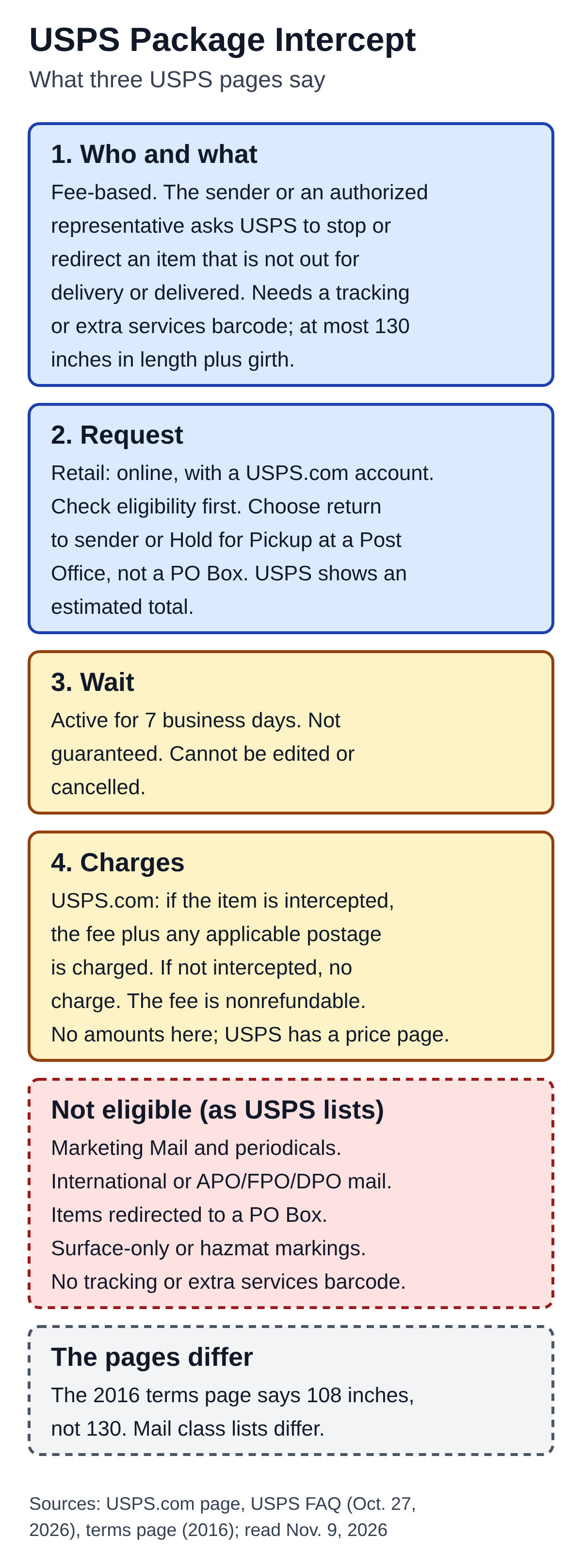
Who can request it
USPS.com and the FAQ both describe the request as coming from the sender or the sender’s authorized representative (the FAQ says “authorized agent”). The pages do not describe a request made by the person receiving the package.
USPS.com splits senders into two groups. Retail senders can redirect a shipment back to their own address or to a Post Office as Hold For Pickup, and they can only request an intercept online with a USPS.com account. Commercial senders can redirect a shipment back to their address, to a new delivery address or to a Post Office as Hold For Pickup through the Business Customer Gateway. The FAQ adds that redirecting to a new delivery address is only available for commercial intercept requests.
What is eligible
According to USPS.com, most domestic mailings with a tracking or extra services barcode are eligible, as long as the total of length and girth is not larger than 130 inches. The FAQ gives the same 130-inch limit, with a note that only USPS Ground Advantage and Parcel Select oversized-priced items measure more than 108 inches and up to 130 inches. It also says the recipient and the sender must both be domestic, with APO, FPO and DPO addresses excluded.
The FAQ also says that commercially shipped packages typically have a tracking number that begins with “92” or “93”. It says those can only be intercepted by a commercial mailer through the Business Customer Gateway, and that the USPS.com retail intercept cannot be used for tracking numbers with those prefixes. The FAQ tells customers to check eligibility with USPS Tracking or the eligibility checker on USPS.com before requesting.
What is not eligible
USPS.com lists these as not eligible: USPS Marketing Mail products and periodicals; items addressed to a Commercial Mailing Receiving Agency; items redirected to a PO Box; and nonmailable items, items with surface-only transportation markings (such as Label 127 or Surface Mail Only) and items with hazardous materials markings such as Consumer Commodity ORM-D.
The FAQ’s list is worded differently. It names mailpieces sent to or from international destinations, sent to or from APO, FPO or DPO destinations, domestic mailpieces that need a customs declaration label, domestic mailpieces marked for surface-only transportation (including hazardous materials markings such as “Limited Quantity,” “Consumer Commodity” or “ORM-D”) and domestic mailpieces without a tracking barcode, including those for extra services.
How a request works
USPS.com describes four steps for a retail request. First, verify that the shipment is eligible. Second, sign in to or create a USPS.com account. Third, submit the request and choose where USPS should redirect the shipment: back to the sender, held at the destination Post Office or held at a new Post Office. Fourth, after you submit, USPS shows an estimated total, which is the intercept fee plus estimated postage if it applies, and then attempts to intercept and redirect the shipment.
Per the FAQ, USPS intercepts the item at the delivery Post Office. It is then returned to the sender or held at a Post Office as Hold for Pickup, but not sent to a PO Box. Tracking continues under the original tracking number.
Time limits and no guarantee
The FAQ says a request is active for 7 business days from the date of the request. The Post Office makes every attempt to locate the item during that time, but the FAQ says there is no guarantee that the item can be intercepted before delivery. USPS can prevent delivery only as long as the item is not showing as out for delivery or delivered. USPS.com also says Package Intercept is not a guaranteed service and that certain conditions apply.
The FAQ says you cannot edit or cancel a Package Intercept request.
Fees and postage
This article gives no amounts. USPS.com and the FAQ both send readers to a separate USPS price page for the Package Intercept fee.
On when charges apply, the three pages say similar things. USPS.com says that if the shipment is intercepted, the card is charged the Package Intercept fee plus any applicable postage, and that any additional postage is charged if the actual postage is greater than the estimate. It also says customers are not charged if the shipment was not intercepted and that the fee is non-refundable if the intercept succeeds. The FAQ says you pay all fees only if an intercept was possible, that there is no charge if the item is delivered before it can be intercepted, and that the fee applies to each mailpiece intercepted. The terms page says fees and postage are charged only upon a successful intercept.
The FAQ also has sentences saying that some postage and fees are charged at the time of the intercept “or otherwise” collected from the recipient or by a USPS carrier at delivery. The FAQ does not explain how those sentences fit with the lines saying there is no charge when the item is delivered first, so this article does not try to reconcile them.
For postage, USPS.com says an intercepted item is redirected as the service it was originally sent with (Priority Mail Express, Priority Mail, USPS Ground Advantage or First-Class Mail) and that you pay the applicable postage. The FAQ is more detailed. It says Priority Mail Express, Priority Mail and USPS Ground Advantage items redirected to the sender are not relabeled and carry no additional postage cost. It says those classes redirected to a Post Office as Hold for Pickup are relabeled and handled as a new item of the same class at the commercial postage price. It says Bound Printed Matter, Media Mail and Library Mail items are relabeled as new Priority Mail items and charged Priority Mail commercial postage, whether they go back to the sender or to a Post Office, and it has separate lines for Parcel Select.
Extra services
USPS.com says retail and commercial customers can also buy additional services for the intercepted package: Adult Signature Required, Adult Signature Restricted Delivery, Signature Confirmation and insurance. The FAQ is more specific. It says Adult Signature Required, Adult Signature Restricted Delivery and Signature Confirmation are available when the item is redirected to a new address or to a Post Office for Hold for Pickup, and that insurance applies only if the original shipment included it, for the original value only.
For Registered Mail, the FAQ says intercept is only possible when the item is redirected to the sender. The item comes back under the original Registered Mail number, not relabeled or repackaged, and the customer must write “Withdrawn” on the Registered Mail receipt, sign it and surrender it to the Post Office. The terms page also says a Registered Mail item can only be returned to the sender.
Where the three pages differ
| Topic | USPS.com page | USPS FAQ (Oct. 27, 2026) | Terms page (updated 7/15/2016) |
|---|---|---|---|
| Mail classes | Excludes Marketing Mail and periodicals; names Priority Mail Express, Priority Mail, USPS Ground Advantage and First-Class Mail as the services items are redirected as | Lists seven classes: Priority Mail Express, Priority Mail, Bound Printed Matter, USPS Ground Advantage (retail and commercial), Parcel Select, Media Mail, Library Mail; First-Class Mail is not in the list | All mail classes except Standard Mail and Periodicals |
| Maximum size | 130 inches in length and girth | 130 inches in length and girth (a note says only USPS Ground Advantage and Parcel Select oversized-priced items are over 108 inches) | 108 inches in length and girth |
| Postage for redirecting | As the service originally used | By class, with relabeling rules | At the Priority Mail rate |
The terms page is the oldest of the three and the only one that gives 108 inches as the limit. The article does not say which page controls. If your item is a First-Class Mail piece, a large package or a class not listed in the FAQ, USPS.com’s eligibility check or a Post Office is the way to confirm.
Sources
All three pages were read on November 9, 2026.
- USPS, “Package Intercept,” USPS.com (the page shows no update date). https://www.usps.com/manage/package-intercept.htm
- USPS, “USPS Package Intercept – The Basics,” USPS FAQ (dated October 27, 2026). https://faq.usps.com/s/article/USPS-Package-Intercept-The-Basics
- USPS, “Package Intercept” terms of use (the page shows “Updated: 7/15/2016”). https://www.usps.com/terms-conditions/package-intercept.htm