Category: Postal service and stamps

  • USPS Tracking Status: What Each One Means and What USPS Says to Do

    USPS’s status guide says an “Out for Delivery” scan means the package “will be delivered by a carrier today,” but USPS also says “USPS Tracking does not expedite or guarantee delivery.” The guide says that if the package has not arrived after 1 full postal business day has passed following that scan, you can use the tracking number to submit a service request to your local Post Office. Other statuses have other waits, and the guide does not use one rule for all of them.

    This article covers two USPS FAQ pages: “Where is my package? Tracking Status Help” (Article 000006077, dated September 29, 2026) and “USPS Tracking® – The Basics” (Article 000007991, dated September 17, 2026). The wording is as of November 13, 2026. The status guide lists 27 statuses in five groups; this article follows those groups and spends most of its space on the statuses where the guide tells you to do something. It gives no prices. It does not cover international tracking, claims and refunds, how a service request is handled, or other carriers.
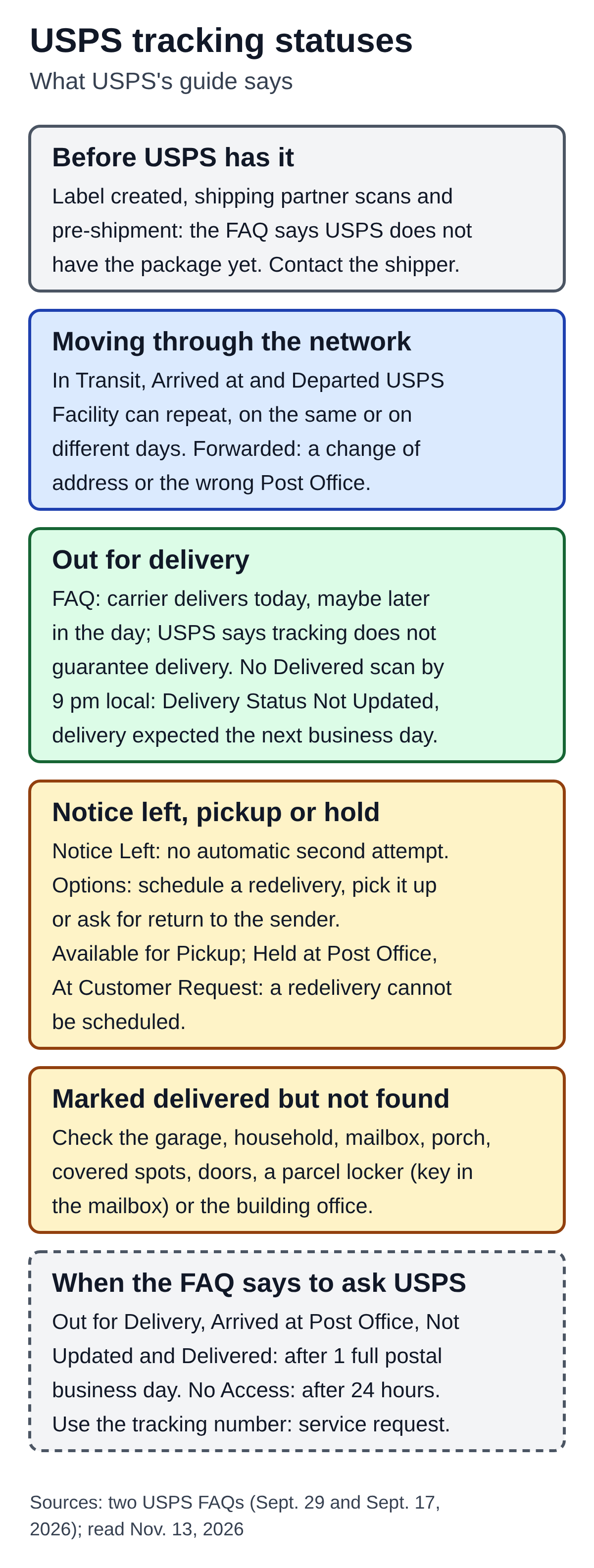
    Diagram of what the USPS tracking status guide says. Before USPS has it: label created, shipping partner and pre-shipment statuses; the FAQ says USPS does not have the package yet, so contact the shipper. Moving through the network: In Transit, Arrived at USPS Facility and Departed USPS Facility can repeat, on the same or on different days; Forwarded means a change of address or the wrong Post Office. Out for delivery: the FAQ says a carrier delivers it today, maybe later in the day, and USPS says tracking does not guarantee delivery; no Delivered scan by 9 pm local time gives Delivery Status Not Updated, with delivery expected the next business day. Notice left, pickup or hold: Notice Left has no automatic second attempt, and the options are to schedule a redelivery, pick it up or ask for return to the sender; for Available for Pickup and Held at Post Office, At Customer Request a redelivery cannot be scheduled. Marked delivered but not found: check the garage, household, mailbox, porch, covered spots, doors, a parcel locker (key in the mailbox) or the building office. When the FAQ says to ask USPS: Out for Delivery, Arrived at Post Office, Delivery Status Not Updated and Delivered after 1 full postal business day; No Access to Delivery Location after 24 hours; use the tracking number to submit a service request. Sources: two USPS FAQs dated Sept. 29 and Sept. 17, 2026, read Nov. 13, 2026.

    What USPS Tracking does and does not promise

    The “Basics” FAQ is plain about the limits. It says “USPS Tracking does not expedite or guarantee delivery.” Tracking can start as soon as the sender or a shipping partner tells USPS electronically to expect a package, continues when USPS accepts it, and ends when the item is delivered or picked up. The FAQ says scanning information “is updated throughout the day as scans become available,” and it points to the Scan Event Status page for what a specific status means.

    Two more points from the same FAQ. First, First-Class Mail postcards, letters and flats “are not eligible for USPS Tracking service,” although letters and flats can get extra services such as Certified Mail or Registered Mail that carry barcodes (our Certified Mail article covers one of them). Second, you may see an Expected Delivery Window, which the FAQ describes as “a 2-hour slot of time when you can expect your package to arrive,” and adds that “Delivery within that time is not guaranteed.” If the status is “Alert,” the FAQ says to check USPS Service Alerts first, because weather and other events can cause delays.

    The FAQ also says the absence of a delivery scan “does not necessarily indicate that the item was not delivered”: the piece may have been delivered without the scan being captured, and it suggests contacting the sender or recipient to confirm.

    Before USPS has the package

    The first group in the status guide, “Acceptance / Preshipment,” covers statuses that come before USPS handles the package. For the statuses that mention a shipping partner (picked up by, arrived at or departed a shipping partner facility, “USPS Awaiting Item,” and “On its Way to USPS”), the guide says “USPS does not have possession of the package” and tells you to contact the shipper with questions. “Shipping Label Created, USPS Awaiting Item” and “Pre-Shipment, USPS Awaiting Item” mean a shipping label has been created with a USPS Tracking number and “The package has not yet been given to USPS.” The advice is again to contact the shipper.

    Two statuses in that group describe USPS handling. “USPS In Possession of Item” means USPS has received or picked up the package and will begin processing it, and the guide says no action is needed. “Shipment Received, Package Acceptance Pending” means a postal facility has received a container or pallet of many packages but has not started processing, and each package will get its own acceptance scan once the container is opened.

    Moving through the network

    For “In Transit,” “Arrived at USPS Facility” and “Departed USPS Facility,” the guide says the package “is currently being processed or transported to your delivering Post Office.” It adds that these scans “may appear multiple times from the same facility and/or on different days as it is traveling,” so a repeat is not described as a problem. The guide gives no number of days for this stage.

    “Forwarded” and “Forward Processed” mean the package is being forwarded to a different address, which the guide says is “due to a change of address request or because the package is at the wrong Post Office for delivery.” (Our mail forwarding article covers change-of-address forwarding.)

    “Arrived at Post Office” is the one status in the “Preparing for Delivery” group. The guide says the package “should arrive today or the next postal business day,” and that if there has been no change in tracking status after 1 full postal business day following the arrival date at your local Post Office and no delivery has occurred, you can use the tracking number to submit a service request.

    Out for delivery, and when the delivery scan is missing

    “Out for Delivery” means the package “has been prepared for delivery at your local Post Office™ and will be delivered by a carrier today.” The guide notes that “Not all packages are delivered by the same carrier who delivers your regular mail and may arrive at a different time or later in the day.” So a package can arrive at a different time than your letters. This is the guide’s description of what the status means, not a delivery promise: the “Basics” FAQ says “USPS Tracking does not expedite or guarantee delivery,” and says delivery within an Expected Delivery Window “is not guaranteed.”

    If no Delivered scan is recorded by 9 pm local time on the day of the Out for Delivery scan, the status changes to “Delivery Status Not Updated” or “Awaiting Delivery Scan.” The guide says this means “we now anticipate delivery of your package on the next business day.” If more than 1 full postal business day has passed since this status and no delivery has occurred, it says to use your tracking number and submit a service request.

    If the status is “Held at Post Office, At Customer Request,” the guide says it is due to a USPS Hold Mail, Hold for Pickup or USPS Delivery Instructions request, and that “A redelivery cannot be scheduled for this package.” Packages held under a valid Hold Mail request are handled according to that request (carrier delivery or customer pickup); with no such request, you must pick the package up with a valid photo ID. See our Hold Mail article for the service itself.

    Delivery attempts, notices and pickup

    This is where the guide’s statuses differ most. In the table, “another attempt” is what the guide says about delivering again.

    StatusWhat the guide says it meansWhat it says about another attempt
    No Access to Delivery LocationThe carrier could not get to the mailbox, porch or garage. Examples: a vehicle blocking the mailbox, a loose dog, a gated community or locked building, utility work or emergency responders“We will automatically reattempt delivery the next business day”
    Notice Left (No Authorized Recipient Available)The package needs a signature and no one was available to sign; a PS Form 3849 Redelivery Notice was left“There will be no automatic second delivery attempt”
    Notice Left (No Secure Location Available)The carrier did not see a secure place to leave the package and returned it to the Post Office“There will be no automatic second delivery attempt”
    Available for PickupThe package cannot be delivered and can be picked up at your local Post Office by you or an authorized agent“A redelivery cannot be scheduled for this package”

    In short, the guide describes scheduling a redelivery only for the two “Notice Left” statuses and for “Redelivery Scheduled” and “Reminder to Schedule Redelivery of your Item”; for “Available for Pickup” and “Held at Post Office, At Customer Request” it says a redelivery cannot be scheduled. For the two “Notice Left” statuses, the guide lists three options: schedule a redelivery using the tracking number or the barcode number on the notice (if delivery to a USPS Smart Locker is available, the notice says so); pick the package up at the Post Office listed on the notice, where an authorized agent can pick it up for you and valid photo ID is required; or request that it be returned to the sender using the Redelivery application. It adds that if you do not claim the package “within the time limit,” it will be returned to the sender, and it does not give that time limit in these entries. “Redelivery Scheduled” and “Reminder to Schedule Redelivery of your Item” lead to the same options. For “Available for Pickup,” the guide says to pick the package up beginning the next business day or request that it be returned to the sender.

    “No Access to Delivery Location” has its own wait. After saying that no action is needed and that delivery will be reattempted automatically, the guide says that if it has been more than 24 hours since that status, you can use your tracking number and submit a service request.

    Two statuses mean the package is going back. For “Insufficient Address” and “No Such Number,” the guide says the package is being returned to the sender because part of the delivery address is missing, incomplete or incorrect, and that the sender will need to reship the item with new postage. (For how USPS pages describe addressing, see our article on addressing an envelope.)

    Marked delivered, but not at your door

    For “Delivered,” the guide says the package has been delivered “with a recorded date, time and delivery location.” If you cannot find it, it says the carrier may have put it somewhere safer, and lists places to check: the garage, other people in your household, the mailbox (packages can come separately from your regular mail, so check again later in the day), the porch, areas protected from weather, areas out of street view such as under a mat or near a back entrance, and exterior doors. If you have a multi-unit community mailbox and there is a key in your regular mail compartment, the guide says your package is in a parcel locker, and the key tag shows the locker number. In an apartment or condo, it says to contact the building’s management office.

    If you still cannot find it and it has been more than one postal business day since the “delivered” scan, the guide says to visit the “email us” page on usps.com to submit a service request to your local Post Office for eligible items. For mail that has gone missing in other ways, the separate Missing Mail search is covered in its own article.

    When the guide says to submit a service request

    The guide uses different waits for different statuses, summarized below. Each wait is quoted from that status’s entry, and the table does not add any rule of its own.

    StatusWait in the guideCondition in the guide
    DeliveredMore than one postal business day since the “delivered” scanThe package cannot be found
    Out for DeliveryAfter 1 full postal business day has passed following the scanThe package has not been delivered
    Arrived at Post OfficeAfter 1 full postal business day following the arrival dateNo change in tracking status and no delivery
    Delivery Status Not Updated / Awaiting Delivery ScanMore than 1 full postal business day since this statusNo delivery has occurred
    No Access to Delivery LocationMore than 24 hours since this statusUse the tracking number

    The guide does not define “1 full postal business day,” and “24 hours” is used only for No Access. The article does not say how the two relate.

    What the pages do not say

    Neither FAQ says how long the In Transit stage can last, or when a package is “late.” The “Basics” FAQ sends you to the Mail Delivery Standards chart in “Delayed mail and packages?” for that, which this article did not read. Neither says what happens after you submit a service request or how long it takes, and the guide says “eligible items” without listing them. The guide does not give the time limit for claiming a package after a notice. Records are kept for a limited time: the “Basics” FAQ gives 120 days for USPS Tracking, one year for Signature Confirmation, and two years for several services including Certified Mail, Priority Mail Express and Registered Mail. The text and email updates it describes stay active for 2 weeks after the request; the FAQ also mentions Informed Delivery as another option, covered in our Informed Delivery article.

    Sources

  • How to Address an Envelope: What USPS Says About Format and Placement

    USPS’s pages agree on the basics: put the return address in the top left corner, put the delivery address in the middle of the envelope (one page says “bottom center”), and end the address with the city, state and ZIP Code, using ZIP+4 if you know it. They differ on smaller points, such as where an apartment number goes and whether to write words out or abbreviate.

    This article covers what five USPS pages say: the FAQ “Addressing Mailpieces” (Article 000008202), the USPS.com page “How to Send a Letter or Postcard,” the short USPS.com popup on addressing an envelope, the transcript of the USPS video “How to Address a Package,” and step 4 of the USPS.com page “How to Prepare & Send a Package.” None of the five shows an update date. The wording is as of November 13, 2026. The article shows where the pages differ instead of choosing one. It gives no postage prices (the letters page lists some, and they are not used here), and it leaves out the FAQ’s rules for mailers who get automation discounts.

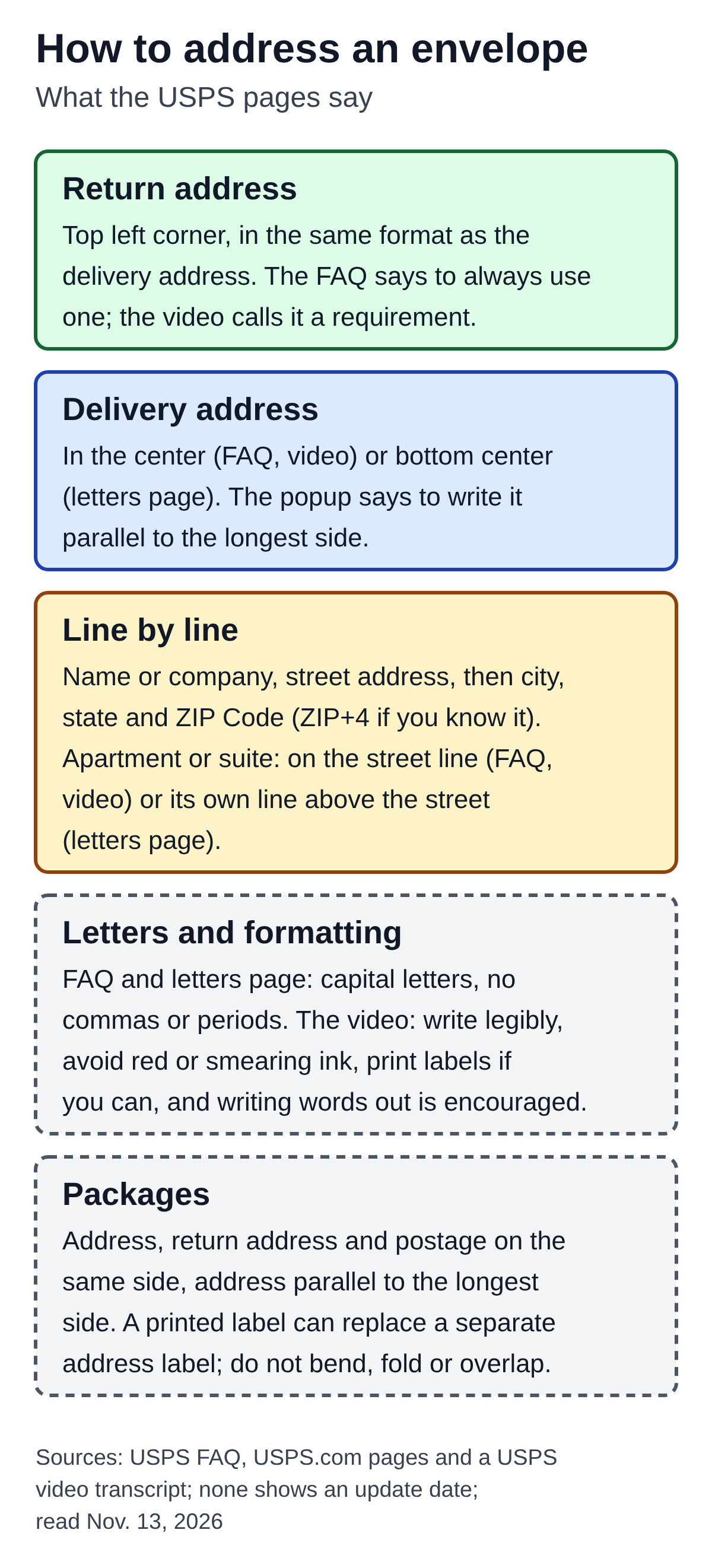
    Diagram of what USPS pages say about addressing an envelope. Return address: top left corner, in the same format as the delivery address; the FAQ says to always use one and the video calls it a requirement. Delivery address: in the center (FAQ, video) or bottom center (letters page); the popup says to write it parallel to the longest side. Line by line: name or company, street address, then city, state and ZIP Code (ZIP+4 if you know it); the apartment or suite goes on the street line (FAQ, video) or on its own line above the street (letters page). Letters and formatting: the FAQ and letters page say capital letters and no commas or periods; the video says to write legibly, avoid red or smearing ink, print labels if you can, and that writing words out is encouraged. Packages: address, return address and postage on the same side, address parallel to the longest side; a printed label can replace a separate address label, and labels should not be bent, folded or overlapped. Sources: a USPS FAQ, USPS.com pages and a USPS video transcript; none shows an update date; read Nov. 13, 2026.

    Where each part goes

    In the table below, each row names the page that makes the statement.

    PartWhat the page saysPage
    Return addressTop left cornerLetters page
    Return addressUpper-left corner on the front of the envelopePopup
    Return address“Above and to the left of” the recipient’s addressVideo transcript
    Delivery address“Center of envelope”FAQ
    Delivery address“Bottom center” of the envelopeLetters page
    Delivery address“In the center”Video transcript
    Delivery addressParallel to the longest side of the envelopePopup
    PostageUpper right cornerFAQ

    The pages do not say how far from the edge anything should sit, so “center” and “bottom center” are left as each page states them.

    Line by line

    The letters page lists four lines for both the return and the delivery address: the full name or company name, the apartment or suite number, the full street address, and the city, state and ZIP+4 Code (it also says to include the ZIP+4 Code “whenever possible”). The FAQ describes the same parts with one difference in order: it prefers the apartment, suite, room or floor number on the same line as, and after, the street address, and says the line above the street address is also allowed, “not below.” The video transcript agrees with the FAQ that the number “can be added on the same line.” So the pages allow the apartment number on the street line (FAQ, video), on its own line above the street (letters page and FAQ), but not below it (FAQ).

    The FAQ also says to use two-letter state abbreviations and a ZIP+4 Code “if known,” and otherwise the ZIP Code, so the instruction when the ZIP+4 is not known is to use the five-digit ZIP Code. The video transcript points to the USPS.com Look Up a ZIP Code tool if the ZIP+4 is unknown. The FAQ says that leaving the ZIP Code off “causes unnecessary delay because it will require manual look-up.” For street directions such as north or south, the FAQ says to “always use applicable directionals,” and the video says directional words “are required.”

    A fictional example

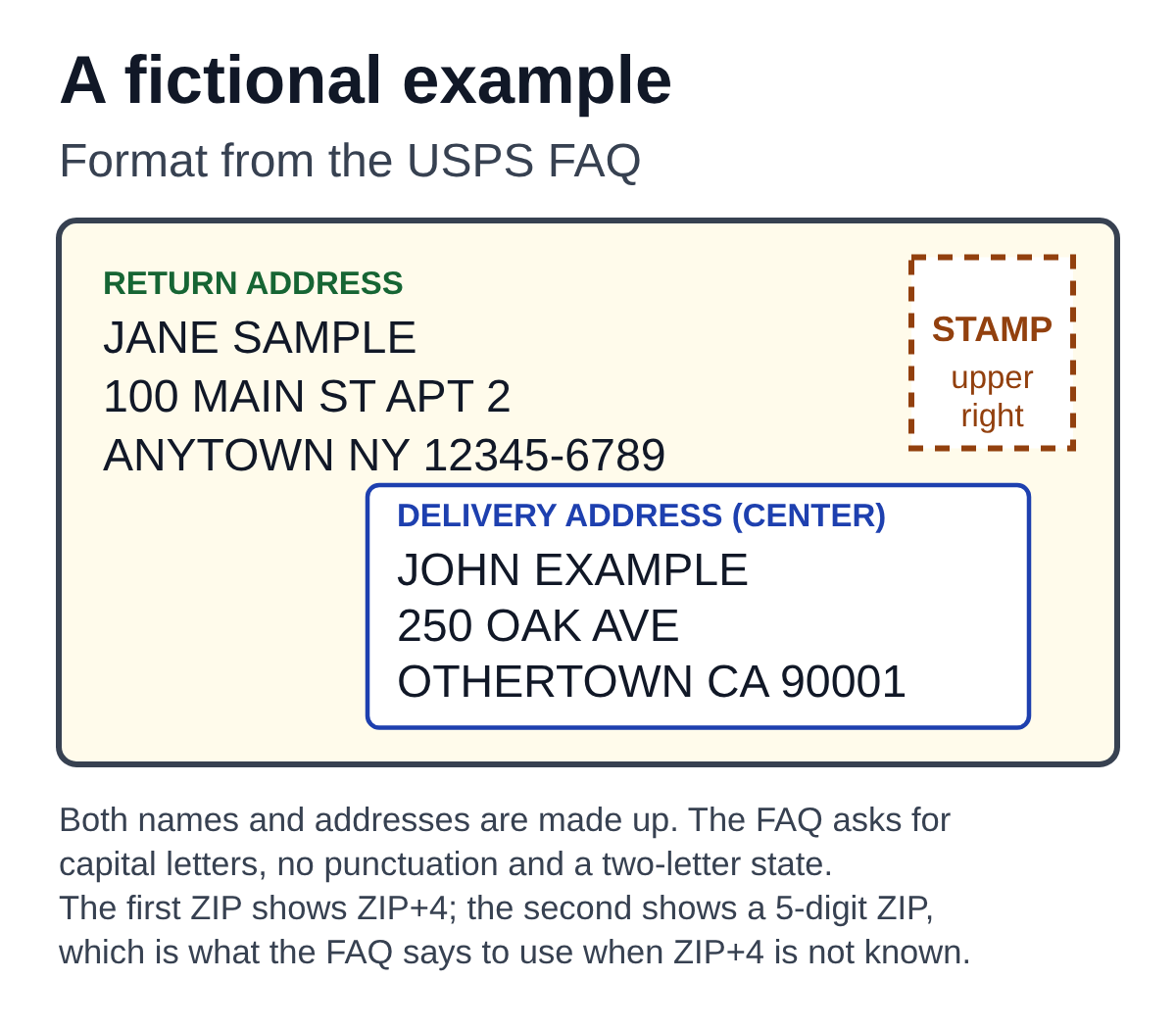
    The picture below shows one envelope laid out the way the FAQ describes it. The names and addresses are made up. The return address (Jane Sample) is in the top left corner, the stamp is in the upper right corner, and the delivery address (John Example) is in the center. Both are in capital letters with no punctuation, two-letter states, and the apartment number on the street line after the street address. The return address shows a ZIP+4 Code; the delivery address shows only a five-digit ZIP Code, which is what the FAQ says to use when the ZIP+4 is not known. If you prefer the letters page’s layout, the apartment number goes on its own line above the street address, and that page puts the delivery address “bottom center” instead of in the center.

    Fictional example of an addressed envelope, following the USPS FAQ format. Top left, return address: JANE SAMPLE, 100 MAIN ST APT 2, ANYTOWN NY 12345-6789. Upper right: where the stamp goes. In the center, delivery address: JOHN EXAMPLE, 250 OAK AVE, OTHERTOWN CA 90001. The first ZIP Code is shown with ZIP+4 and the second as a 5-digit ZIP Code, which is what the FAQ says to use when the ZIP+4 is not known. Both names and addresses are made up.

    Capital letters, punctuation and abbreviations

    The FAQ says: “Use all CAPS, spaces between words, no punctuation, and left justify the margin.” The letters page says to print neatly in capital letters and not to use commas or periods, with a pen or permanent marker. The video transcript does not mention capital letters. It says to write legibly, that USPS scanners “can decipher most handwriting styles and printed font types,” and to avoid red pen or ink that smears. For typed or printed addresses, the FAQ suggests 10, 12 or 14 point type.

    On abbreviations the pages lean different ways. The FAQ says to “always use applicable abbreviated locators,” such as APT, ST and AVE. The video transcript says the shortened forms for street, road, drive and avenue can be used, “but writing the words is encouraged.”

    The return address

    The FAQ’s first guideline is “Always use a return address,” because an undeliverable letter can then be returned. The video transcript calls the return address “a requirement.” Further down, the FAQ says a return address is “required on certain types of mail” and points to the Domestic Mail Manual for the list. The pages do not reconcile “always” and “a requirement” with “certain types of mail,” so the article leaves them side by side.

    The FAQ adds a rule dated December 14, 2023: USPS no longer accepts items shipped domestically with a foreign return address, and “domestic shipments can only have a domestic return address.” A foreign address can only be used when shipping an item internationally, with the appropriate customs form.

    Packages and labels

    The popup says the address, return address and postage should all be on the same side of the package, and warns that if it is improperly addressed, it “might get returned to you.” The USPS.com package page says to write the address parallel to the longest side and to make sure the return address, the delivery address and the postage fit on the same side. It adds that a printed shipping label can be used instead of a separate address label, that all labels go on the same side, and that labels should not be bent, folded or overlapped. For stamps on an envelope, see our Forever stamp article.

    Postcards and special addresses

    For postcards, the letters page says to write the delivery address in the space provided, on the same side as the message and the stamp. The same page has short sections for special addresses. A Puerto Rico address with an urbanization code (URB) is written on four lines. The U.S. Virgin Islands abbreviation is “VI,” not “US VI” or “USA VI.” For military and diplomatic addresses (APO, FPO and DPO) in another country, the page says not to include the city or country name, but to include unit and box numbers if they are assigned. The page links to more details on secondary addresses and on military addresses, which this article did not read.

    What the pages do not say

    None of the five pages shows an update date. The FAQ gives no date at all, and the letters page, popup and video transcript give none. The FAQ mixes consumer guidance with rules for mailers (automation discounts, barcode areas, precanceled stamps, Periodicals and nonprofit mail), and this article leaves the mailer rules out. No page says what happens to an envelope addressed in lowercase or with punctuation; the popup says only that an improperly addressed package “might get returned to you.” The video transcript does not mention capital letters, while the FAQ and the letters page ask for them, and the pages do not explain the difference.

    Sources

  • USPS Missing Mail Search: When You Can File and What You Need

    USPS says a Missing Mail search request can be filed online starting 7 days after the mailing date and up to 365 days after it. USPS also says that submitting a search “does not guarantee a successful outcome,” and that sometimes it cannot find the item.

    This article covers what two USPS pages say about the search: the USPS FAQ “Missing Mail – The Basics” (Article 000007968, dated May 19, 2026) and the USPS.com page “Find Missing Mail” (no update date shown). It also points to a third page, USPS.com “File a Claim,” for claims. The wording is as of November 13, 2026. The two search pages overlap but are not identical, and the article shows where they differ instead of choosing one. It gives no prices. It does not cover claims and refunds in detail, the USPS Mail Recovery Center, international mail, or packages that tracking shows as delivered.

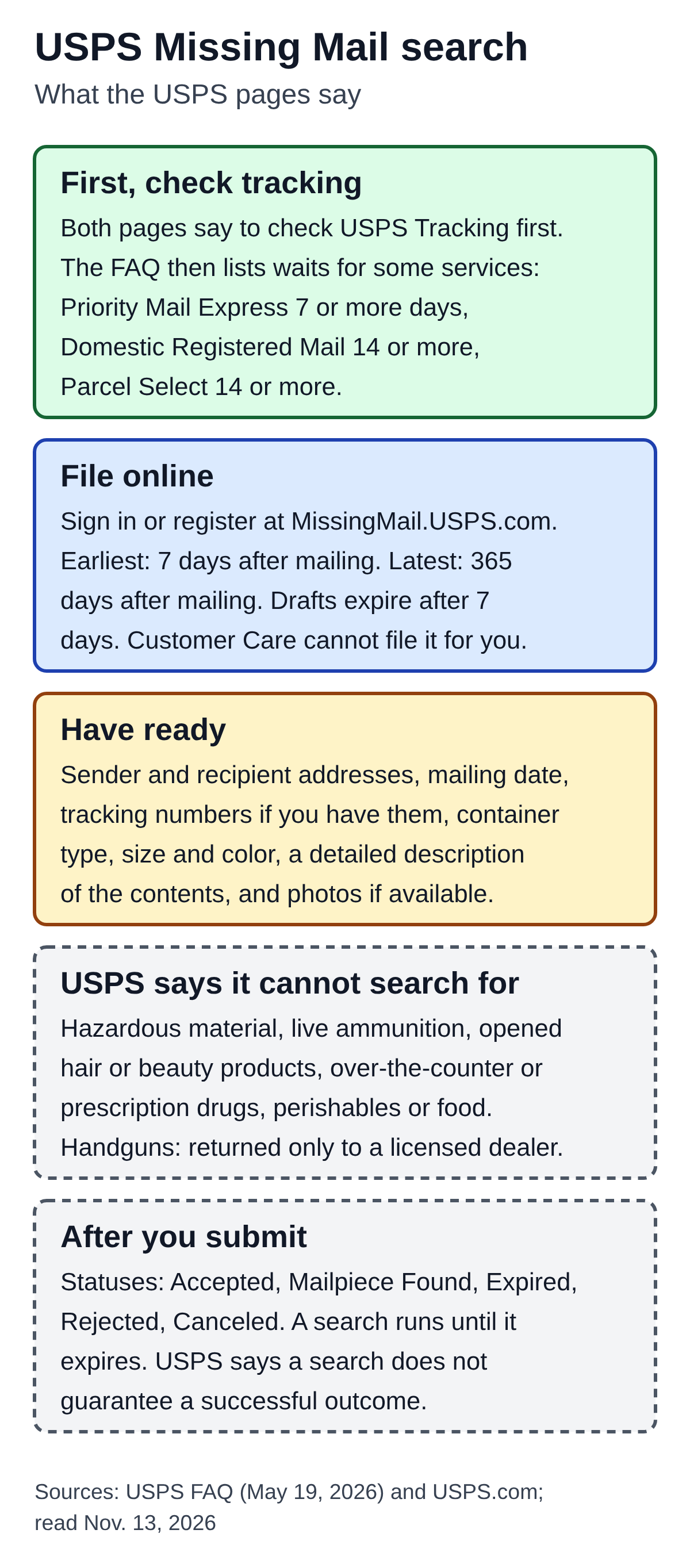
    Diagram of what USPS pages say about a Missing Mail search. First, check tracking: both pages say to check USPS Tracking first, and the FAQ lists waits for some services (Priority Mail Express 7 or more days, Domestic Registered Mail 14 or more, Parcel Select 14 or more). File online: sign in or register at MissingMail.USPS.com; earliest 7 days after mailing, latest 365 days after mailing; drafts expire after 7 days; Customer Care cannot file it for you. Have ready: sender and recipient addresses, mailing date, tracking numbers if you have them, container type, size and color, a detailed description of the contents, and photos if available. USPS says it cannot search for hazardous material, live ammunition, opened hair or beauty products, over-the-counter or prescription drugs, perishables or food; handguns are returned only to a licensed dealer. After you submit: statuses are Accepted, Mailpiece Found, Expired, Rejected and Canceled; a search runs until it expires; USPS says a search does not guarantee a successful outcome. Sources: USPS FAQ dated May 19, 2026 and USPS.com, read Nov. 13, 2026.

    Start with tracking

    Both pages put tracking first. USPS.com says that if the package or mail has tracking, check USPS Tracking for its current status before starting a search. The FAQ says to check USPS Tracking before taking the actions it describes. USPS.com adds a line for Informed Delivery users: a mail item may sometimes be delayed, and it points to the Informed Delivery FAQs (our Informed Delivery article covers that service).

    The FAQ defines Missing Mail as “mail that has not been delivered by the expected delivery date,” which it says includes packages that are undelivered, lost or late. If it has been lost, late or missing for 7 days or more, the FAQ lists four options: submit a search request at MissingMail.USPS.com, read the article on the USPS Mail Recovery Center, file a claim (for insured items meeting the appropriate timeframe), or visit a local Post Office.

    The FAQ then gives a table by service. In the table below, “wait” is the time the FAQ says to allow, and the last column is what the FAQ says comes next.

    Service in the FAQ tableWaitWhat the FAQ says next
    Priority Mail Express7 or more days since mailingIf the recipient confirmed it has not arrived, submit a search request and/or email USPS
    Domestic Registered MailAllow 14 or more days from mailingSubmit a search request and/or file a claim
    Parcel SelectAllow 8 days to arrive; 14 or more days since mailingIf the recipient confirmed it has not arrived, submit a search request and/or email USPS
    Priority Mail, First-Class Mail with a trackable service, USPS Ground Advantage, and the USPS Tracking, Signature Confirmation and Certified Mail servicesNone listed in the rowCheck the delivery status in USPS Tracking

    The FAQ names Certified Mail as one of the trackable services (see our Certified Mail article). For the last row, the only timing the FAQ gives is the 7-day minimum described next. The FAQ’s Registered Mail and Parcel Select rows say to allow 14 or more days, while the filing rule below says the application accepts requests from day 7. The FAQ does not say whether a request for those two services is accepted before day 14, so the article does not say either.

    When you can file

    According to the FAQ, the earliest the Missing Mail application allows a request is seven days after the original mailing date, and the latest is 365 days after it. The FAQ “strongly” suggests submitting as soon as possible within that 7 to 365 day window. USPS.com gives the start only: requests “can be submitted starting 7 days from mailing.”

    What to have ready

    The FAQ lists these items: the mailer and recipient addresses; the date of mailing; tracking numbers (“highly recommended, if available”); the type, size and color of the container or packaging (its example is a 12 x 10 brown box); and a detailed description of the contents of each item, with photos if available. USPS.com lists much the same: sender and recipient addresses, the size and type of container, identifying information such as the tracking number or the mailing date from the mailing receipt or Click-N-Ship label receipt, a description of the contents (such as brand, model, color or size), and pictures.

    How to file, and who cannot do it for you

    The FAQ says to go to MissingMail.USPS.com (the USPS search request page) and sign in or register, complete the form and submit it. You can save a draft, but drafts expire after 7 days. The FAQ also says that Customer Care representatives are not able to submit a Missing Mail search request for you. USPS.com says USPS sends a confirmation email when it receives the request and periodic updates about the search.

    What USPS says it cannot search for

    For the safety of customers and employees, the FAQ says USPS cannot search for or return hazardous material, live ammunition, opened hair or beauty products, over-the-counter drugs, prescription drugs, or perishables and food. The same list includes handguns, with a different note: the FAQ says they “will only be returned to a licensed dealer” on the sender’s behalf. USPS.com says a package may not be recovered “because it was not safe to forward,” and links to a page on recovery restrictions that this article did not read.

    After you submit

    The FAQ lists these statuses: Accepted (the form was received and the inventory search is under way), Mailpiece Found (the item was identified and is being rewrapped and mailed back), Expired (the search form reached its retention period and will no longer be run), Saved as Draft, Rejected (for example by a clerk because it was a duplicate), and Canceled. Updates go by email to the address given under “Whom can we contact about this search?”, and there is a final email when the item is returned or the search expires. If an item is found, USPS rewraps it and sends it to the address on the form. If it is not found, the search keeps running until it expires. USPS.com puts it this way: “sometimes we cannot find missing mail items.”

    A single request can list several items inside one mailpiece, but separate mailpieces need separate requests. Only the contents of a request can be edited; for other errors the FAQ says to cancel the request and submit a new one with the correct information. A request can be canceled from the Missing Mail Search History page, after which no further matches are tried.

    Claims and refunds

    USPS.com has two more sections under the search steps. For a service with a money-back guarantee, such as Priority Mail Express, it says you may be able to request a refund. For mail that included insurance, it says you may be able to file an insurance claim. It then adds a sentence that is limited to “damaged or missing contents”: for those, USPS recommends filing a claim “immediately,” and says “you must file no later than 60 days from the date of mailing.” The page ties that 60-day sentence to damaged or missing contents, so it is not treated here as a deadline for every lost or late item. The FAQ’s wording is shorter: file a claim “for insured items meeting the appropriate timeframe,” with no number. Our USPS refunds article covers the USPS.com refund page and the Domestic Mail Manual’s refund rules, including the windows for Priority Mail Express.

    For the claim rules themselves, USPS has a separate page, File a Claim. It separates two cases: if an item arrives damaged or is missing contents, it says you must file no later than 60 days after the mailing date; if an item does not arrive at all, it says to file in the time period for the service you used, which differs by service. This article gives no claim amounts or filing periods beyond that. The FAQ also lists “Domestic Claims – The Basics” as a related article, which this article did not read. Our USPS claims article compares that FAQ with the File a Claim page and section 609 of the Domestic Mail Manual.

    What the pages do not say

    Neither page gives how long a search stays active: the FAQ says a search expires when it reaches its “retention period” without stating its length. Neither gives how often the periodic updates come, or a rate of how many items are found. Neither mentions a fee for filing a search. The FAQ opens by saying that “whether you are sending it or receiving it” the mail is important, but neither page says in so many words who may file. USPS.com shows no update date. USPS Package Intercept, a separate service that tries to stop an eligible package before delivery, is covered in our Package Intercept article.

    Sources

  • USPS Holiday Shipping Deadlines 2026: Send-By Dates for Christmas

    For delivery before Dec. 25, USPS recommends sending Lower 48 mail by Thursday, Dec. 17 with USPS Ground Advantage or First-Class Mail, by Friday, Dec. 18 with Priority Mail, or by Saturday, Dec. 19 with Priority Mail Express. International and military dates are earlier, and USPS says the actual delivery date may vary.

    This article reads three USPS sources: the USPS.com page “2026 Holiday Shipping Deadlines,” a USPS news release dated September 22, 2026, and the USPS FAQ “2026 Holiday Mailing Deadlines,” dated October 14, 2026. The wording is as of November 13, 2026. The USPS.com page shows no update date. The three sources give the same send-by dates; they differ in some footnotes, shown below. The article gives no prices and does not cover Post Office hours, delivery on or around Christmas, other carriers or business mailers.

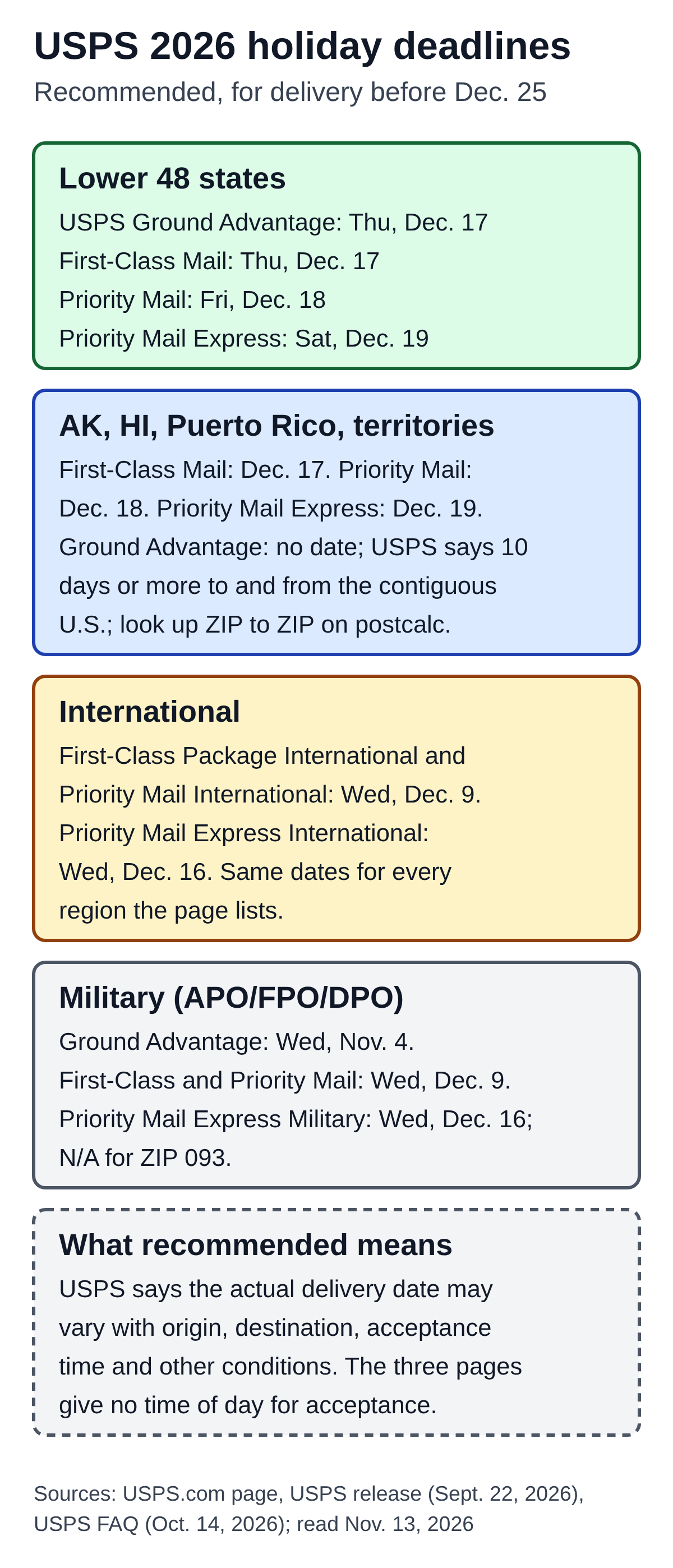
    Diagram of the send-by dates USPS recommends for delivery before December 25, 2026, from the USPS.com page 2026 Holiday Shipping Deadlines, a USPS news release dated Sept. 22, 2026 and a USPS FAQ dated Oct. 14, 2026. Lower 48 states: USPS Ground Advantage Thursday Dec. 17; First-Class Mail Thursday Dec. 17; Priority Mail Friday Dec. 18; Priority Mail Express Saturday Dec. 19. Alaska, Hawaii, Puerto Rico and territories: First-Class Mail Dec. 17, Priority Mail Dec. 18, Priority Mail Express Dec. 19; USPS Ground Advantage has no date, and USPS says service between the contiguous U.S. and these places has a service expectation of 10 days or more, to be looked up from ZIP Code to ZIP Code on postcalc. International: First-Class Package International Service and Priority Mail International Wednesday Dec. 9; Priority Mail Express International Wednesday Dec. 16; the same dates for every region the page lists. Military mail to APO, FPO and DPO addresses: USPS Ground Advantage Wednesday Nov. 4; First-Class Mail and Priority Mail Wednesday Dec. 9; Priority Mail Express Military Service Wednesday Dec. 16, not available for ZIP 093. What recommended means: USPS says the actual delivery date may vary with origin, destination, acceptance time and other conditions, and the three pages give no time of day for acceptance. Sources read Nov. 13, 2026.

    Lower 48 states, Alaska, Hawaii, Puerto Rico and territories

    USPS describes these as “recommended send-by dates for expected delivery before December 25.” The first column is the contiguous U.S. (the Lower 48 states); the second is Alaska, Hawaii, Puerto Rico and U.S. territories.

    ServiceLower 48AK, HI, Puerto Rico, territories
    USPS Ground AdvantageThu, Dec. 17No date; see below
    First-Class MailThu, Dec. 17Thu, Dec. 17
    Priority MailFri, Dec. 18Fri, Dec. 18
    Priority Mail ExpressSat, Dec. 19Sat, Dec. 19

    The FAQ labels the First-Class Mail row “including greeting cards.” For USPS Ground Advantage to or from Alaska, Hawaii, Puerto Rico and the territories, the table gives no date. A footnote says packages between the contiguous United States and Alaska, Hawaii, American Samoa, Puerto Rico, the U.S. Virgin Islands, Guam, the Northern Mariana Islands and the Freely Associated States “will have a 10-day or more service expectation,” that days vary with distance, and that customers can look up service expectations from one ZIP Code to another for a particular mailing date at postcalc.usps.com/ServiceCommitments. Another footnote says Ground Advantage packages to or from these ZIP Codes may have longer transit times and extended estimated delivery dates, and to adjust the induction date as needed.

    A third footnote says U.S. Customs and Border Protection requires mailers to prepay duties, taxes and fees, and to obtain proof of payment, on articles valued up to $2,500 entering the customs territory of the United States from American Samoa, Guam, the Northern Mariana Islands and the U.S. Virgin Islands, and points to the Domestic Mail Manual for details.

    International mail

    For international mail, USPS lists the same dates for each of nine destination groups: Africa, Asia/Pacific Rim, Australia/New Zealand, Canada, the Caribbean, Central and South America, Europe, Mexico and the Middle East.

    ServiceSend by
    First-Class Package International ServiceWed, Dec. 9
    Priority Mail InternationalWed, Dec. 9
    Priority Mail Express InternationalWed, Dec. 16

    The FAQ adds that the actual delivery date may vary “including customs delays.” The USPS.com page’s note on this table does not mention customs.

    Military mail (APO, FPO and DPO)

    ServiceZIPs 090-092, 094-099, 340, 962-966ZIP 093
    USPS Ground AdvantageWed, Nov. 4Wed, Nov. 4
    First-Class MailWed, Dec. 9Wed, Dec. 9
    Priority MailWed, Dec. 9Wed, Dec. 9
    Priority Mail Express Military ServiceWed, Dec. 16N/A

    USPS’s note says Priority Mail Express Military Service is available to selected military and diplomatic Post Offices and to check with the local Post Office whether it is available for an APO, FPO or DPO address. The Ground Advantage date of November 4 has already passed as of the date of this article. The September 22 release says USPS recommends visiting the holiday shipping page for the full list of military and international dates beginning mid-October.

    What “recommended” means

    The pages call these “recommended” dates. Footnote 1 of the USPS.com page and the FAQ say the actual delivery date may vary depending on origin, destination, Post Office acceptance time (the FAQ says acceptance date and time) and other conditions. The September 22 release says customers “should always plan to mail and ship packages early to ensure arrival by Dec. 25.”

    The two USPS pages put different notes about the Priority Mail Express guarantee on different tables. On the USPS.com page, footnote 5 is attached to the Priority Mail Express column of the table for Alaska, Hawaii, Puerto Rico and U.S. territories; it says that as of August 1, 2023, USPS no longer processes refund requests for guaranteed service on these items, and that refund requests for loss are still processed. The USPS.com table for the Lower 48 has no such footnote. In the FAQ, footnote 5 is attached to the Priority Mail Express row of the same Alaska, Hawaii, Puerto Rico and territories table and reads: “Excluding Puerto Rico, USPS does not process refund requests for guaranteed service on these items. Refund requests for loss will still be processed.” The FAQ puts a separate note on the Priority Mail Express row of its Lower 48 table, and repeats it at the top of the page: for Priority Mail Express 1-Day shipments mailed December 22 through December 25, postage for the money-back guaranteed service is not refunded if the shipment was delivered, or delivery was attempted, within two business days of the date of mailing. The USPS.com page has no such note. This article does not reconcile the wording of the two pages, and it does not apply any of these notes outside the table they are attached to.

    The USPS.com page also says that Hanukkah (Dec. 4 to Dec. 12) is earlier this year, so please adjust accordingly; it gives no send-by dates specific to Hanukkah or Kwanzaa. It also points to free shipping supplies, printing labels and scheduling a free package pickup; how pickup works is covered in How Does USPS Package Pickup Work? Free Pickup and Limits.

    What the pages do not say

    The USPS.com page shows no update date; the release is dated September 22, 2026 and the FAQ October 14, 2026. None of the three pages gives a time of day by which a Post Office must accept an item, and none gives Post Office hours. They give no send-by dates for other mail types or for returns, and no prices. For USPS Ground Advantage to Alaska, Hawaii, Puerto Rico and the territories, they give a service expectation of 10 days or more and a lookup tool, not a send-by date.

    Sources

    All pages were read on November 13, 2026.

  • How Does USPS Package Pickup Work? Free Pickup and Limits

    Package Pickup is a free USPS service: your letter carrier collects eligible prepaid packages from your address on the next delivery day or a day you choose. USPS’s FAQ says it costs nothing regardless of how many items you schedule, and that you can schedule, edit or cancel it Monday through Saturday until 2:00 AM Central Time on the day of the pickup. Each item can weigh up to 70 pounds and measure up to 130 inches in total length and girth. Pickup on Demand, which lets you choose a two-hour window, is a separate service with a fee.

    This article covers what three USPS pages say: the FAQ “Package Pickup & Pickup on Demand,” the USPS.com page “How to Prepare & Send a Package” and USPS’s “Schedule a Pickup” page. For two points that the FAQ leaves to the Domestic Mail Manual (DMM), it also reads DMM sections 116, 126, 136 and 601. The wording is as of November 9, 2026. None of the three USPS pages shows an update date, and DMM 116, 126 and 136 show none either. The article gives no prices or fee amounts and instead names the USPS price list the FAQ points to, and it does not cover international mail in detail, business mailers, USPS Connect or how a particular carrier handles a stop.

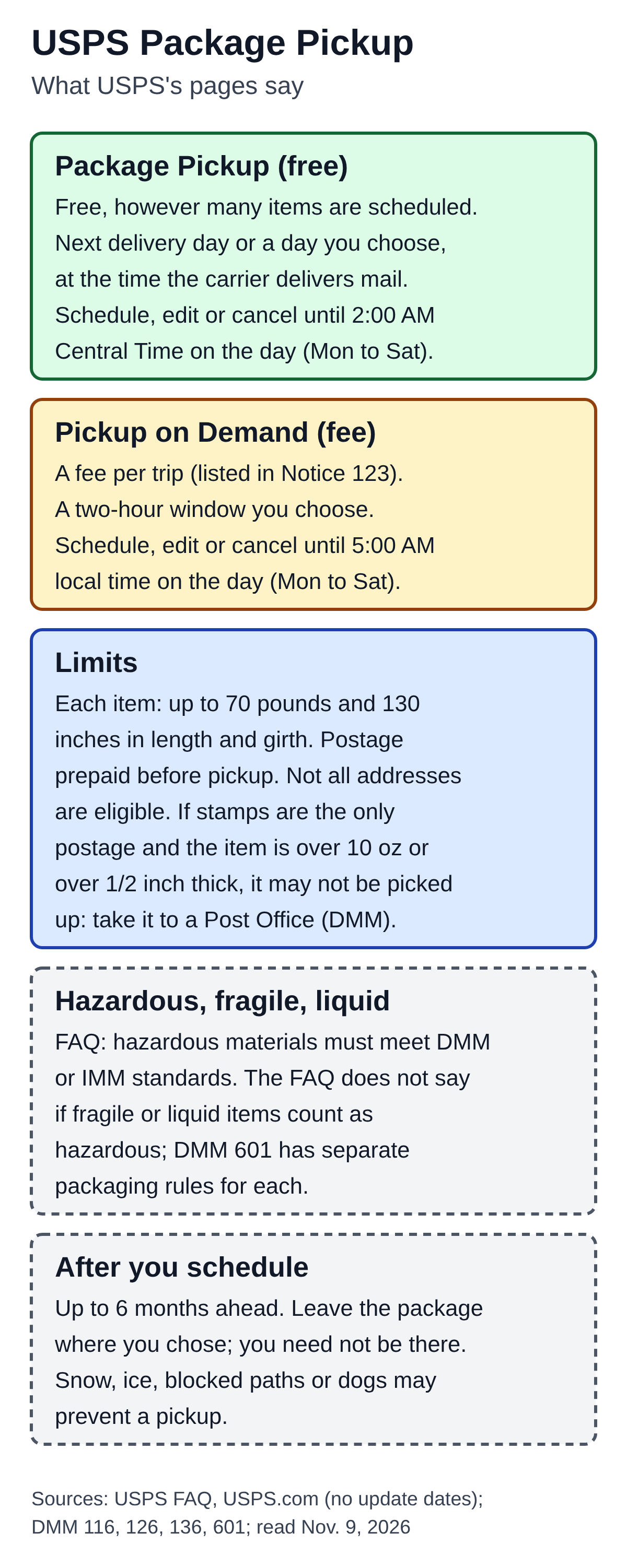
    Diagram of what USPS says about Package Pickup, from USPS's Package Pickup and Pickup on Demand FAQ, the USPS.com page How to Prepare and Send a Package, USPS's Schedule a Pickup page and sections of the Domestic Mail Manual (DMM). Package Pickup: free, regardless of the number of items; next delivery day or a designated day, at the time the carrier delivers mail; schedule, edit or cancel Monday to Saturday until 2:00 AM Central Time on the day. Pickup on Demand: a fee per trip, listed in Notice 123; a two-hour window; schedule, edit or cancel until 5:00 AM local time. Limits: each item up to 70 pounds and 130 inches in total length and girth; not all addresses are eligible; postage must be prepaid. If stamps are the only postage and the item weighs more than 10 ounces or is more than one-half inch thick, the DMM says it may not be picked up and the sender must take it to a Post Office; the DMM sections read cover Priority Mail Express, Priority Mail, First-Class Mail and USPS Ground Advantage retail. Hazardous, fragile and liquid items: the FAQ says hazardous materials must meet DMM or IMM standards and does not say whether fragile or liquid items count as hazardous; DMM section 601 has separate packaging rules for each. After scheduling: up to six months ahead; leave the package where you chose and you need not be present; snow, ice, obstructed paths or dogs may prevent a pickup. The FAQ and the USPS.com page show no update date. Sources read Nov. 9, 2026.

    Package Pickup and Pickup on Demand side by side

    USPS’s FAQ describes three options for outgoing mail: Pickup on Demand, Package Pickup and Collection Service, which means prepaid mail dropped in a collection box or handed to a letter carrier or other postal employee. The two scheduled services differ as follows.

    Package PickupPickup on Demand
    CostFree, regardless of the number of itemsA fee per trip, regardless of the number of items; the FAQ says fees are in Notice 123
    WhenNext delivery day or a designated delivery day, at the time the carrier delivers your mail; can occur at any time on the scheduled dateA specific date within a two-hour window; typically occurs within two hours of the scheduled time
    Schedule, edit or cancel byMonday to Saturday until 2:00 AM Central Time on the day of the pickupMonday to Saturday until 5:00 AM local time on the day of the pickup
    Mail that is eligibleThe list in the next sectionThe same list plus USPS Connect Local, Package Service parcels, and Priority Mail Express and Priority Mail Open and Distribute shipments

    What can be picked up

    The FAQ says the letter carrier can only pick up packages with prepaid postage, or return merchandise, that are eligible for the free or the paid service. For Package Pickup it lists Priority Mail Express, Priority Mail, USPS Ground Advantage, returns, International Priority Mail Express, International Priority Mail and First-Class Package International Service. It adds that packages of other mail classes, such as First-Class Mail items, may also be picked up if they are combined with one of those products.

    Media Mail is not named on that list, and this article does not say whether a Media Mail package can be picked up. The rules for that service are in What Can You Send by USPS Media Mail? What Qualifies.

    Two notes in the FAQ apply to specific services. For Priority Mail Express, the guarantee for a specific mailing requires that the item be presented to an acceptance employee at a Post Office, and the FAQ says to contact the local Post Office for guarantee details. International packages can be picked up only if the shipping label, customs forms and postage payment were completed online; packages with hand-written customs forms must be taken to a Post Office retail location.

    Postage and the 10-ounce rule

    The FAQ says sufficient postage must be on the package before the pickup. You can buy postage online through Click-N-Ship, PC Postage or postage meters. The valid ways to prepay that it lists are postage stamps (provided the item weighs 10 oz or less and is 1/2 inch in thickness or less), a postage meter imprint, PC Postage products, online Click-N-Ship labels with postage, a prepaid Priority Mail Flat Rate envelope and return items that are prepaid. The FAQ also says the letter carrier is not required to verify postage, but that offices follow standard revenue protection practices if a package appears underpaid.

    In the DMM, the weight and thickness rule is worded for items paid only with stamps. The DMM says that Priority Mail Express (section 116, 1.0), Priority Mail (section 126, 1.2) and retail First-Class Mail and USPS Ground Advantage (section 136, 1.0) items bearing only postage stamps as postage payment, and weighing more than 10 ounces or measuring more than one half-inch in thickness, may not be picked up during the normal delivery and collection of mail or through Pickup on Demand. Section 126 says such Priority Mail pieces are precluded from pickup service. In each section the sender must present such an item to an employee at a Post Office, and sections 116 and 136 add that improperly presented items will be returned to the sender. This article reads those three sections only and does not cover other mail classes.

    The FAQ puts the same point as mailpieces that weigh more than 10 oz or are more than 1/2 inch thick and bear postage stamps for postage having to be presented at a retail counter. One FAQ sentence reads “10 oz or less or 1/2-inch or less”; this article follows the DMM wording, which applies to an item over either limit. The USPS.com page adds that a stamped package over those limits put in a mailbox is left by the carrier and one dropped in a blue collection box is returned to the sender, and that if you print the postage with Click-N-Ship or at a USPS kiosk you can use any drop-off method. The DMM wording covers items bearing only postage stamps.

    Size, hazards and addresses

    Each item can weigh up to 70 pounds and measure up to 130 inches in total length and girth.

    In its limitations on what can be picked up, the FAQ says hazardous materials must meet all packaging, labeling and other USPS mailability standards in the DMM or the International Mail Manual (IMM), as applicable. The next FAQ sentence says “This includes items that contain anything fragile without proper packaging or liquid items.” The FAQ does not define hazardous materials and does not say whether fragile or liquid items count as hazardous. The DMM has separate packaging rules for them in section 601: mailers must package mailpieces to withstand normal transit and handling and must cushion fragile items (3.1.1); a mailpiece containing liquid must be marked on the outer container to show it holds liquid and carry orientation arrows, and primary containers must be closed with screw-on caps with at least one and one-half turns, soldering, clips or similar means (3.4); and mailpieces containing perishable, hazardous, biological or restricted materials are subject to the standards in Publication 52 (3.6). This article does not go through those standards in detail and does not say which items a carrier would refuse at a pickup.

    The FAQ says not all addresses are eligible for Package Pickup, and USPS’s Schedule a Pickup page says it will verify that the address is eligible. The pages do not list which addresses are not eligible.

    Scheduling, changing and leaving the package

    You can submit a request on a weekend or holiday, but the pickup happens on the next scheduled delivery day; USPS’s example is a Saturday-afternoon request accepted for Monday unless Monday is a Postal holiday. You can schedule up to 6 months in advance, and a login is needed for future and repeat requests, including daily, weekly or monthly pickups within the next six months.

    When you request a pickup you choose where the package will be left. The FAQ lists locations such as in or at the mailbox, on the porch, the front, back or side door, knock on the door or ring the bell, the mail room, an office or reception. For multi-story buildings it asks residents to bring packages to a ground-level, secured location. It says letter carriers may use their discretion and that snow, ice, obstructed pathways and dogs may prevent a pickup. You do not need to be present, as long as you are shipping postage-paid items within the United States that have been properly prepared for pickup and left in a safe location for the carrier.

    To change or cancel, the FAQ says to open the Schedule a Pickup application, choose “Modify an Existing Pickup” and enter the confirmation number with the email address or phone number. You can modify the date, the location, the number of packages and the total weight. If the package volume or weight rises on the same day as the pickup, the FAQ says to call the local Post Office. You get a confirmation email or, if no email address was given, a notice from the carrier after the pickup; if the item was not collected, the notice says why. Delivery status online is available for Priority Mail Express items and packages with USPS Tracking or Signature Confirmation.

    If the pickup does not happen

    The FAQ says to contact the local Post Office and to file a service request through “Email Us,” then “Where is my Mail?” It adds that Pickup on Demand refunds can be requested online if the service was not performed according to its service features.

    What the pages do not say

    None of the three USPS pages shows an update date, and neither do DMM 116, 126 and 136; DMM 601 section 3.4 carries the mark [4-6-26]. The FAQ gives the cutoff for Package Pickup as 2:00 AM Central Time in one place, while its note on modifying or canceling says “before 2:00 am” without a time zone; this article uses the Central Time wording and does not resolve the difference. The pages do not list the addresses that are not eligible, do not say what time of day a carrier will arrive, and do not give the Pickup on Demand fee, which the FAQ places in Notice 123. The FAQ does not say whether fragile or liquid items count as hazardous materials, and the DMM sections read here do not say how a carrier handles them at a pickup.

    Sources

    All pages were read on November 9, 2026.

  • What Can You Send by USPS Media Mail? What Qualifies

    USPS says Media Mail is for a short list of items: books, films, printed music, recordings and a few educational and medical materials. USPS.com says that if you include anything that is not allowed, you or your recipient will have to pay higher postage rates, and that all Media Mail packages are subject to opening and inspection. USPS.com gives a maximum weight of 70 pounds.

    This article covers what two USPS pages say: the Media Mail section of the USPS.com Mail & Shipping Services page and section 173 of the Domestic Mail Manual (DMM), “Media Mail and Library Mail.” The wording is as of November 9, 2026. Neither page shows an update date. The article gives no prices or fee amounts and instead links USPS’s price calculator and price list, and it does not cover Library Mail in detail, commercial mailings, international mail or how a borderline item would be treated at a Post Office.

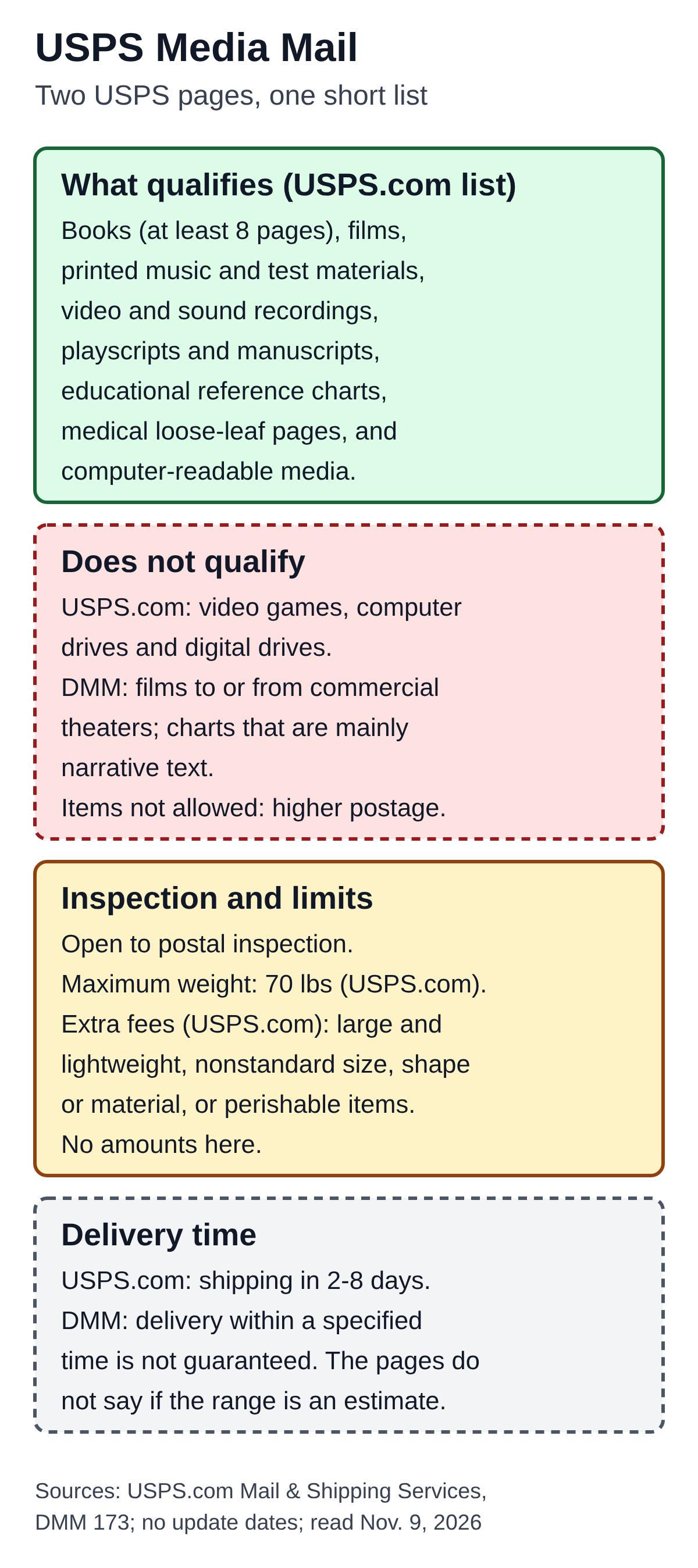
    Diagram of what USPS says about Media Mail, from the USPS.com Mail and Shipping Services page and Domestic Mail Manual 173. What qualifies, per the USPS.com list: books of at least 8 pages, films 16 millimeter or narrower, printed music and test materials, video and sound recordings, playscripts and manuscripts, printed educational reference charts, medical loose-leaf pages and binders, and computer-readable media. Does not qualify: USPS.com says video games, computer drives and digital drives do not; the DMM says films sent to or from commercial theaters and charts conveyed mainly by narrative text do not; items that are not allowed cost higher postage. Inspection and limits: Media Mail is open to postal inspection, USPS.com gives a maximum weight of 70 pounds, and USPS.com says extra fees apply to packages that are large and lightweight, nonstandard in size, shape or material, or perishable; no amounts are given. Delivery time: USPS.com shows shipping in 2 to 8 days and the DMM says delivery within a specified time is not guaranteed; the pages do not say whether the range is an estimate. Neither page shows an update date. Sources read Nov. 9, 2026.

    What qualifies, item by item

    USPS.com lists eight kinds of items. The DMM, which says “only these items may be mailed at the Media Mail prices,” adds the conditions. The table puts the two side by side.

    ItemUSPS.com listWhat DMM 173 adds
    BooksBooks (at least 8 pages)At least eight printed pages; wholly reading matter or scholarly bibliography, or reading matter with incidental blank spaces for notations; no advertising other than incidental announcements of books
    Films16-millimeter or narrower width filmsPositive prints in final form for viewing; films and film catalogs sent to or from commercial theaters do not qualify
    Printed musicPrinted music and test materialsPrinted music in bound or sheet form
    Test materialsPrinted music and test materialsPrinted objective test materials and their accessories, used by or on behalf of educational institutions
    RecordingsVideo and sound recordings (tapes, albums, CDs and DVDs)Sound recordings, with video recordings and player piano rolls classified as sound recordings; includes incidental announcements and guides or scripts for use with them
    Playscripts and manuscriptsPlayscripts and manuscriptsPlayscripts and manuscripts for books, periodicals and music
    Educational reference chartsPrinted educational reference chartsA single printed sheet whose information is conveyed mainly by graphs, diagrams, tables or other nonnarrative matter; a chart conveyed mainly by narrative text does not qualify
    Medical loose-leaf pagesMedical loose-leaf pages and bindersMedical information for distribution to doctors, hospitals, medical schools and medical students
    Computer-readable mediaComputer-readable mediaContaining prerecorded information, and guides or scripts prepared solely for use with such media

    What does not qualify

    USPS.com adds a note that video games, computer drives and digital drives do not qualify for Media Mail prices. The DMM does not mention video games. Its list for computer-readable media covers media containing prerecorded information and guides or scripts for use with them, and this article does not say how a particular disc or drive would be treated.

    Other limits come from the DMM list in the table: books must have at least eight printed pages and no advertising beyond incidental book announcements; films and film catalogs sent to or from commercial theaters do not qualify; and a chart conveyed mainly by narrative text does not qualify as an educational reference chart. The DMM also says matter that is mailed or required to be mailed as First-Class Mail, or that is entered as Periodicals, is not Media Mail.

    Inspection

    USPS.com says all Media Mail packages are subject to opening and inspection by the Postal Service. The DMM says Media Mail and Library Mail are not sealed against postal inspection, and that mailing articles at Media Mail prices constitutes the mailer’s consent to postal inspection of the contents, regardless of how the package is closed.

    Weight, size and fees

    USPS.com gives a maximum weight of 70 pounds and sends readers to the Media Mail eligibility standards (the DMM section above) for the full list of requirements. It also says you will pay additional fees for a package that is large and lightweight, has a nonstandard size, shape or material, or has perishable items. The DMM says Media Mail pieces are charged per pound or fraction thereof, and that any fraction of a pound counts as a whole pound. This article gives no amounts. For prices, USPS.com links its Price Calculator, and the DMM refers readers to Notice 123, the USPS price list.

    Delivery time

    USPS.com shows “Shipping in 2-8 Days” for Media Mail, with a footnote that service to or from destinations outside the contiguous U.S. may be affected by limited transportation. The DMM says USPS does not guarantee the delivery of Media Mail or Library Mail within a specified time. Both statements are on official USPS pages. The pages do not say whether the USPS.com range is an estimate, so this article does not read it as a promise, and it does not say which statement controls.

    Enclosures and writing on the package

    The DMM sets extra rules. A book may have one envelope or one addressed postcard bound into its pages and one order form, and may include incidental announcements of books. Printed matter that is mailable as USPS Marketing Mail may be included loose with qualifying material. An invoice that relates only to the matter mailed may go inside the piece or in an envelope marked “Invoice Enclosed” attached to the outside.

    On writing, the DMM says markings that have the character of personal correspondence require, with certain exceptions, additional postage at First-Class Mail prices. The exceptions include the sender’s and addressee’s names and addresses, marks describing the contents, instructions for using the item, and words or phrases such as “Do Not Open Until Christmas” and “Happy Birthday, Mother.” Every piece must show a delivery address with the correct ZIP Code or ZIP+4 code, and the sender’s return address.

    Library Mail

    USPS.com calls Library Mail a related service for eligible organizations, including schools, museums, nonprofits and other groups. DMM section 173 covers both services, and its Library Mail rules (section 5.0) name the eligible senders and addressees. This article does not cover them.

    What the pages do not say

    Neither page shows an update date. The old USPS.com Media Mail page now shows “This Page Has Moved” and points to the Mail & Shipping Services page. The pages do not settle borderline items, so for an item that is not on the list, a Post Office is the place to ask.

    Sources

    Both pages were read on November 9, 2026.

  • How Does USPS Package Intercept Work? Eligibility and Limits

    USPS Package Intercept is a fee-based service that lets the sender of an eligible item ask USPS to try to stop delivery or redirect it, as long as the item is not yet out for delivery or delivered. USPS says it is not a guaranteed service. The request is active for 7 business days, it cannot be edited or cancelled, and USPS.com says that if the shipment is intercepted, the Package Intercept fee plus any applicable postage is charged, while customers are not charged if the shipment was not intercepted.

    This article covers what three USPS pages say: the USPS.com Package Intercept page, a USPS FAQ called “USPS Package Intercept – The Basics” (dated October 27, 2026) and a USPS Package Intercept terms page (it shows “Updated: 7/15/2016”). The wording is as of November 9, 2026. The three pages do not use the same wording on mail classes, maximum size or postage, and the article shows those differences instead of choosing one. It does not give any fee or postage amount, because USPS lists those on a separate price page, and it does not cover commercial intercept requests in detail, international mail or what to do about a lost or stolen package.

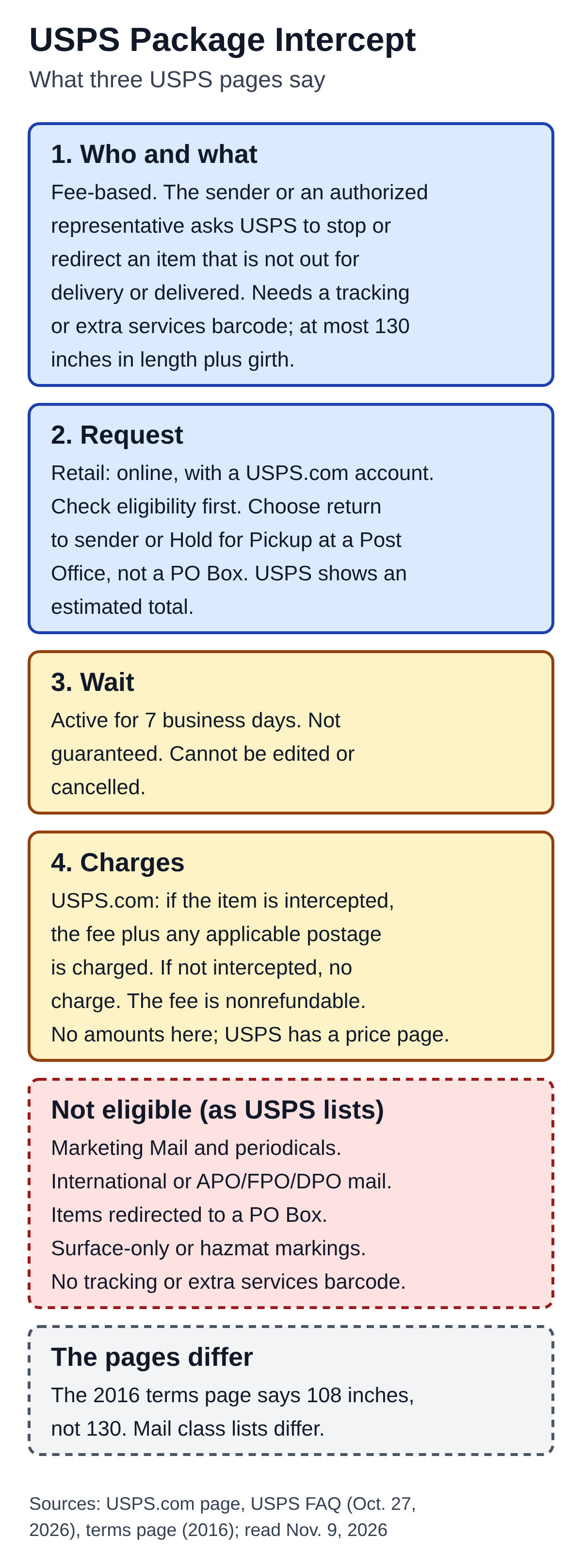
    Diagram of what USPS says about Package Intercept, from the USPS.com page, a USPS FAQ dated Oct. 27, 2026 and an older terms page. Step 1, who and what: a fee-based service for the sender or an authorized representative, for an item that is not out for delivery or already delivered, with a tracking or extra services barcode and no more than 130 inches in length and girth. Step 2, request: retail senders request online with a USPS.com account after checking eligibility, and choose return to sender or Hold for Pickup at a Post Office; an estimated total is shown. Step 3, wait: requests are active for 7 business days, success is not guaranteed, and a request cannot be edited or cancelled. Step 4, charges: USPS.com says that if the item is intercepted, the fee plus any applicable postage is charged, that customers are not charged if it is not intercepted, and that the fee is nonrefundable. Not eligible, as USPS lists it: Marketing Mail and periodicals, international or APO, FPO and DPO mail, items redirected to a PO Box, surface-only or hazardous materials markings, and items without a tracking or extra services barcode. The 2016 terms page says 108 inches instead of 130. Sources read Nov. 9, 2026.

    Who can request it

    USPS.com and the FAQ both describe the request as coming from the sender or the sender’s authorized representative (the FAQ says “authorized agent”). The pages do not describe a request made by the person receiving the package.

    USPS.com splits senders into two groups. Retail senders can redirect a shipment back to their own address or to a Post Office as Hold For Pickup, and they can only request an intercept online with a USPS.com account. Commercial senders can redirect a shipment back to their address, to a new delivery address or to a Post Office as Hold For Pickup through the Business Customer Gateway. The FAQ adds that redirecting to a new delivery address is only available for commercial intercept requests.

    What is eligible

    According to USPS.com, most domestic mailings with a tracking or extra services barcode are eligible, as long as the total of length and girth is not larger than 130 inches. The FAQ gives the same 130-inch limit, with a note that only USPS Ground Advantage and Parcel Select oversized-priced items measure more than 108 inches and up to 130 inches. It also says the recipient and the sender must both be domestic, with APO, FPO and DPO addresses excluded.

    The FAQ also says that commercially shipped packages typically have a tracking number that begins with “92” or “93”. It says those can only be intercepted by a commercial mailer through the Business Customer Gateway, and that the USPS.com retail intercept cannot be used for tracking numbers with those prefixes. The FAQ tells customers to check eligibility with USPS Tracking or the eligibility checker on USPS.com before requesting.

    What is not eligible

    USPS.com lists these as not eligible: USPS Marketing Mail products and periodicals; items addressed to a Commercial Mailing Receiving Agency; items redirected to a PO Box; and nonmailable items, items with surface-only transportation markings (such as Label 127 or Surface Mail Only) and items with hazardous materials markings such as Consumer Commodity ORM-D.

    The FAQ’s list is worded differently. It names mailpieces sent to or from international destinations, sent to or from APO, FPO or DPO destinations, domestic mailpieces that need a customs declaration label, domestic mailpieces marked for surface-only transportation (including hazardous materials markings such as “Limited Quantity,” “Consumer Commodity” or “ORM-D”) and domestic mailpieces without a tracking barcode, including those for extra services.

    How a request works

    USPS.com describes four steps for a retail request. First, verify that the shipment is eligible. Second, sign in to or create a USPS.com account. Third, submit the request and choose where USPS should redirect the shipment: back to the sender, held at the destination Post Office or held at a new Post Office. Fourth, after you submit, USPS shows an estimated total, which is the intercept fee plus estimated postage if it applies, and then attempts to intercept and redirect the shipment.

    Per the FAQ, USPS intercepts the item at the delivery Post Office. It is then returned to the sender or held at a Post Office as Hold for Pickup, but not sent to a PO Box. Tracking continues under the original tracking number.

    Time limits and no guarantee

    The FAQ says a request is active for 7 business days from the date of the request. The Post Office makes every attempt to locate the item during that time, but the FAQ says there is no guarantee that the item can be intercepted before delivery. USPS can prevent delivery only as long as the item is not showing as out for delivery or delivered. USPS.com also says Package Intercept is not a guaranteed service and that certain conditions apply.

    The FAQ says you cannot edit or cancel a Package Intercept request.

    Fees and postage

    This article gives no amounts. USPS.com and the FAQ both send readers to a separate USPS price page for the Package Intercept fee.

    On when charges apply, the three pages say similar things. USPS.com says that if the shipment is intercepted, the card is charged the Package Intercept fee plus any applicable postage, and that any additional postage is charged if the actual postage is greater than the estimate. It also says customers are not charged if the shipment was not intercepted and that the fee is non-refundable if the intercept succeeds. The FAQ says you pay all fees only if an intercept was possible, that there is no charge if the item is delivered before it can be intercepted, and that the fee applies to each mailpiece intercepted. The terms page says fees and postage are charged only upon a successful intercept.

    The FAQ also has sentences saying that some postage and fees are charged at the time of the intercept “or otherwise” collected from the recipient or by a USPS carrier at delivery. The FAQ does not explain how those sentences fit with the lines saying there is no charge when the item is delivered first, so this article does not try to reconcile them.

    For postage, USPS.com says an intercepted item is redirected as the service it was originally sent with (Priority Mail Express, Priority Mail, USPS Ground Advantage or First-Class Mail) and that you pay the applicable postage. The FAQ is more detailed. It says Priority Mail Express, Priority Mail and USPS Ground Advantage items redirected to the sender are not relabeled and carry no additional postage cost. It says those classes redirected to a Post Office as Hold for Pickup are relabeled and handled as a new item of the same class at the commercial postage price. It says Bound Printed Matter, Media Mail and Library Mail items are relabeled as new Priority Mail items and charged Priority Mail commercial postage, whether they go back to the sender or to a Post Office, and it has separate lines for Parcel Select.

    Extra services

    USPS.com says retail and commercial customers can also buy additional services for the intercepted package: Adult Signature Required, Adult Signature Restricted Delivery, Signature Confirmation and insurance. The FAQ is more specific. It says Adult Signature Required, Adult Signature Restricted Delivery and Signature Confirmation are available when the item is redirected to a new address or to a Post Office for Hold for Pickup, and that insurance applies only if the original shipment included it, for the original value only.

    For Registered Mail, the FAQ says intercept is only possible when the item is redirected to the sender. The item comes back under the original Registered Mail number, not relabeled or repackaged, and the customer must write “Withdrawn” on the Registered Mail receipt, sign it and surrender it to the Post Office. The terms page also says a Registered Mail item can only be returned to the sender.

    Where the three pages differ

    TopicUSPS.com pageUSPS FAQ (Oct. 27, 2026)Terms page (updated 7/15/2016)
    Mail classesExcludes Marketing Mail and periodicals; names Priority Mail Express, Priority Mail, USPS Ground Advantage and First-Class Mail as the services items are redirected asLists seven classes: Priority Mail Express, Priority Mail, Bound Printed Matter, USPS Ground Advantage (retail and commercial), Parcel Select, Media Mail, Library Mail; First-Class Mail is not in the listAll mail classes except Standard Mail and Periodicals
    Maximum size130 inches in length and girth130 inches in length and girth (a note says only USPS Ground Advantage and Parcel Select oversized-priced items are over 108 inches)108 inches in length and girth
    Postage for redirectingAs the service originally usedBy class, with relabeling rulesAt the Priority Mail rate

    The terms page is the oldest of the three and the only one that gives 108 inches as the limit. The article does not say which page controls. If your item is a First-Class Mail piece, a large package or a class not listed in the FAQ, USPS.com’s eligibility check or a Post Office is the way to confirm.

    Sources

    All three pages were read on November 9, 2026.

  • How Does a USPS PO Box Work? Sizes, ID and Service Periods

    A USPS PO Box is a secure, numbered box at a Post Office where your mail is kept until you collect it. USPS says you can apply online or at a Post Office, and that you pick up your keys or lock combination at the Post Office where the box is, after the staff verify your identification. The rental fee depends on the box size and the location. This article does not give fees.

    This article covers what three official USPS sources say: the USPS.com page “Rent a PO Box”, the USPS FAQ “PO Box – The Basics” (dated October 16, 2026), and section 4.0 of the Domestic Mail Manual (DMM 508), which sets the rules for PO Box service. The wording is as of November 6, 2026. The USPS.com page and the DMM show no update date. The article does not cover prices, free box service, Caller Service or business accounts.

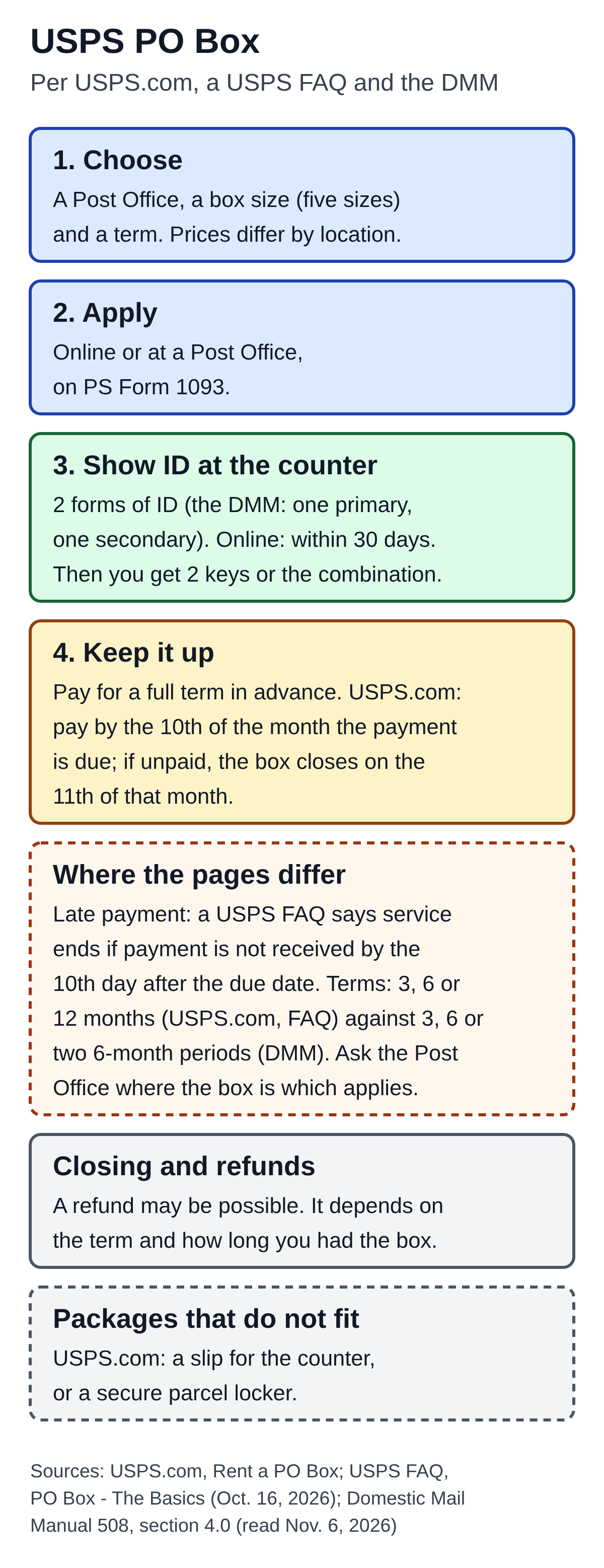
    Diagram of how a USPS PO Box works, per USPS.com, a USPS FAQ and the Domestic Mail Manual. 1. Choose: a Post Office, a box size (five sizes) and a term; prices differ by location. 2. Apply: online or at a Post Office, on PS Form 1093. 3. Show ID at the counter: 2 forms of ID (the DMM: one primary, one secondary); online applicants within 30 days; then you get 2 keys or the combination. 4. Keep it up: pay for a full term in advance; USPS.com says pay by the 10th of the month the payment is due, and an unpaid box closes on the 11th of that month. Where the pages differ: a USPS FAQ says service ends if payment has not been received by the 10th day after the due date; terms are 3, 6 or 12 months (USPS.com, FAQ) against 3, 6 or two 6-month periods (DMM); ask the Post Office where the box is. Closing and refunds: a refund may be possible, depending on the term and how long you had the box. Packages that do not fit: a slip for the counter or a secure parcel locker (USPS.com). Sources: USPS.com, Rent a PO Box; USPS FAQ, PO Box - The Basics (Oct. 16, 2026); Domestic Mail Manual 508, section 4.0 (read Nov. 6, 2026).

    Sizes

    USPS.com says most Post Offices have five PO Box sizes, depending on availability, and the DMM says the sizes available vary by facility. The page describes what each size holds; the DMM gives capacities in cubic inches. Both give the same frontal dimensions, though they list the width and height of sizes 3 and 5 in a different order.

    SizeFront (inches)What USPS.com says it holdsDMM capacity
    1 (XS)3 x 5.510-15 letters and 3 rolled magazinesUnder 296 cubic inches
    2 (S)5 x 5.515+ letters, 5 rolled magazines, or 1 Small Priority Mail Flat Rate Box296 through 499
    3 (M)5.5 x 11Large envelopes and magazines stacked, and 2 Small Priority Mail Flat Rate Boxes500 through 999
    4 (L)11 x 11Small and Medium Priority Mail Flat Rate Boxes, with room for 10-15 letters1,000 through 1,999
    5 (XL)12 x 22.5Big enough for multiple packages2,000 or more

    How to get one

    USPS.com describes four online steps: search for Post Offices near you, choose a location, box size and payment period, complete the online application (which generates PS Form 1093) and submit it with payment, then print the form and take it to the Post Office counter where the box is, with 2 forms of acceptable U.S. identification, within 30 days of applying online. After the retail associate verifies your identity, you get your keys or lock combination. To apply in person, you bring your payment and 2 forms of acceptable U.S. identification to the Post Office.

    The DMM describes identification in more detail. Each applicant listed on the form, including both spouses and other individuals listed but not minors, must present two items of valid, current identification: one acceptable primary form and one acceptable secondary form. The DMM refers to its sections 608.10.3 and 608.10.4 for what counts, and this article does not list them. Spouses may complete and sign one form. Minors may be provided with service unless a parent or guardian objects in writing, but they cannot apply online.

    You can rent a box in a different city or state, but USPS.com says you still have to visit the Post Office where the box is, with the proper documentation, to pick up the keys or combination.

    If the box you want is not available

    USPS.com says you can choose another size, look at another location, or ask to be put on a wait list for that size at that location. USPS says it will contact you by email or phone when the box becomes available, and that you then have 2 days to reserve it before it goes to the next person on the list. The DMM says the postmaster may refer you to another facility, use a waiting list, provide general delivery until a box is available, or offer a different size or Caller Service, and that online customers cannot apply for a box that is not available but can join the waiting list.

    Service periods, payment and renewal

    USPS.com lists terms of 3, 6 and 12 months, and the USPS FAQ lists 3-month, 6-month (semi-annual) and 12-month (annual) increments. The DMM says in 4.1.7 that PO Box service is available in 3-, 6- or two 6-month (semi-annual) prepaid periods, and in 4.4.3 that a fee may generally be paid up to one year in advance. None of the pages says in so many words how a 12-month term relates to two 6-month periods, so this article does not call the wording a conflict and does not say which terms a given Post Office offers.

    All three say the 3-month option involves automatic recurring renewal. USPS.com adds that a 3-month term has no opt-out, while with a 6- or 12-month term you can opt out of automatic renewals. The DMM adds that the 3-month option is not available at locations on the April/October payment schedule.

    USPS.com lists four ways to pay: online with a credit or debit card, at a self-service kiosk, by mail (a check or money order payable to “U.S. Postal Service,” sent to the Postmaster where the box is), or in person. You pay for a full rental period at the beginning.

    The pages describe the payment date and late payment in different words. USPS.com says payments must be made by the 10th of the month the payment is due, and that if you do not pay, the box is closed on the 11th of that month. The USPS FAQ says that if payment has not been received by the 10th day after the due date, the service is terminated and incoming mail is returned to senders, and that box fees are due on either the 15th or the last day of the month, depending on the customer’s billing cycle. The DMM gives no closing date: it says a renewal fee may be paid during the last 30 days of the service period but no later than its last day (4.4.4), and that the lock replacement fee also applies as a late payment charge when a box is renewed more than 10 days after the renewal due date (4.7.5). The DMM also lists failing to pay by the due date as one of the cases in which a box is surrendered. The pages do not say how these dates fit together, so this article does not give one deadline; the Post Office where the box is can tell you which date applies to your box.

    If you close a box, USPS.com says you may be eligible for a refund, and that the amount depends on how long you have had the box. The USPS FAQ sets refund conditions by term (for example, it says a box on a 3-month term is not eligible for a refund once it is activated), and the DMM sets refund rules by service period in 4.6. See USPS’s refund details for the current conditions. Our USPS refunds article compares how the USPS.com refund page and the PO Box FAQ word PO Box refunds.

    Keys and access

    USPS.com says you get two keys, or the combination, when you open a box, and the DMM says two keys are initially issued to each new box customer. USPS.com says more keys cost an additional fee. Most locations allow 24/7 access to the box, although USPS.com says hours vary by Post Office. The DMM says mail meant for a box must show the PO Box number in the address immediately above the city, state and ZIP Code.

    Packages and signatures

    If a package does not fit in the box, USPS.com says you will either get a slip to pick it up at the counter during normal business hours, or get it from a secure parcel locker, including USPS Smart Lockers at select locations. For deliveries that need a signature, USPS leaves a notice in the box and you sign at the counter; with the free Signature on File service, USPS.com says it leaves the item in the box instead.

    USPS.com also describes Street Addressing, where available: you can use the street address of your Post Office together with your PO Box number, which lets you receive packages from private carriers such as UPS, FedEx, DHL and Amazon, as long as they comply with USPS mailing standards.

    Closing a box

    USPS.com says you can close a box online through Manage PO Box or by telling the retail associate at the Post Office where the box is, and that you should then submit a Change of Address form, after which mail can be forwarded to your new address for up to one year. The DMM lists a written notice to discontinue service and a permanent change-of-address order among the cases in which a box is surrendered.

    Sources

    All three pages were read on November 6, 2026.

  • Is the Post Office Open on Veterans Day? What USPS Says for 2026

    USPS says it will observe Veterans Day on Wednesday, November 11, 2026, and that all Post Office locations will be closed. The notice adds that regular mail delivery and retail services will resume on Thursday, November 12. Both statements come from a USPS national release dated November 4, 2026.

    This article covers only what that release says about November 11 and 12, 2026. The wording is as of November 6, 2026. It does not cover other carriers, local Post Office hours or other holidays.

    Diagram of what USPS's national release of November 4, 2026 says about Veterans Day 2026. Wednesday, November 11: USPS will observe Veterans Day; all Post Office locations will be closed. Thursday, November 12: regular mail delivery and retail services will resume. Not in the notice: whether Priority Mail Express is delivered on November 11; the notice does not say, either way. Source: USPS national release, Nov. 4, 2026.

    What the USPS notice says

    The release is titled “U.S. Postal Service To Observe Veterans Day Holiday, Nov. 11” and is published in the USPS Newsroom. This is what it states about the holiday:

    DateWhat USPS says
    Wednesday, November 11, 2026USPS will observe Veterans Day. All Post Office locations will be closed.
    Thursday, November 12, 2026Regular mail delivery and retail services will resume.

    What the notice does not say

    The notice does not say whether Priority Mail Express will be delivered on November 11, either that it will or that it will not. This article does not fill that gap from other years or from other USPS notices, so on that question the notice gives no answer.

    The notice also does not list hours for any individual Post Office. Apart from the date on which regular mail delivery and retail services resume, it does not describe delivery on November 11.

    Sources

    The page was checked on November 6, 2026.

  • What Is USPS Certified Mail? What It Includes and How It Works

    USPS Certified Mail is an Extra Service that gives the sender a mailing receipt and, if requested, electronic verification that an item was delivered or that a delivery attempt was made. The USPS FAQ says it is bought at the time of mailing, requires a signature, and can go with Priority Mail or First-Class Mail. The FAQ names the addressee as the signer; the Domestic Mail Manual (DMM) says the recipient signs and prints a name unless an electronic signature is used, and that delivery may go to another person at some addresses, such as a hotel or an apartment house, when the sender has not restricted delivery.

    This article covers what USPS’s pages say. The wording is as of October 29, 2026, and comes from the five USPS pages listed at the end. It describes the service. It does not give advice on whether to use it, and it does not discuss legal effect.

    Diagram of USPS Certified Mail. How it works: bought with Priority Mail or First-Class Mail; mailing receipt; signature at delivery, the recipient signs and prints a name unless an electronic signature is used; delivery verification if requested. Add-ons: Return Receipt; Restricted Delivery, only the addressee or an agent authorized in writing. Not included: insurance of its own, international mail. If undeliverable: notice to the addressee; if the piece is not called for or redelivery is not requested, returned after 15 days, or fewer if the sender specifies; start of the count not stated. No price shown.

    What Certified Mail is

    The USPS FAQ calls Certified Mail a numbered Extra Service that can be bought at the time of mailing at a Post Office. The Domestic Mail Manual (DMM) says Certified Mail is dispatched and handled in transit as ordinary mail, and the FAQ says the item travels at the speed of the mail class it is bought with.

    What you get

    A mailing receipt. The FAQ says the sender gets a mailing receipt as confirmation an item was sent (PS Form 3800, “Receipt for Certified Mail”). In plain terms, Form 3800 has a green label that goes on the item and a receipt for the sender. The DMM says the label goes above the delivery address and to the right of the return address (to the left of the address on parcels), and that the sender writes the name and complete address of the recipient on the form. If a postmarked receipt is requested, the USPS employee round-dates the receipt to show when the item was accepted. Otherwise, the DMM says the sender detaches the receipt, marks the date and mails the item. The number on the receipt is the one used to look up the item’s status.

    Delivery information, if requested. USPS says Certified Mail provides electronic verification that an item was delivered or that a delivery attempt was made. The FAQ says the status can be retrieved on USPS.com by entering the number shown on the mailing receipt, by telephone using that number, or by bulk electronic file transfer for mailers who send USPS an electronic manifest. The DMM gives 1-800-222-1811 as the telephone number.

    A signature. USPS’s pages word this point in several ways. The FAQ says Certified Mail requires a signature from the addressee. DMM 503 says USPS keeps a record of delivery that includes the recipient’s signature, and that a delivery record can be obtained by buying a return receipt at the time of mailing. USPS.com says the signature of the person who accepts the mailing comes with the service when it is combined with Return Receipt.

    DMM 508 says who may receive the item. For Certified Mail in general, it says a mailpiece may not be opened or given to the recipient before the recipient signs and prints his or her name on the form or label, unless an electronic signature is used as described in 503.1.8a, and that an acceptable form of identification may be required. DMM 503, section 1.8, says the signature in a proof of delivery letter may be one obtained from the recipient at the time of delivery or, for certain services, an electronic signature that the addressee (or representative) previously provided and that USPS keeps on file. The pages read do not say which services or recipients that covers, so this article does not say whether it applies to a given Certified Mail item. When delivery is not restricted at the sender’s request, DMM 508 says mail addressed to a person at a hotel, apartment house and similar places may be delivered to any person in a position to whom mail for that location is usually delivered. This article does not list every case in 508. Restricted Delivery, described below, is narrower.

    Which mail it goes with

    The FAQ lists two eligible classes, Priority Mail and First-Class Mail, and the DMM’s eligibility table lists the same two. One sentence in the FAQ’s section on insurance also names Priority Mail Express; because the FAQ’s own list of eligible classes does not include it, this article lists only the two classes in the list.

    USPS says Certified Mail is not available with international mail. It may be sent to APO, FPO and DPO addresses and to U.S. possessions and territories.

    Add-ons

    Return Receipt is bought at the time of mailing and gives the sender a delivery record showing the recipient’s signature. The FAQ says it can arrive by mail or electronically, and the DMM says the hard copy (Form 3811) is received by mail.

    Certified Mail Restricted Delivery lets the sender direct delivery only to the addressee or the addressee’s authorized agent. DMM 503 says the addressee must be an individual, specified by name. DMM 508 says postal employees deliver mail marked Restricted Delivery only to the addressee or a person authorized in writing as the addressee’s agent, that an acceptable form of identification may be required, and that when mail is addressed to two or more persons jointly, all addressees or their agents must be present to accept delivery together. It also lists conditions for particular cases, such as mail for minors, which this article does not cover.

    The FAQ also lists Adult Signature Required and Adult Signature Restricted Delivery, for an adult age 21 or older, and says they are not available at retail. This article does not go further into those two services.

    What it does not include

    The DMM says no insurance coverage is provided when purchasing Certified Mail, except for Priority Mail pieces with included insurance. The FAQ says insurance cannot be bought as an extra service when Certified Mail is selected, and gives the example of Priority Mail with included insurance (up to $100), which keeps that coverage with Certified Mail.

    If the item cannot be delivered: the 15-day period

    Two USPS pages describe a 15-day period. The FAQ says Certified Mail will be held at the Post Office for 15 days and will be returned to sender on the 16th day. DMM 508.1.1.7, which covers Certified Mail along with other accountable mail, gives the conditions: a notice is provided to the addressee for a mailpiece that cannot be delivered, and if the piece is not called for or redelivery is not requested, it is returned to the sender after 15 days, unless the sender specifies fewer days on the piece.

    Three limits follow from the pages. First, the DMM mentions only fewer days for a sender’s choice, and the pages read do not say how the sender specifies it on the piece. Second, neither page says which day the count starts from, such as the day of the delivery attempt or the day the notice is left, so this article does not calculate a date. Third, the two pages word the period differently (“held for 15 days and returned on the 16th day” in the FAQ, “returned after 15 days” in the DMM), and this article gives both without reconciling them further. DMM 508.1.1.7 also gives other periods for Priority Mail Express and COD, which this article does not cover.

    Refunds

    The FAQ says the service fee, not the postage, is eligible for a refund in four cases: the mailing receipt and electronic verification have not been received after 30 days but the item is known to have been delivered; non-delivery when USPS is at fault; incorrect charges for postage or fees; and paid services not provided. A request can be made 30 to 60 days after the mailing date, on USPS.com (usps.com/help/refunds.htm) or at a Post Office with PS Form 3533, along with evidence of mailing and postage. The FAQ says refunds are at the discretion of the local Post Office, and that there is no refund for Certified Mail service if the item is undeliverable but a delivery was attempted. Our USPS refunds article covers the USPS.com refund page and DMM 604.9, including how they count the 30 to 60 days for extra services.

    Fees

    This article does not state a price. The FAQ sends readers to USPS Notice 123, the Price List, and to USPS’s page on insurance and extra services for fees. Notice 123 lists the Certified Mail fee per item, in addition to postage and other fees, and shows the date its prices take effect at the top of the page. A newer version of the list may show different fees, so check the version in effect at USPS Notice 123.

    What this article does not cover

    This article does not cover what Certified Mail means legally, whether it counts as notice, whether a recipient must accept it, or when a law, court or agency requires it. It does not compare Certified Mail with Registered Mail or other USPS services, and it does not cover Adult Signature services, prices, international mail, mailing services run by other companies, DMM 508 delivery conditions other than those named above, or advice on how to send an item. It describes what five USPS pages state on the date above and does not track changes to them.

    Sources

    All five pages were checked on October 29, 2026.