USPS pages do not describe one “return to sender” process. They describe three situations with different rules: mail that reached you but is not yours, mail you want to refuse, and a sender’s mail that could not be delivered. The marking, the postage and the limits are different in each, and several of the pages’ rules do not match each other word for word.
This article compares what two USPS FAQs and the Domestic Mail Manual (DMM) say: the FAQ “How is Undeliverable and Misdelivered Mail Handled?” (Article 000006175, dated May 19, 2026), the FAQ “Refuse unwanted mail and remove name from mailing lists” (Article 000006162, dated September 3, 2026), and DMM 508 (recipient options), 507 (returning mail and dead mail) and 604 (postage), read as posted on Postal Explorer on November 20, 2026. The DMM pages show no update date. It reports what the pages say and does not decide which wording governs.
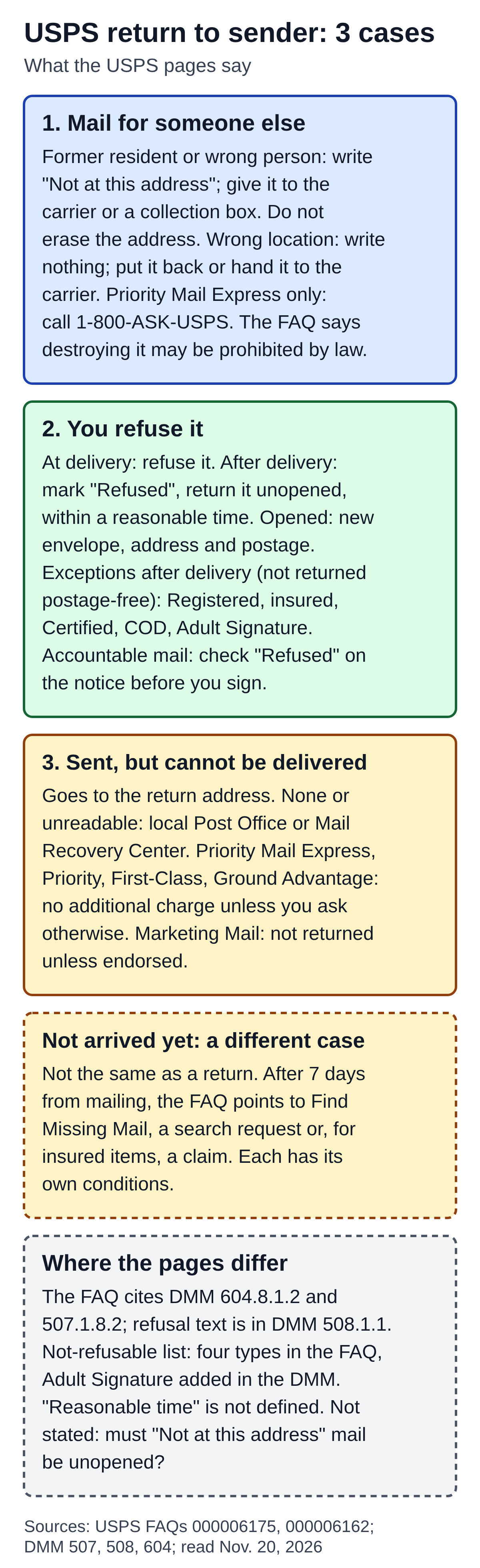
Three situations, three sets of rules
| Situation | What the pages say you can do | Where it comes from |
|---|---|---|
| Mail came to your address but is for someone else | Write “Not at this address” and hand it to your mail carrier or put it in a collection box, or, if it was delivered to the wrong location, put it back unmarked | FAQ 000006175 |
| You are the addressee and do not want the mail | Refuse it when it is offered. After delivery, mark it “Refused” and return it unopened within a reasonable time, unless it is a type the DMM says cannot be refused and returned postage-free (Registered Mail, insured mail, Certified Mail, COD, Adult Signature) or it has been opened | FAQ 000006162, DMM 508.1.1 |
| You sent it and USPS could not deliver it | USPS tries to return it to the return address; with no usable return address, the local Post Office or the Mail Recovery Center handles it | FAQ 000006175, DMM 507.1.8 and 507.1.9 |
A piece that has not arrived yet is a different case from one that is being returned. For that, the FAQ points to Find Missing Mail, a search request or, for insured items, a claim, each with its own conditions; see the last part of the section on sending mail.
Mail came to you for someone else
The FAQ on refusing mail says USPS “will deliver the mail as addressed,” and that mail is delivered to residential or business addresses even if the name on the piece is different from the known residents. So getting mail with a stranger’s or a former resident’s name is not, by that page’s account, a mistake by itself. The FAQ on misdelivered mail then gives separate instructions for three cases.
- A previous resident, and you do not know their new address. Return the piece to the mailstream, by leaving it in a collection box or other mail receptacle, with the notation “Not at this address” marked on the envelope.
- The piece was delivered to the wrong location. Do not erase or mark over the information and do not write any endorsement on it. Put it back in the mailbox or hand it to your mail carrier.
- The location is right but the person named does not live there. Write “Not at this address” on the piece, do not erase or mark over the address, and give it to your mail carrier or drop it in a collection box.
The first and third cases read almost the same, and the second case says not to write anything. The FAQ does not explain how to tell the wrong location from the right location with the wrong person, so this article does not either.
Two exceptions are on the same page. For Priority Mail Express items only, the FAQ says you can get the number of the Priority Mail Express Reporting Unit by calling 1-800-ASK-USPS (1-800-275-8777). And if you receive a “We ReDeliver for You” PS Form 3849 notice for a different address or for someone who does not live at yours, and the correct forwarding address is unknown, the FAQ says to check the “Other” box on the notice, write in “Refused,” and return the form to your mailbox or hand it to your carrier. That is the word “Refused” on a notice, not on a letter, and it is a different instruction from “Not at this address.”
The FAQ also says destroying mail that was not intended for you “may be prohibited by US laws,” that willfully destroying mail is an act that may be punishable by the federal government, and that questions about legality go to local law enforcement.
One case works differently. For mail sent to an individual at a business, the FAQ says mail addressed to a company is delivered to the company, including mail endorsed “Personal and Confidential” for a specific person, and that this also applies to mail for former employees. It says USPS responsibility ends at that point and that what happens next follows each company’s policy.
You are the addressee and want to refuse it
DMM 508.1.1.2 says the addressee may refuse to accept a mailpiece when it is offered for delivery. DMM 508.1.1.3 covers refusal after delivery: the addressee may mark the piece “Refused” and return it within a reasonable time, if the piece or any attachment is not opened. The FAQ says the same and adds that a piece that has been opened, even if resealed, cannot be marked “Refused” and returned. To send an opened piece back, the DMM and the FAQ both say it has to go in a new envelope or wrapper with a correct address and new postage.
Some mail cannot be refused and returned postage-free after delivery. The DMM lists Registered Mail, insured mail, Certified Mail, collect on delivery (COD) and Adult Signature pieces, plus response mail to a sales promotion, solicitation, announcement or other advertisement that was not refused when it was offered. The FAQ’s list names Registered, Insured, Certified and COD and the response mail, and says that for the first group “Postage must be paid by the customer” for the mail to be returned.
The same FAQ adds a note that customers may refuse accountable mail before signing for it: check the box marked “Refused” on the back of the delivery notice, sign your name by the “X,” and place it back in your mailbox. DMM 508.1.1.7 adds that for these services the addressee or a representative may obtain the sender’s name and address while the piece is held by the USPS employee, before accepting delivery and endorsing the delivery receipt. For how these services work in general, see our article on Certified Mail.
If a recipient wants to add an extra service such as Certified Mail to a piece being returned, the FAQ says they must pay return postage to mail it back in addition to paying for the extra service.
Postage due is a separate case. The FAQ on undeliverable mail says a shortpaid piece is delivered postage due, and that if the recipient refuses to pay and accept it, it is endorsed “Returned for Additional Postage” and sent to the return address. DMM 604.8.1.2, the section the refusal FAQ cites, covers this: mail with insufficient postage that is refused by the addressee or otherwise undeliverable is returned to the sender with “Returned for Additional Postage” if it is First-Class Mail with a return address, and is treated as dead mail if it has no return address.
Two other options appear on the refusal pages. The addressee may ask the postmaster in writing to withhold from delivery, for no more than 2 years, any foreign letter or printed matter with a specified name or address on the outside (DMM 508.1.1.4; the FAQ says “foreign letter or publication material”). And the FAQ points to services outside USPS for reducing marketing mail, the mail suppression service DMAchoice, run by the Association of National Advertisers and described as independent of USPS, and the credit-reporting companies’ opt-out for prescreened offers. Those are not USPS actions, and this article does not cover them or give any fee.
You sent it: mail that is returned, and mail that has not arrived
For undeliverable mail, the FAQ says that if USPS cannot deliver as addressed, it uses the return address to try to return it. DMM 507.1.8.3 says Priority Mail Express, Priority Mail, First-Class Mail, USPS Ground Advantage Retail and USPS Ground Advantage Commercial pieces that cannot be delivered as addressed or forwarded are, unless the sender asks otherwise, “returned to the sender at no additional charge.” For other classes, DMM 507.1.8.4 says the mail is treated as appropriate for the class and the sender’s instructions.
A returned piece generally may not be remailed unless it is put in a new envelope or wrapper with a correct address and new postage (DMM 508.1.1.6). The exception is a shortpaid piece, which can have the additional postage affixed to the original. The FAQ says the same for a piece endorsed “Returned for Additional Postage,” and adds that the “postage due” message is left intact.
The pages describe a few specific reasons for return.
- Missing or short postage. The FAQ says an item with no postage, or one where postage appears to have fallen off, is endorsed “Returned for Postage Mail” and sent to the return address. It also says greeting cards without a return address generally are delivered with postage due during December rather than routed to the Mail Recovery Center, for domestic First-Class Mail only.
- A missing apartment number. The FAQ says mail is delivered, as a matter of policy, if any one of four elements is present: the apartment number is on the envelope; the recipient’s name is on or inside the mail receptacle; the name is on the alphabetical directory furnished by apartment management; or the mail carrier recognizes the information and remembers the correct apartment number.
- USPS Marketing Mail. The FAQ says these items are not automatically forwarded or returned if they cannot be delivered, that they are handled according to the sender’s endorsements, and that without an endorsement USPS disposes of the piece.
- A Post Office box. DMM 507.1.8.7 says deliverable mail addressed to a box is not returned until after the box is declared vacant, except for certified, COD, insured, registered, postage due, Adult Signature and perishable mail.
- A forwarding order that has ended. Our mail forwarding article reports USPS saying it returns mail to the sender for 6 months with a label showing the new address once forwarding ends.
For mail with extra services, DMM 507.1.8.5 says that if a return receipt is attached to a certified, COD, numbered insured, registered or Priority Mail Express piece being returned, the reason for non-delivery is shown on the face of the piece and the receipt stays attached. It says the sender must sign a delivery receipt for returned Priority Mail Express, Registered Mail, COD articles, Adult Signature pieces and mail insured above a stated value, while returned Certified Mail and Signature Confirmation pieces, and Priority Mail Express when the sender requested a signature waiver, may be returned without obtaining a signature when they are returned as undeliverable.
If a piece has no return address, or the return address cannot be read, the FAQ says it will either be handled by the local Post Office or sent to the Mail Recovery Center. A domestic piece with a foreign return address is handled under dead mail procedures. DMM 507.1.9 defines dead mail as undeliverable mail that cannot be returned, says some types are opened at a mail recovery center to find the sender or addressee, and says a customer can start an inquiry at the local Post Office with a Mail Recovery Center search form or through the Missing Mail online application.
A piece that has not arrived is a different case from one that is being returned, and the FAQ does not say that a piece not delivered after 7 days is returned. If a piece has not arrived within 7 days from its date of mailing, the FAQ’s three options are the Find Missing Mail page, a Missing Mail search request at MissingMail.USPS.com, or an online claim for insured items that meet the timeframe requirements. Our Missing Mail article covers that search. For tracking statuses that say a package is going back, such as “Insufficient Address” or “No Such Number,” see our tracking status article.
The FAQ also mentions endorsements that a mailer prints on a piece in advance, such as Change Service Requested, Address Service Requested, Return Service Requested and Temp-Return Service Requested, and says some require payment of an address-correction fee. Those are tools for mailers rather than steps for a household sender, and this article does not read their definitions.
Where the pages differ
- The section numbers. The refusal FAQ cites DMM 604.8.1.2 and 507.1.8.2 as the two places where mail can be refused. On the pages read, 507.1.8.2 says returnable mail is returned if refused by the addressee, and 604.8.1.2 covers refused or undeliverable mail with insufficient postage. The rules for refusing at delivery and after delivery appear in DMM 508.1.1.2 and 508.1.1.3. This article cites the numbers where it found the text.
- What cannot be refused. The FAQ names Registered, Insured, Certified and COD mail. The DMM adds Adult Signature. The FAQ says the customer pays postage to return them; the DMM says they may not be refused and returned postage-free.
- Which words to write. “Refused” is for mail you refuse and for a misdelivered redelivery notice. “Not at this address” is for mail for someone who does not live where you do. For a piece delivered to the wrong location, the FAQ says to write nothing.
- Opened mail. The pages say an opened piece cannot be marked “Refused.” They do not say whether a piece marked “Not at this address” must be unopened.
- Returned for postage. “Returned for Postage Mail” (no postage) and “Returned for Additional Postage” (shortpaid and refused or undeliverable) are different endorsements in the FAQ.
What the pages do not say
The pages do not define “a reasonable time” for returning refused mail, and they do not say how long a returned piece takes to reach the sender. They do not say how to tell a misdelivery from mail delivered as addressed, what to do if you opened someone else’s piece by mistake, or whom to contact if the same wrong mail keeps arriving. They give no figure for how long the Mail Recovery Center holds a piece. This article gives no fee or price.
Sources
The pages were checked on November 20, 2026.
- USPS FAQ, “How is Undeliverable and Misdelivered Mail Handled?,” Article 000006175, dated May 19, 2026. https://faq.usps.com/s/article/How-is-Undeliverable-and-Misdelivered-Mail-Handled
- USPS FAQ, “Refuse unwanted mail and remove name from mailing lists,” Article 000006162, dated September 3, 2026. https://faq.usps.com/s/article/Refuse-unwanted-mail-and-remove-name-from-mailing-lists
- USPS Domestic Mail Manual, 508 Recipient Services, sections 1.1.1 to 1.1.7 (no update date shown). https://pe.usps.com/text/dmm300/508.htm
- USPS Domestic Mail Manual, 507 Mailer Services, sections 1.8 and 1.9 (no update date shown). https://pe.usps.com/text/dmm300/507.htm
- USPS Domestic Mail Manual, 604 Postage Payment Methods and Refunds, section 8.1 (no update date shown). https://pe.usps.com/text/dmm300/604.htm