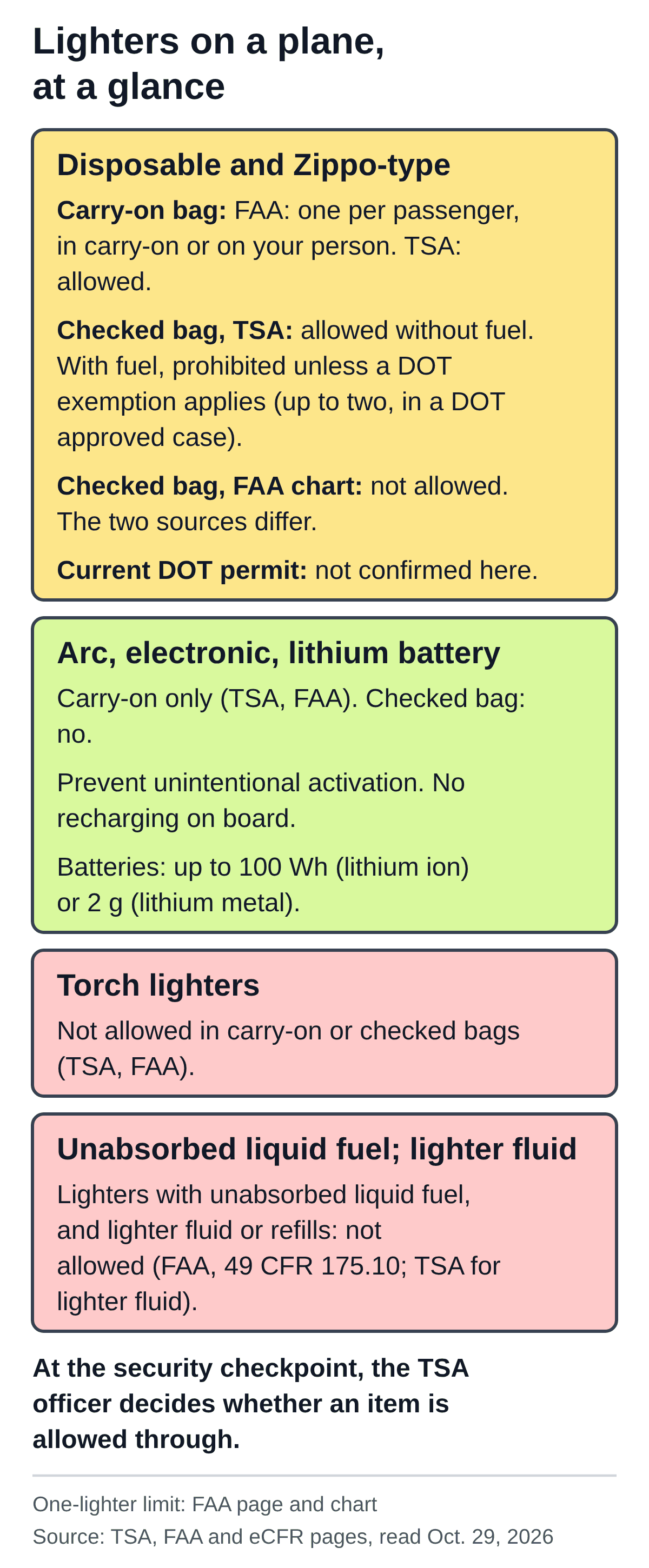
For a disposable or Zippo-type lighter, the FAA says one lighter per passenger, in a carry-on bag or on one’s person, and TSA lists carry-on bags as allowed. For checked bags the two differ: TSA says lighters without fuel are allowed and lighters with fuel are prohibited unless they adhere to a Department of Transportation (DOT) exemption, while the FAA’s chart says “Not allowed in Checked Bags.” This article could not confirm a current DOT permit, so it does not say whether that exemption applies today. Both list torch lighters as not allowed in carry-on or checked bags.
This article covers what TSA’s and the FAA’s pages say. The wording is as of October 29, 2026, and comes from the eight pages listed at the end. TSA’s pages carry different update dates: July 14, 2026 (disposable and Zippo lighters), November 4, 2024 (arc and electronic lighters) and October 10, 2024 (torch lighters, lighter fluid and lithium battery powered lighters). It describes the rules and does not give advice on what to pack.
What the FAA and TSA say, by type of lighter
| Type of lighter | FAA page, chart and 49 CFR 175.10 | TSA page |
|---|---|---|
| Disposable (butane) and Zippo-type (liquid absorbed in a lining): carry-on | One per passenger, in carry-on or on one’s person. The regulation: on one’s person or in carry-on baggage only | Carry-on: Yes |
| Disposable and Zippo-type: checked bags | The chart says “Not allowed in Checked Bags” | “Yes (Special Instructions)”: without fuel allowed; with fuel prohibited unless a DOT exemption applies. A current DOT permit was not confirmed |
| Arc, electronic and other lithium battery powered | Carry-on only, with measures to prevent unintentional activation and no recharging on board | Arc and electronic page: carry-on “Yes (Special Instructions)”, checked No. Lithium battery powered page: carry-on Yes, checked No |
| Torch | Not allowed in the cabin or in checked baggage | Carry-on: No. Checked: No |
| Unabsorbed liquid fuel (desk, table and antique wick lighters) | Forbidden. The regulation: not permitted on one’s person, in carry-on or in checked baggage (other than liquefied gas) | No separate TSA page was read for this type |
| Lighter fluid and refills | The regulation: lighter fuel and lighter refills not permitted on one’s person, in carry-on or in checked baggage | Lighter fluid: carry-on No, checked No |
Disposable and Zippo-type lighters
The FAA’s page groups absorbed-liquid lighters and butane lighters, with Zippo-type and disposable lighters as its examples, and limits them to one lighter per passenger in carry-on or on one’s person. The FAA adds that when a carry-on bag is checked at the gate or at planeside, any lighter in the carry-on must be removed from the bag and kept with the passenger in the aircraft cabin.
The regulation, 49 CFR 175.10(a)(2), covers a lighter intended for use by an individual when carried on one’s person or in carry-on baggage only. TSA’s page lists “Disposable and Zippo” lighters as “Yes” for carry-on bags.
How many lighters
The FAA’s page and its chart, updated November 14, 2025, both say one lighter per passenger for absorbed-liquid and butane lighters. The regulation says “a lighter” in the singular. TSA’s page for disposable and Zippo lighters does not state a number. This article therefore attributes the one-lighter limit to the FAA and the regulation.
Checked bags: where TSA’s and the FAA’s wording differs
TSA’s page for disposable and Zippo lighters lists checked bags as “Yes (Special Instructions).” The instructions have two parts. Lighters without fuel are allowed in checked bags. Lighters with fuel are prohibited in checked bags unless they adhere to the Department of Transportation exemption, which TSA says allows up to two fueled lighters if properly enclosed in a DOT approved case.
The FAA’s chart, updated November 14, 2025, says “Not allowed in Checked Bags” in its lighters row. The FAA’s web page describes these lighters as carried in a carry-on bag or on one’s person, the regulation says the same, and the FAA’s pages do not mention the exemption. So for checked bags, TSA’s page gives a conditional answer and the FAA’s chart does not allow them. This article shows both and does not choose between them.
What this article could not confirm. TSA’s page does not name the exemption, the approval behind it or the cases that qualify, and the FAA’s pages do not mention it. This article did not find a permit document that it could confirm as current, so it does not say whether the exemption applies today, does not explain how it works and does not say that a particular case qualifies. TSA’s page, the FAA’s page and chart, and the regulation all allow a disposable or Zippo-type lighter in a carry-on bag.
Arc, electronic and other lithium battery powered lighters
TSA has two pages for these lighters. The page for arc, electronic and e-lighters lists carry-on as “Yes (Special Instructions)” and checked bags as No. The page for lithium battery powered lighters lists carry-on as Yes and checked bags as No, and has no further text.
TSA’s arc and electronic page says measures must be taken to prevent unintentional activation of the heating element while on board. Its examples are removing the battery from the lighter, placing the lighter into a protective case, and using a protective cover, safety latch or locking device on the activation button. Each lithium ion battery must not exceed 100 Wh, and each lithium metal battery must not exceed 2 grams of lithium. Recharging the device or its batteries on board is not permitted.
The FAA’s page says lithium battery powered lighters (it lists Tesla coil, flux, arc and double arc lighters) are allowed in carry-on only, with the same activation measures, battery limits and no recharging on board. The regulation adds that the batteries must meet the tests in the UN Manual of Tests and Criteria, Part III, Subsection 38.3, and that the lighters must have a safety cap or similar protection against unintentional activation. For the rules on power banks, see the TSA and FAA rules for power banks.
Torch lighters
TSA lists torch lighters as No for carry-on bags and No for checked bags. Its page describes them as making a thin, needle-like flame that is hotter (reaching 2,500 F) and more intense than the flame from common lighters. The FAA’s page says torch lighters are not allowed in the cabin or in checked baggage under both the Hazardous Materials Regulations and TSA security rules, and its chart lists torch lighters as not allowed in carry-on or checked bags.
One naming detail: the FAA’s page lists “butane lighters” among the other names for torch lighters, while its entry for butane lighters, with disposable lighters as an example, allows one per passenger. TSA’s torch page does not use that name. This article uses “torch lighter” for the kind TSA describes as making a thin, needle-like flame.
Lighters with unabsorbed liquid fuel, and lighter fluid
The FAA’s page says lighters that use liquid fuel but do not have an absorbent lining, such as desk and table lighters and antique wick lighters, are forbidden. The regulation says lighter fuel, lighter refills and lighters containing unabsorbed liquid fuel (other than liquefied gas) are not permitted on one’s person or in carry-on or checked baggage. TSA’s page for lighter fluid lists carry-on bags as No and checked bags as No.
The TSA officer
TSA’s pages say the final decision rests with the TSA officer on whether an item is allowed through the checkpoint. That statement is about screening at the security checkpoint. TSA’s page for disposable and Zippo lighters also says that questions about regulations can be taken to the FAA’s website.
What this article does not cover
This article does not cover matches, e-cigarettes and vaping devices, camping stoves, butane canisters, mailing a lighter, other countries’ rules, any airline’s own policy, or how to pack a lighter. It describes what the eight pages state on the date above and does not track changes to them.
Sources
All eight pages were checked on October 29, 2026. The FAA chart is a PDF.
- TSA, “Lighters (Disposable and Zippo)” (page shows “Last Updated on July 14, 2026”). https://www.tsa.gov/travel/security-screening/whatcanibring/items/lighters-disposable-and-zippo
- TSA, “Lighters (Arc Lighters, Electronic Lighters, E-Lighters)” (page shows “Last Updated on November 4, 2024”). https://www.tsa.gov/travel/security-screening/whatcanibring/items/lighters-arc-lighters-electronic-lighters-e-lighters
- TSA, “Lighters (Lithium Battery Powered)” (page shows “Last Updated on October 10, 2024”). https://www.tsa.gov/travel/security-screening/whatcanibring/items/lighters-lithium-battery-powered
- TSA, “Lighters (Torch)” (page shows “Last Updated on October 10, 2024”). https://www.tsa.gov/travel/security-screening/whatcanibring/items/lighters-torch
- TSA, “Lighter (Fluid)” (page shows “Last Updated on October 10, 2024”). https://www.tsa.gov/travel/security-screening/whatcanibring/items/lighter-fluid
- FAA, “PackSafe – Lighters” (page shows “Last updated: Monday, April 13, 2026”). https://www.faa.gov/hazmat/packsafe/lighters
- FAA, PackSafe printable chart (shows “Updated: 11/14/25”). https://www.faa.gov/hazmat/packsafe/printable-chart
- eCFR, 49 CFR 175.10, “Exceptions for passengers, crewmembers, and air operators” (page shows “up to date as of 10/27/2026”). https://www.ecfr.gov/current/title-49/subtitle-B/chapter-I/subchapter-C/part-175/subpart-A/section-175.10